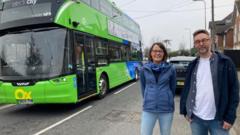
The modern city is dying because we’ve confused a public thoroughfare with a private locker.
Every time a municipality moves to strip away street-side parking to make room for dedicated bus lanes, the same tired script plays out. Local residents organize. They clutch their pearls. They claim the "character" of the neighborhood is being erased. They cite "accessibility" while actually defending their right to store two tons of steel and glass on public land for free.
It is time to stop apologizing for the bus. It is time to stop treating "congestion" as an act of God rather than a series of bad math equations. If you are angry that a parking ban is speeding up a bus that carries 60 people, you aren't a concerned citizen. You are a math denier.
The False Economy of the "Convenience" Argument
The argument most residents lean on is that removing parking "kills" local business or makes life impossible for the elderly. This is a mirage. I have spent a decade looking at urban throughput data, and the reality is that the "convenience" of street parking is a tax paid by everyone else in the city.
A single car parked on a busy arterial road consumes roughly 180 square feet. In a city like London, San Francisco, or Sydney, that real estate is worth more than the car itself. When a city "gives" that space to a resident for a $50-a-year permit—or for free—it is a massive public subsidy to the private car owner.
When you block a bus lane to keep those spots, you are choosing to delay 2,000 commuters per hour so that 12 people don't have to walk an extra 400 yards from a parking garage. It is the height of entitlement masquerading as community advocacy.
The Physics of Throughput
Let’s talk about the actual mechanics of a street. A city street is not a "place" to be; it is a mechanism for moving things. If the mechanism is jammed, the city fails.
Imagine a scenario where we treated the internet like our streets. Imagine if a few individuals were allowed to park "data packets" in the middle of a fiber optic cable, slowing down everyone else's Netflix stream because they didn't feel like storing their files on a hard drive. We would call it digital sabotage. Yet, on our physical streets, we call it "neighborhood rights."
Consider the throughput formula for a standard lane of traffic:
$$T = \frac{V}{L + G}$$
Where $T$ is the throughput, $V$ is the velocity, $L$ is the length of the vehicle, and $G$ is the safety gap. When you add a bus to this equation, the capacity of the lane doesn't just increase—it scales. A bus takes up the space of two or three cars but carries the load of forty. By banning parking and giving that bus its own lane, you aren't "limiting" the road. You are finally using it to its full potential.
The Myth of the "Empty Bus"
The most common retort from the anti-parking crowd is: "But the buses are always empty!"
This is a failure of observation. If you see an empty bus at 11:00 AM, you are ignoring the fact that the same bus was packed at 8:15 AM. But more importantly, buses are often empty because of the parking you’re defending.
Buses are subject to the "vicious cycle of transit."
- The bus is slow because it’s stuck in car traffic.
- Because the bus is slow, people with any other choice buy a car.
- More cars mean more parking demand and more traffic.
- The bus gets even slower.
By banning parking and creating dedicated lanes, you break the cycle. You make the bus faster than the car. The moment the bus is faster, the "empty bus" problem disappears. Transit isn't a social service for the poor; it's a utility for the efficient. If it’s slow, it’s useless. If it’s fast, it’s the spine of the economy.
Why "Community Consultation" Is a Scam
We have democratized urban planning to the point of paralysis. The "Neighbours angry at parking ban" headline is a symptom of a process designed to favor the loudest, most sedentary voices over the silent, moving majority.
The people who benefit from a parking ban are the ones who pass through the neighborhood. They are the workers, the students, and the delivery drivers who are currently stuck in a gridlock caused by your SUV. Because they don't live on that specific block, they don't get a vote in the "community meeting."
I have watched cities spend $500,000 on "impact studies" for a project that costs $50,000 in paint and signs. We are litigating the obvious. We are asking permission from people who have a vested interest in the status quo to change the status quo. It is like asking a coal miner for permission to build a solar farm; you already know the answer, and it has nothing to do with the "public good."
The Retail Fallacy
Business owners are usually the first to scream about parking. They believe that every car parked out front represents a customer.
Data from cities like New York, Melbourne, and Paris consistently shows that business owners overestimate the number of customers who arrive by car by a factor of three. When you replace a parking lane with a wide sidewalk or a bus lane, foot traffic increases. People who are on foot or getting off a bus spend more money because they are "eyes on the street" rather than "eyes on a parking spot."
The "parking crisis" for small business is actually a "stagnation crisis." If you want your shop to thrive, you need more humans, not more stationary metal boxes.
The Brutal Reality of Transit Priority
If we are serious about climate goals, or even just basic economic sanity, we have to accept that the era of the "unrestricted car" is over.
You cannot have a growing city and a car for every adult. The geometry doesn't work. The more we try to "accommodate" the car with parking and wide lanes, the more we induce demand for more cars. It is a hunger that cannot be satisfied.
Removing street parking isn't a "war on cars." It’s an intervention for an addict.
The Real Cost of "Free" Parking
Let's look at the hidden costs of that parking spot you're fighting for:
- Carbon emissions: Cars circling for parking account for up to 30% of urban congestion in many major hubs.
- Infrastructure decay: Pavement that is constantly occupied by heavy vehicles requires more maintenance, funded by everyone’s taxes.
- Safety: Parked cars create "sightline obstructions." They are the reason kids get hit when they step into the street. They are the reason cyclists get "doored."
When we remove parking to speed up the bus, we are reclaiming the public realm for its original purpose: movement.
Stop Asking for Permission
The most effective cities in the world—the ones we all love to visit on vacation—don't ask for permission to be efficient. They don't hold a six-month inquiry every time they want to paint a red stripe on the asphalt.
Copenhagen didn't become a cycling and transit haven because the residents were naturally more virtuous. It happened because the city leadership made it intentionally difficult and expensive to drive and park, while making it incredibly easy to move by other means.
The anger you feel about losing "your" parking spot is actually the feeling of a subsidized privilege being revoked. It's uncomfortable. It's frustrating. It's also necessary.
If you want to live in a place where you can park a truck directly in front of your door for zero dollars, move to the suburbs. If you want to live in a city, accept that the street belongs to the people moving through it, not the person who got there first and decided to leave their trash in the middle of the road.
Paint the lane. Move the cars. Let the bus through.