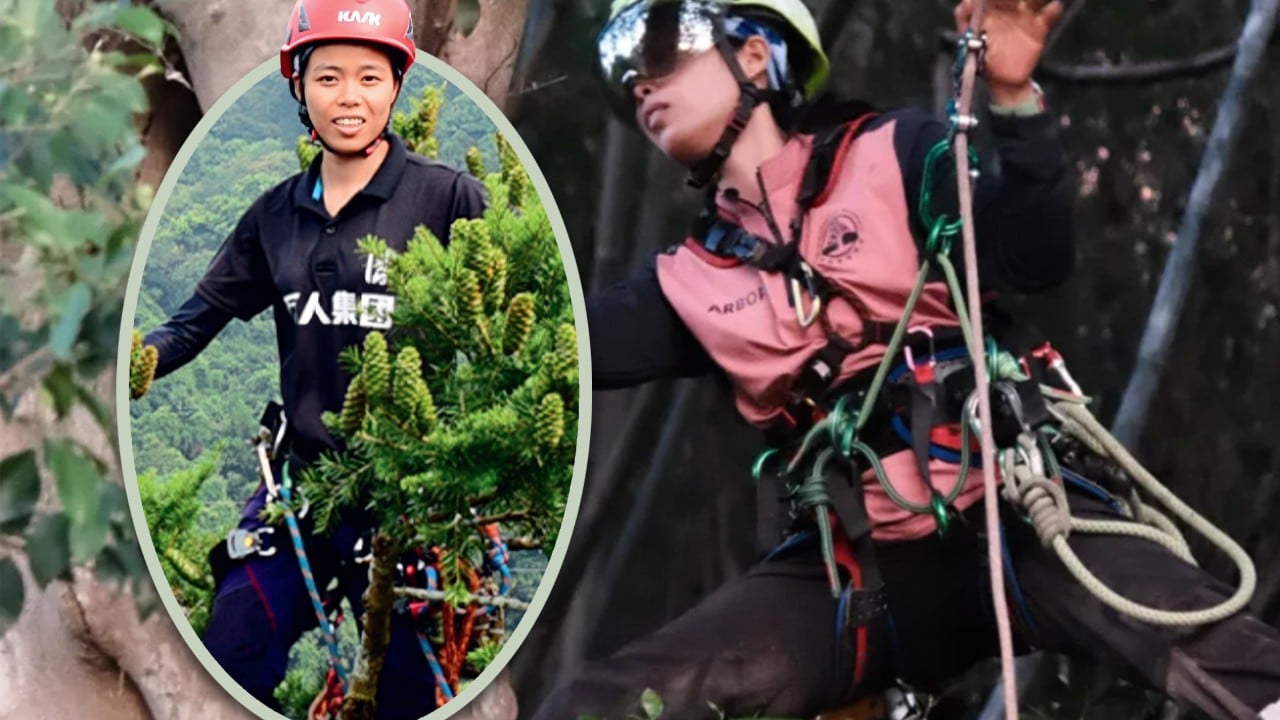
The professionalization of tree climbing represents a shift from anecdotal, intuitive movement to a data-backed discipline governed by biomechanics and safety engineering. While media narratives often focus on the psychological victory over acrophobia, the actual value proposition of an elite arboreal expert lies in the mastery of three distinct domains: tension-based safety systems, physiological optimization for vertical environments, and the technical application of botany in high-risk zones. In the case of China’s first female expert tree climber, the transition from fear to proficiency serves as a case study in systematic desensitization and the acquisition of high-consequence technical skills.
The Biomechanical Architecture of Technical Tree Climbing
Technical tree climbing (TTC) operates on different physical principles than recreational rock climbing or industrial rope access. The primary differentiator is the dynamic nature of the anchor point. Unlike a static rock face or a steel beam, a tree limb is a living cantilever subject to variable load-bearing capacities and environmental degradation.
Professional tree climbing requires the management of a complex force distribution system. The climber must calculate the Safe Working Load (SWL) of organic anchors while factoring in variables such as species-specific wood density, moisture content, and the presence of internal fungal decay.
The Force Distribution Matrix
The safety of a climber is dependent on the management of the Fall Factor, which is the ratio of the height of a fall to the length of rope available to absorb the energy. In arboriculture, practitioners utilize Work Positioning Systems to maintain a Fall Factor as close to zero as possible. This involves:
- Divergent Anchoring: Distributing weight across multiple lateral limbs to reduce the strain on a single point of failure.
- Mechanical Advantage Systems: Utilizing pulleys and friction hitches to reduce the caloric cost of ascent. A 3:1 or 5:1 mechanical advantage system allows a climber to exert less physical force, thereby preserving cognitive function for high-risk cutting or inspection tasks.
- Friction Management: The use of cambium savers and ring-to-ring conduits to protect the tree’s vascular system while ensuring consistent rope glide.
Psychological Reframing and the Systematic Erasure of Acrophobia
The narrative of "conquering fear" is often treated as an act of will, but in a professional context, it is a byproduct of Exposure Therapy and Competence-Based Confidence. The subject’s journey from a fear of heights to expert status follows the standard psychological framework for phobia extinction.
Fear is a physiological response to a perceived lack of control. By introducing rigorous safety protocols and redundant gear systems, the climber replaces an abstract threat with a manageable technical problem. The "fear of heights" is actually a fear of gravity’s consequences. When the gear system is proven—through repeated, low-stakes testing—to be more reliable than human grip, the amygdala’s threat response is suppressed by the prefrontal cortex’s logical assessment.
The Cognitive Load of High-Altitude Precision
Expertise in this field is measured by the reduction of cognitive load. A novice climber spends 80% of their mental energy on self-preservation and 20% on the task at hand. A master arborist inverts this ratio. The ability to perform delicate botanical surgery or structural assessments 30 meters above the ground requires the automation of safety checks. This automation is achieved through Procedural Memory, where the "tie-in" and "change-over" sequences become as subconscious as breathing.
The Economic and Operational Value of Arboreal Specialization
The emergence of female experts in a male-dominated technical field is not merely a social milestone; it indicates the maturation of the industry. Historically, tree work was viewed as "brute force" labor. Modern arboriculture, however, prioritizes precision, ecological preservation, and risk mitigation—areas where technical adherence often outperforms raw physical strength.
The Specialized Service Economy
The market for expert tree climbers is driven by three primary economic drivers:
- Urban Forest Management: As cities invest in green infrastructure to combat heat islands, the demand for "low-impact" maintenance increases. Traditional heavy machinery (cranes and bucket trucks) cannot access many urban environments without significant property damage or traffic disruption.
- Scientific Research Access: Canopy ecology is one of the last frontiers of terrestrial biology. Researchers require climbers who can move through the "Red Zone"—the outermost, thinnest branches—to collect samples or install sensors without damaging the specimen.
- High-Value Property Protection: For historical or endangered trees, the cost of a mistake is infinite. The expertise required to prune a 500-year-old oak is closer to neurosurgery than landscaping.
Technical Limitations and Risk Vectors
Despite the advancement in gear, the profession remains inherently dangerous due to Environmental Stochasticity. No amount of training can fully account for:
- Sudden Microbursts: High-velocity winds that can oscillate a tree’s crown beyond its structural limit.
- Biological Hazards: Defensive insects (wasps, hornets) or poisonous plant matter that can cause acute physical distress at height.
- Equipment Fatigue: The subtle degradation of nylon and polyester fibers due to UV exposure and pitch/sap contamination.
The "Expert" designation is therefore a temporary state maintained through constant vigilance and the regular replacement of life-support components.
Strategic Roadmap for Specialized Skill Acquisition
For organizations or individuals looking to replicate this level of technical proficiency, the path is not through "bravery," but through the following structural phases:
- Phase 1: Ground-Level Technical Mastery. Perfecting knots, hitches, and mechanical hardware in a zero-risk environment until muscle memory is absolute.
- Phase 2: Static Load Ascent. Transitioning to vertical movement on certified, non-organic anchors (stadium rafters, climbing gyms) to isolate the sensation of height from the complexity of tree biology.
- Phase 3: Controlled Arboreal Integration. Moving into the canopy on "bombproof" anchors under the supervision of a lead climber, focusing on movement efficiency rather than task completion.
- Phase 4: Operational Autonomy. Managing the full work cycle, from site assessment and hazard identification to the final descent.
The professionalization of this niche reflects a broader trend in the global labor market: the replacement of "rugged" generalists with highly specialized technicians who leverage mechanical systems to overcome human biological limitations. The true transformation of a climber is not found in their lack of fear, but in their absolute trust in a calculated system of ropes, carabiners, and physics.