The border between Sudan and Ethiopia isn't just a line on a map anymore. It’s a pressure cooker. In only thirty days, more than 100,000 people crossed that line, fleeing a war that refuses to quit. This isn't just another statistic. It’s a massive, unfolding catastrophe that the rest of the world seems to be watching on 2x speed.
When you look at the sheer volume of people moving, it’s easy to lose the human element. But imagine leaving everything you own because the alternative is a bullet or starvation. That's the reality for the families arriving at the Metema and Kurmuk border points. They aren't looking for a better life. They’re looking for any life at all.
The Breaking Point in Sudan
The war in Sudan has been tearing the country apart for over a year now. The fight between the Sudanese Armed Forces (SAF) and the Rapid Support Forces (RSF) has turned neighborhoods into battlefields. What started as a power struggle in Khartoum has bled into every corner of the nation.
We’re seeing a total collapse of infrastructure. Hospitals are gone. Markets are empty. If the bombs don't get you, the lack of clean water might. This recent surge of 100,000 people entering Ethiopia in just one month shows that the situation isn't stabilizing. It’s getting worse. People who tried to "wait it out" have finally realized that there’s nothing left to wait for.
The intensity of the violence in regions like Darfur and Kordofan is driving this specific wave. It’s a domino effect. One village gets hit, the next one panics, and suddenly you have a column of thousands walking toward the Ethiopian highlands.
Ethiopia is Stepping Up But Straining
Ethiopia has its own set of problems. Internal conflicts and a brutal drought have already stretched its resources thin. Yet, the country remains one of the largest refugee hosts on the continent.
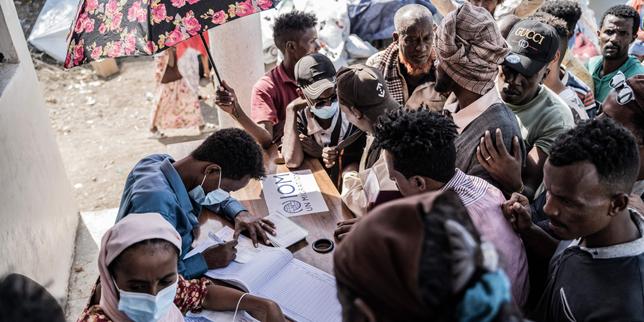
Most of these 100,000 new arrivals are women and children. They show up exhausted. Many have walked for weeks. They’ve dodged checkpoints where soldiers—from both sides—frequently harass or rob civilians. By the time they hit the Ethiopian border, they’re physically and mentally spent.
The Ethiopian government and organizations like the UNHCR (United Nations High Commissioner for Refugees) are trying to manage the flow, but the math doesn't work. You can’t build shelters and provide medical care for 100,000 people in four weeks without massive external help. The international community loves to promise aid, but the actual delivery of that aid is often slow and buried in red tape.
Why Ethiopia is the Choice
You might wonder why people flee to Ethiopia when it has its own instability. The answer is simple. Geography and history. Ethiopia and Sudan share a massive border and a long history of cross-border movement. For many in eastern Sudan, Ethiopia is the only reachable sanctuary.
It’s a grueling journey. The terrain is rough, and the heat is unforgiving. But when the alternative is staying in a zone where the RSF or SAF are conducting door-to-door raids, the mountains of Ethiopia look like paradise.
The Invisible Crisis of Returnees
A detail that often gets missed in these reports is that not everyone crossing into Ethiopia is a "refugee" in the traditional sense. A huge chunk of these 100,000 people are actually Ethiopian citizens who were living and working in Sudan.
They’re "returnees." They’ve lived in Sudan for decades, built lives, and started businesses. Now, they’re coming back to an Ethiopia they might not even recognize, with nothing but the clothes on their backs. They don't always qualify for the same immediate aid that refugees get, which creates a secondary crisis within the camps.
Dealing with this distinction is a nightmare for aid workers. Do you prioritize the Sudanese national who just fled a burning city, or the Ethiopian national who lost his entire life’s work in Khartoum? There are no good answers here.
What This Means for Regional Stability
You can't move 100,000 people into a sensitive border area in 30 days and expect things to stay quiet. This mass migration is changing the demographics of the region overnight.
Local Ethiopian communities in the Amhara and Benishangul-Gumuz regions are being incredibly generous, but that generosity has an expiration date. When food prices spike because the local market can’t handle an extra 100,000 mouths to feed, tensions rise. It’s a textbook scenario for localized conflict.
The security risk is also real. Whenever you have a massive, chaotic movement of people across a border, it’s easy for armed actors to slip through. Both the Sudanese and Ethiopian governments are nervous about this. They’re trying to vet people, but how do you vet 3,000 people arriving every single day? You can’t.
The International Response is Falling Short
Let’s be honest. Sudan is a "forgotten war" compared to Gaza or Ukraine. The funding gap is embarrassing. The UN’s humanitarian response plan for Sudan is consistently underfunded.
When the money doesn't show up, people die. It’s that blunt. Without more funding for the World Food Programme (WFP) and medical NGOs, the camps in Ethiopia will become breeding grounds for disease. Cholera is already a major concern in these types of crowded, makeshift environments.
The 100,000 people who fled this month are just the tip of the spear. If the fighting in Sudan reaches Al Jazirah or more parts of the east, those numbers could double or triple. Ethiopia cannot carry this weight alone.
Moving Toward a Solution
If you want to help or stay informed, stop looking at this as a temporary blip. This is a long-term regional shift.
First, the pressure must stay on international donors to fulfill their pledges. Money for Sudan shouldn't be a "leftover" priority.
Second, the focus needs to shift toward supporting the host communities in Ethiopia. If we only help the refugees and ignore the local Ethiopians whose lives are being disrupted, we’re just setting the stage for the next conflict.
Stay updated by following on-the-ground reports from the UNHCR and the International Organization for Migration (IOM). These groups provide the most accurate daily counts and needs assessments. Support organizations that have a direct presence at the Metema and Kurmuk crossings. The best way to help is to ensure that the resources actually reach the border, where the need is most desperate.