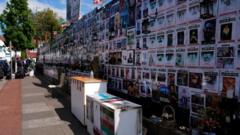
Shock and anger don't even begin to describe the mood in North London right now. When news broke about the suspected arson at Golders Green memorial wall, it felt like a gut punch to a community already on edge. This isn't just about a damaged structure or some charred brickwork. It’s about the desecration of a space meant for reflection, mourning, and quiet remembrance.
People are asking if nowhere is safe. If you haven't been following the details, the incident involved a fire that broke out late at night at the memorial site. Emergency services responded quickly, but the damage was done. Investigators are currently treating it as a deliberate act. This suggests someone went there with the specific intent to burn a symbol of collective memory. That's a heavy thought to sit with.
The immediate impact of the Golders Green incident
The physical damage is one thing. You can scrub soot and replace stones. But the psychological weight is much harder to clean up. Golders Green has long been a heartbeat for the Jewish community in London. When a memorial wall—a place literally built to honor the dead—is targeted, it sends a message of pure hostility.
Police have stepped up patrols in the area. It's a standard move, but it highlights the reality that people feel vulnerable. Local leaders have been vocal, calling this a cowardly act. They're right. Creeping around in the dark to set fire to a wall isn't a political statement. It’s a hate-filled tantrum.
I’ve seen how these things play out before. Usually, the community rallies. They show up with flowers, they hold vigils, and they refuse to be intimidated. But that doesn't change the fact that someone felt empowered enough to strike at such a sensitive location.
Understanding the rise in communal tensions
We can't look at the suspected arson at Golders Green memorial wall in a vacuum. It's happening during a time of massive global and local friction. We’ve seen a documented spike in antisemitic incidents across the UK over the last couple of years. The statistics from the Community Security Trust (CST) are pretty grim. They show that when international tensions rise, local communities often pay the price in the form of vandalism and harassment.
It’s easy to get lost in the "why" of it all. Is it a lone actor? Is it a coordinated group? While we wait for the forensic teams to do their jobs, the broader context remains. Places of worship and memorial sites are becoming targets because they represent identity. When you can’t argue with a person’s existence, you attack the things they hold sacred.
Security failures and what needs to change
Let’s be real for a second. Why was it so easy for this to happen? Many memorial sites are designed to be open and accessible. That’s the whole point—they are for the public. But in 2026, that openness is a massive security risk.
- Most sites lack 24-hour physical security because it's too expensive.
- CCTV is often outdated or has blind spots that "guests" can exploit.
- Lighting in these areas is frequently kept low to maintain a somber atmosphere, which unfortunately provides cover for arsonists.
Security experts are now pushing for a "harder" approach to these sites. This might mean more high-resolution thermal cameras or motion-sensing lights that don't ruin the aesthetic but do scare off anyone lurking after hours. It’s a shame it has to come to this, but ignoring the threat isn't an option anymore.
How the community is responding to the fire
The response hasn't been one of fear, but of organized resilience. Within hours of the news hitting the wires, local groups started coordinating. They didn't wait for the council to act. They checked in on neighbors. They contacted the Metropolitan Police to offer any doorbell camera footage they might have.
I think there’s a lesson here in how to handle targeted hate. You don't retreat. If the goal of the arsonist was to make the community hide, they failed miserably. If anything, this has pulled people closer. You see people from all backgrounds—not just the Jewish community—condemning the act. That's the only way to actually fight back.
The role of social media in spreading information
One thing that's different now compared to five years ago is how fast the narrative moves. Before the fire was even fully out, photos were on X and Telegram. While this helps spread awareness, it also fuels rumors. I saw people claiming it was a specific group before the police even arrived.
You have to be careful with that. Spreading unverified theories just adds more gasoline to the fire—literally and figuratively. The best thing anyone can do right now is let the professionals handle the investigation and focus on supporting the recovery efforts.
What happens next for the Golders Green memorial
The investigation is still in the "active" phase. This means detectives are combing through hours of footage and looking for any forensic trail left behind. Arson is notoriously hard to prove unless someone is caught in the act or leaves behind a clear accelerant trail, but the pressure is on.
The memorial wall will be restored. That’s a given. There’s already talk of a fundraising drive to not only fix the damage but to enhance the entire site. It's a way of saying, "You tried to destroy this, so we're going to make it even better."
If you live in the area or care about protecting these spaces, there are things you can actually do. Don't just post a black square on Instagram and call it a day.
- Support organizations like the CST that provide security for Jewish communal buildings.
- Report any suspicious activity immediately, even if it feels "minor."
- Volunteer for clean-up days if the site managers ask for help.
- Push your local representatives to allocate more funding for the protection of religious and memorial landmarks.
The fire at Golders Green is a reminder that peace is fragile. It takes active work to maintain a society where a memorial wall can exist without being torched in the middle of the night. Stand with the community, stay vigilant, and don't let these acts of cowardice go unchallenged.


;height:auto;width:100%25)
