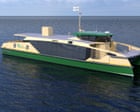
Sydney is celebrating a two-year-delayed electric ferry trial as a massive win for the environment. The narrative is comforting: swap out diesel, plug in a battery, and glide silently into a zero-emission utopia by the time the new Fish Market route opens in 2029.
It is a comforting story. It is also completely wrong. Don't forget to check out our earlier post on this related article.
Slapping lithium-ion batteries onto public maritime transit and calling it a day is the ultimate lazy consensus. It satisfies politicians who need a green backdrop for a press conference, but it ignores the brutal physics of marine engineering and the actual mechanics of urban decarbonization. I have spent years analyzing fleet transitions and transport infrastructure, and I have seen cities blow millions on vanity electrification projects that achieve a fraction of the emissions reductions a boring, well-optimized bus route could deliver overnight.
We are asking the wrong questions about public transit. The issue is not how to make a niche, low-capacity ferry look eco-friendly. The issue is how to move the maximum number of people with the lowest possible carbon footprint per passenger kilometer. On that metric, Sydney's celebrated electric ferry trial is a costly, inefficient distraction. If you want more about the background of this, Wired offers an in-depth breakdown.
The Flawed Physics of Marine Electrification
Batteries are heavy. Water is dense. When you combine those two facts, the utopian vision of electric shipping begins to crack.
In automotive transport, electrification makes undeniable sense. A car requires energy to accelerate, but once it is at cruising speed on a highway, overcoming rolling resistance is relatively easy. If the car slows down, regenerative braking captures a significant portion of that kinetic energy and feeds it back into the battery.
Water does not work that way. A boat is constantly fighting displacement and hydrodynamic drag. Every meter a ferry moves requires continuous, high-energy output just to push water out of the way. There is no coasting. There is no regenerative braking. The moment you cut the power, the water stops you.
To power a commercial ferry for a full day of operations, you need a massive battery pack. That pack adds immense weight.
The Displacement Trap: More battery weight means deeper draft. Deeper draft means greater hydrodynamic resistance. Greater resistance means the vessel requires even more energy just to move at its standard operating speed.
You end up wasting a significant percentage of your battery capacity just to carry the weight of the battery itself.
Imagine a scenario where a transit agency spends millions retrofitting a harbor route, only to realize the vessel's payload capacity has dropped because the battery pack takes up the weight equivalent of 50 passengers. You are now burning grid power to transport lithium across the harbor while commuters are left waiting on the wharf. That is not environmental progress; it is an engineering circle.
The 2029 Delusion and the Opportunity Cost of Capital
The current timeline slates the new electric Fish Market route for 2029. A three-year trial followed by a multi-year rollout for a single route is not a fast track to sustainability. It is a bureaucratic crawl that protects the status quo.
While the public waits for a handful of boutique electric ferries to hit the harbor, millions of dollars in capital are tied up in specialized charging infrastructure and bespoke vessel designs. That capital is finite. Every dollar spent on an expensive, low-capacity maritime project is a dollar stolen from high-impact transit upgrades.
Consider what that same funding could do if applied to Sydney’s bus network. Replacing a fleet of diesel buses with standard electric models requires no reinventing of the wheel. The technology is mature, the supply chains exist, and the passenger throughput is orders of magnitude higher.
If your goal is to reduce city-wide emissions as quickly as possible, you do not start with the harbor ferries, which account for a tiny sliver of the city's total transport emissions. You start with the gridlocked arterial roads. Targeting ferries first is choosing aesthetics over arithmetic.
Dismantling the Clean Energy Myth
The phrase "quieter and cleaner" sounds great until you look at the source of the electrons.
An electric ferry is only as clean as the grid that charges it. New South Wales still relies heavily on coal for its baseline electricity generation. Charging a massive marine battery from a grid dominated by fossil fuels does not eliminate emissions; it merely shifts them from the ferry’s exhaust pipe to a smokestack in the Hunter Valley.
While the harbor air might smell slightly cleaner, the global carbon balance sheet remains virtually unchanged. Until the grid is fully decarbonized, high-load electric vehicle infrastructure represents a localized shifting of pollution, packaged as an environmental victory for affluent commuters.
Furthermore, the environmental cost of manufacturing marine-grade battery packs is staggering. These are not standard car batteries. They require ruggedization, advanced thermal management systems, and massive amounts of raw materials like cobalt, lithium, and nickel. The upfront carbon debt of building one of these vessels is massive. If the vessel spends its life running short, under-utilized routes like the upcoming Fish Market run, it may never operate long enough to offset the carbon generated during its production.
The Actual Solution Nobody Wants to Hear
If we want to fix urban transit and reduce emissions, we need to stop chasing high-tech silver bullets and focus on structural efficiency.
- Prioritize Passenger Density Over Power Source: A fully loaded diesel bus or train is far more efficient per passenger than a half-empty electric ferry. The focus must be on maximizing load factors, not just changing the fuel type.
- Optimize Existing Hull Designs: Significant emissions reductions can be achieved right now by retrofitting existing diesel fleets with advanced hull coatings, lightweight materials, and optimized propulsion systems. This can be done at a fraction of the cost of total electrification and takes effect immediately, not in 2029.
- Invest in Low-Emission Transition Fuels: Instead of waiting for perfect battery technology and charging infrastructure, fleets can utilize renewable diesel or hybrid systems today. This cuts emissions immediately across the entire fleet rather than waiting a decade for a pure-electric rollout.
We are coddling the public with a narrative that we can solve climate change through seamless, painless tech upgrades that require no change in urban planning or consumer behavior. Buying into the hype of a delayed, over-budget electric ferry trial is actively harming our ability to deploy real, scalable transit solutions.
Stop looking at the shiny new boat. Look at the balance sheet, look at the grid, and look at the physics. The math does not add up.