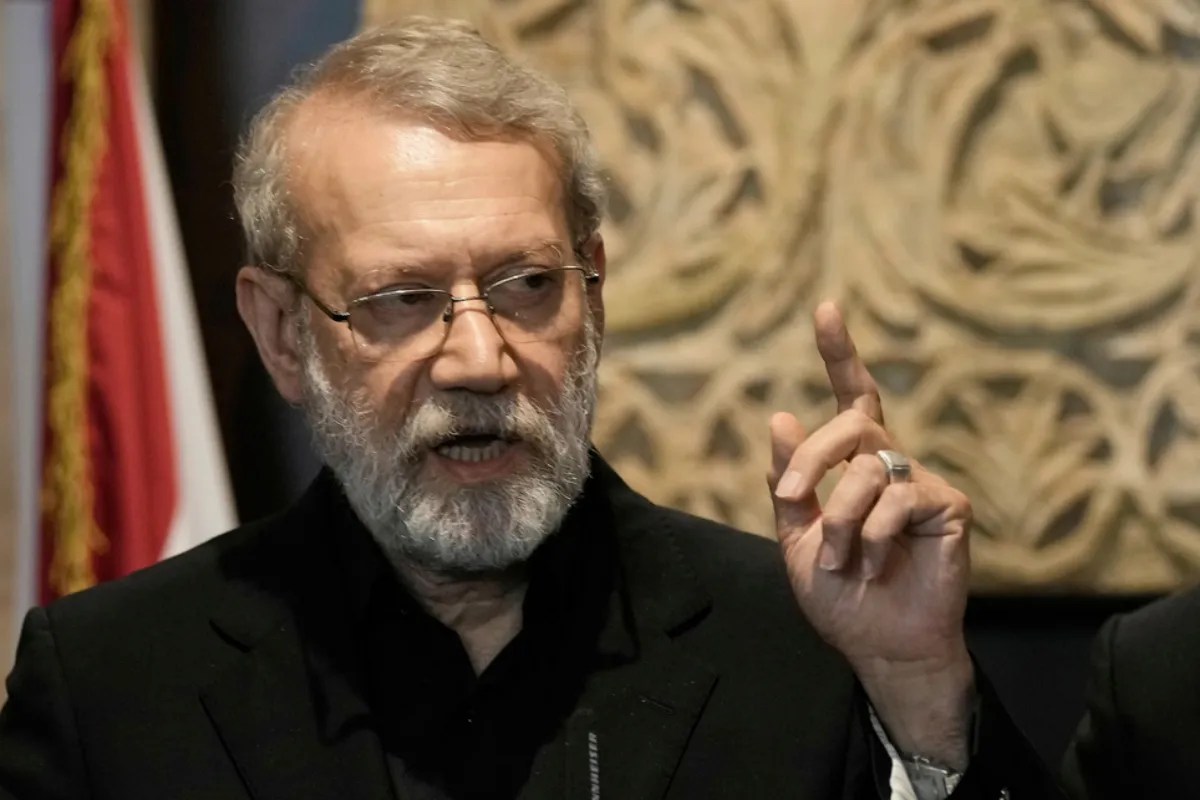
Foreign Minister Abbas Araghchi wants you to believe that the Iranian state is a monolith of resilience. After reports regarding the status of Ali Larijani—a titan of the "moderate" conservative establishment—the official line is predictable: the Islamic Republic is unshakable, the "Axis of Resistance" is intact, and individual losses are mere ripples in a deep ocean.
This is a lie. Not because Araghchi is a bad diplomat, but because his job is to sell a 1980s survival manual to a 2026 world that has already moved on.
The consensus among regional analysts is that Iran’s "Deep State" can simply plug-and-play new leaders into its hierarchy. They point to the transition after Ebrahim Raisi’s helicopter crash as proof of stability. They are looking at the plumbing while the foundation is rotting. The supposed "unshakable" nature of Iran isn't a sign of strength; it’s a symptom of a rigid system that has lost the ability to flex. When a system can’t flex, it breaks.
The Larijani Vacuum and the Death of the Middle Ground
Ali Larijani isn't just another name in the Rolodex of Tehran’s elite. He represents the last vestige of the "Pragmatic Conservative"—the bridge between the ideological hardliners and the international community. Araghchi’s bravado ignores the math of power.
In any authoritarian structure, you need "grey men" to facilitate backchannel deals. Larijani was the primary architect of the 25-year cooperation program with China and a key player in the JCPOA negotiations. By sidelining or losing figures of his caliber, the Iranian regime isn't becoming "purer." It’s becoming blind.
I’ve watched political structures across the Middle East attempt this "purification" ritual. It happened in Iraq under the Ba'athists. It happened in Libya. When you eliminate the internal dissenters and the pragmatic balancers, you don’t get a more efficient government. You get an echo chamber. And echo chambers are terrible at navigating existential crises.
The Fragility of the "Axis" Proxy Logic
The media loves to talk about Iran’s regional influence as a "strategic depth" play. Araghchi claims that external shocks cannot destabilize the domestic front. This assumes that the Iranian public is still buying the "export the revolution" brand.
They aren't.
Data from internal Iranian socio-economic surveys—the ones the Ministry of Interior tries to bury—consistently show that the average Iranian cares significantly more about the value of the Rial than the survival of a proxy in Lebanon or Yemen. The "unshakable" narrative relies on the idea that the Revolutionary Guard (IRGC) can keep the lid on forever.
Consider the fundamental equation of state survival:
$$S = \frac{R}{D}$$
Where $S$ is Stability, $R$ is Resources (economic and military), and $D$ is Domestic Discontent.
As the denominator ($D$) grows due to hyperinflation and social repression, and the numerator ($R$) shrinks due to sanctions and the cost of maintaining regional militias, the stability coefficient $S$ approaches zero. No amount of "revolutionary fervor" in a press release changes the physics of that math. Araghchi is trying to solve for $S$ by pretending $D$ doesn't exist.
The Intelligence Breach Reality Check
Let’s talk about the elephant in the room that the official Iranian narrative refuses to acknowledge: the catastrophic failure of their internal security apparatus.
Over the last few years, we’ve seen high-level assassinations on Iranian soil, the theft of nuclear archives, and mysterious "accidents" at sensitive facilities. If the state is as unshakable as Araghchi claims, why is its most elite layer of protection as porous as a sponge?
The "stability" they project is a theatrical performance for an audience that is increasingly walking out of the theater. When a government spends more time denying rumors than it does fixing the structural reasons why those rumors exist, the game is already over.
The Myth of the "Seamless" Succession
The biggest misconception in Western media is that the Supreme Leader, Ali Khamenei, has a clear path for what comes next. The "unshakable" rhetoric is designed to mask the absolute chaos happening behind the scenes.
The struggle isn't between "reformists" and "hardliners"—that’s an outdated binary. The real war is between the IRGC’s business wing and the traditional clerical establishment. Figures like Larijani were the glue holding those two disparate worlds together.
Without the glue:
- The IRGC moves toward a full military dictatorship.
- The clerical establishment loses its last shred of public legitimacy.
- The youth population (70% of the country) waits for the first sign of a crack to widen.
Araghchi says Iran won't "waver." History says otherwise. Every regime that claimed it was permanent, right up until the moment it wasn't, used the exact same script.
The Brutal Truth for Investors and Diplomats
If you are a diplomat or a corporate entity looking at the region, stop asking "Will the regime fall tomorrow?" That’s the wrong question. It’s a binary trap.
The real question is: "What does a desperate, cornered, and paranoid Tehran do to survive?"
A cornered regime doesn't seek stability; it seeks chaos to distract from its own internal failures. This is why we see increased maritime provocations and a doubling down on nuclear escalation. It isn't a sign of confidence. It’s a "Hail Mary" pass.
Stop listening to the choreographed statements from the Foreign Ministry. The reality is found in the black markets of Tehran, the whispers in the corridors of the Majlis, and the fact that the regime’s most prominent figures are looking for exit strategies.
The "unshakable" Iran is a myth maintained by those who have the most to lose when it finally collapses. The facade is thick, but the structural integrity is gone.
Araghchi can keep the microphone. The streets already have the truth.
Burn the script.