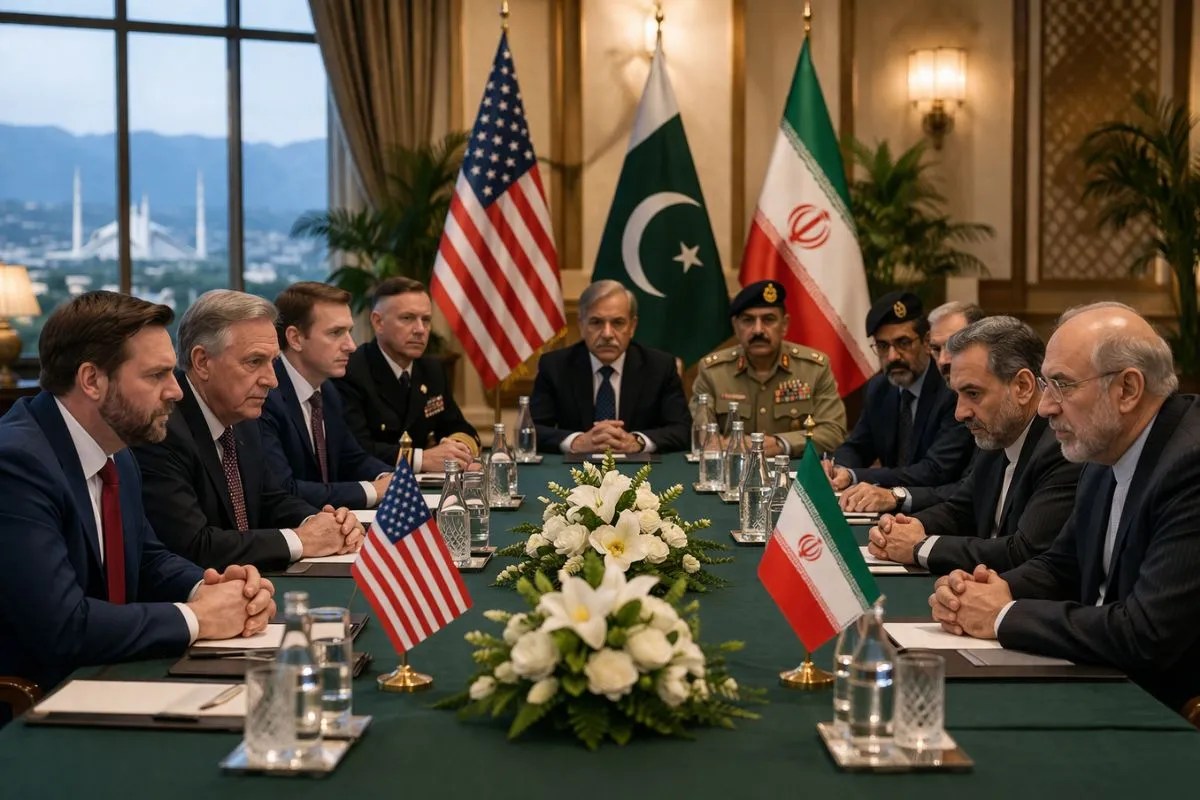
The air in Islamabad during these high-stakes summits doesn't smell like politics. It smells of diesel exhaust, roasted corn from street vendors, and the heavy, humid stillness that precedes a monsoon. Inside the fortified corridors of power, men in tailored suits trade syllables like currency. Outside, a shopkeeper named Hamid adjusts his radio. He doesn't care about the nuances of enriched uranium or the specific wording of a maritime treaty. He cares about the price of cooking oil. He cares whether the lights will stay on tonight.
This is the friction point where global grand strategy meets the dinner table.
When the news broke that Iran had played a "big card" just as delegates were unpacking their briefcases in Pakistan, the reaction in Western capitals was a predictable mix of frantic cables and hurried press briefings. But to understand why this move sent a tremor through the geopolitical floorboards, we have to look past the podiums. We have to look at the shadows.
The Invisible Lever
Geopolitics is often described as a game of chess, but that is a lazy comparison. Chess is transparent. You see the pieces. International diplomacy, especially involving the tripartite tension between Tehran, Islamabad, and Washington, is more like a game of poker played in a room where the lights keep flickering.
Iran’s latest move—a calculated assertion of influence right as the Islamabad talks flickered to life—wasn't just a diplomatic flourish. It was a reminder of geography. You can ignore a country’s ideology, but you cannot ignore its borders. Iran sits on the world’s jugular. By signaling a new level of cooperation with regional neighbors or threatening a pivot that excludes Western oversight, they aren't just talking to the people in the room. They are talking to the markets.
Consider the drone. Not the sleek, million-dollar machines seen in cinema, but the gritty, functional technology that has rewritten the rules of modern friction. While the US focuses on high-altitude dominance, regional players have mastered the art of the "low and slow." This technology has become the new language of the Middle East and South Asia. When Iran "opens a card," it is often a technological one. It’s a signal that the old monopoly on power has dissolved.
The Weight of the American Shadow
In Washington, the reaction was a sharp intake of breath. For decades, the US has operated on the assumption that it is the only architect capable of drawing the blueprints for regional stability. That assumption is currently being dismantled, brick by brick.
The American dilemma is profound. If they react too harshly, they risk pushing regional powers into a permanent, hardened alliance that bypasses the dollar entirely. If they stay silent, they appear obsolete. It is a tightrope walk over a canyon of shifting sand.
Imagine a young analyst in the State Department. Let's call her Sarah. She spends eighteen hours a day looking at satellite imagery and intercepted communiqués. She sees the movement of hardware, the subtle shifts in naval patrols, and the sudden uptick in encrypted traffic. To Sarah, these aren't just "events." They are data points in a collapsing architecture. She knows that every time a regional power makes a bold move without consulting her office, the world gets a little bit smaller for American influence.
The real tension isn't about what was said at the Islamabad table. It’s about what was understood. The participants know that the US is distracted—divided internally, weary of "forever wars," and increasingly focused on the Pacific. This perceived weakness is a vacuum. And in physics, as in politics, vacuums are always filled.
The Human Cost of a Standoff
We often speak of "sanctions" as if they are a clinical tool, a dial that can be turned up or down to adjust a nation’s behavior. They are not. Sanctions are a blunt instrument that falls most heavily on the people who have never stepped foot in a palace.
In Tehran, a schoolteacher searches for imported medicine that has tripled in price. In Islamabad, an engineer wonders if the proposed pipeline—the one that promised to solve the city’s energy crisis—will ever be more than a line on a map. These are the people who actually live the "new turn" in the talks. When Iran plays a card to counter American pressure, they are trying to break a siege. When the US pushes back, they are trying to maintain a standard.
The tragedy of the Islamabad talks is that the human element is the first thing discarded in favor of "strategic depth."
The technology of war and the technology of peace are now indistinguishable. A turbine that powers a hospital can be seen as a dual-use item. A software update for a power grid is a potential Trojan horse. This paranoia defines the modern diplomatic era. It makes trust impossible and creates a cycle where "opening a card" is the only way to ensure you aren't forgotten.
The Ghost in the Machine
We must talk about the silence.
The most significant parts of these negotiations never make it to a press release. They happen in the breaks, in the hushed conversations by the coffee machines, and in the encrypted pings between capitals. Iran’s move was a public one, designed to be seen. But the real "big card" is the quiet integration of regional economies.
China is the ghost at this feast.
While the US and Iran trade barbs, the infrastructure of the East is being woven together. Rail lines, fiber optic cables, and oil pipelines are being laid down with a quiet, relentless efficiency. This isn't about a single meeting in Islamabad. It’s about the slow, tectonic shift of the world’s center of gravity.
If the US wants to remain relevant, it cannot simply rely on the old playbook of threats and isolation. That world is gone. The new world is messy. It is multipolar. It is a place where a country under heavy sanctions can still dictate the rhythm of a major international summit.
The Point of No Return
There is a specific kind of exhaustion that sets in during these marathons. By day three, the grand rhetoric has faded. The delegates are tired. The coffee is cold. This is when the real deals are struck—or when the real failures occur.
The "new turn" in the Islamabad talks isn't a victory for any one side. It is a symptom of a deeper fever. It shows that the old methods of containment are failing. Iran knows this. Pakistan knows this. And, despite the public bravado, the US knows this too.
The stakes are far higher than a single nuclear agreement or a trade pact. The stakes are the fundamental rules of the twenty-first century. Will we live in a world defined by a single, aging hegemon, or a chaotic, vibrant, and dangerous collection of regional powers?
Hamid, the shopkeeper in Islamabad, turns off his radio as the sun begins to set. The news was full of big words and bigger threats, but he still doesn't know if the price of oil will drop tomorrow. He locks his door and looks up at the sky. High above, invisible to the naked eye, the satellites of a dozen different nations are passing over, blinking in the dark, watching a world that is changing faster than the men in the suits can describe.
The card has been played. The table is set. But the game has moved far beyond the room where it started.
Silence returns to the streets of Islamabad, but it is the heavy, expectant silence of a world waiting for the other shoe to drop. The map is being redrawn, not with ink, but with the quiet, stubborn persistence of those who refuse to be sidelined in their own backyard.