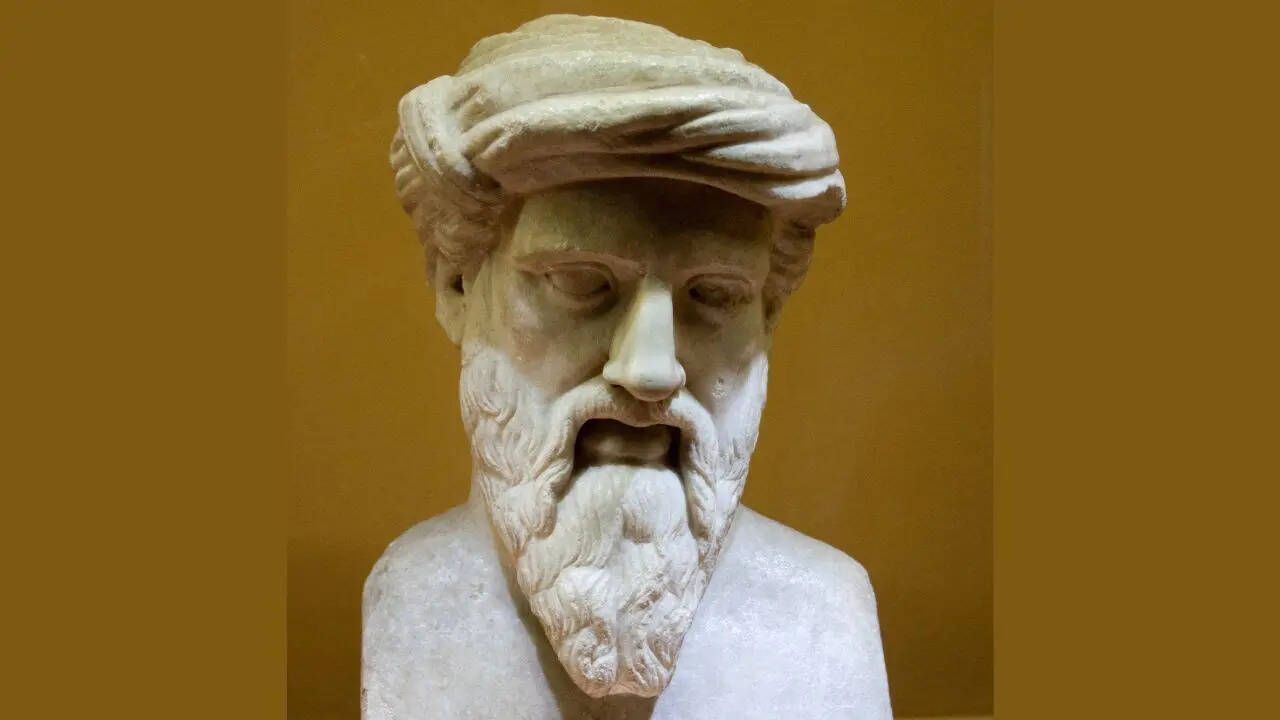
Pythagoras was a genius at geometry, but his advice on communication is a recipe for modern stagnation. The quote "The oldest, shortest words— ‘yes’ and ‘no’— are those which require the most thought" has become a sacred cow for the indecisive. It’s the ultimate intellectual security blanket for people who want to feel deep while they’re actually just being slow.
The "lazy consensus" here is that deliberation equals wisdom. We’ve been conditioned to believe that every binary choice is a high-stakes minefield. We treat "yes" and "no" like we’re cutting the red wire on a live bomb. In reality, the cost of the "thought" Pythagoras demands is often higher than the cost of a wrong decision.
In the high-velocity world of business and personal growth, the "thoughtful" person is usually just the person who missed the window of opportunity.
The Paralysis of the Binary
The pedestal we put these two words on creates a psychological bottleneck. When you treat "yes" and "no" as heavy, profound anchors, you develop a fear of commitment. This isn't just about being a "yes man" or a "naysayer." It’s about the friction added to every interaction.
I have seen executive teams spend six months "thinking" about whether to greenlight a project. They weigh the "yes." They fear the "no." By the time they choose, the market has shifted, the talent has quit, and the competitor has already failed and pivoted three times.
The weight isn't in the words. The weight is in your ego. We agonize over these words because we’re obsessed with being right. If you stop trying to be right and start trying to be fast, the power dynamic shifts.
Speed is the Only Real Asset
If you’re running a startup or managing a career, your primary goal isn't accuracy—it’s iteration.
Imagine a scenario where you have a 60% success rate on decisions.
- Person A spends three weeks "thinking" about a "yes" and gets it right.
- Person B spends three minutes, says "yes," fails in three days, and says "no" to the next two iterations before finding the winner.
Person B is now lightyears ahead while Person A is still patting themselves on the back for their "Pythagorean depth."
In $OODA$ loop theory (Observe, Orient, Decide, Act), the goal is to cycle through the loop faster than your opponent. Pythagoras is telling you to jam the "Decide" phase with unnecessary cognitive load. In a competitive environment, that’s suicide.
The False Profundity of "No"
Modern productivity gurus have fetishized the word "no." They tell you that "no" is a superpower, that you should protect your time like it's the gold in Fort Knox. They cite Warren Buffett saying that successful people say no to almost everything.
This is survivor bias at its worst. Buffett says "no" to everything because he already has everything. For anyone still climbing, a "thoughtful no" is often just a missed connection.
The "no" doesn't require deep thought; it requires a filter. If the request doesn't align with your current $KPIs$, it’s a "no." Done. Move on. Thinking about it more doesn't make it a better "no." It just makes you a bottleneck.
Stop Respecting the Words
We need to demythologize these sounds. They are tools, not monuments.
The Low-Stakes "Yes"
Most "yes" decisions are reversible.
- Buying a tool? Yes.
- Taking a meeting? Yes.
- Testing a new headline? Yes.
If it’s reversible, the "thought" required is near zero. If you spend more than sixty seconds weighing a reversible decision, you are burning money.
The Strategic "No"
The only time a "no" requires thought is when it’s a bridge-burner. But even then, the thought should be tactical, not philosophical. Is this person someone I need later? If yes, find a way to say "no" that feels like a "not yet." That’s not deep thought; that’s basic social engineering.
The High Cost of the "Thoughtful" Leader
I once worked with a CEO who took the Pythagoras quote to heart. He was "thoughtful." He was "deliberate." He was also the reason the company went from a $200 million valuation to a fire sale in eighteen months.
Every time a VP brought him a "yes/no" proposal, he would sit on it. He wanted to ensure he wasn't being impulsive. He wanted to "give it the thought it required."
While he was thinking, the engineers lost morale. The sales team couldn't close because they didn't have the feature set. The board grew restless. His "thoughtfulness" was actually cowardice masked as wisdom. He was terrified of the consequences of a "yes" that failed, so he chose the silent "no" of delay.
Decision Debt is Real
Every time you "think" about a short word, you are accruing decision debt. This is the mental energy you lose by keeping a binary choice open in the back of your mind.
It’s like having fifty tabs open in Chrome. Each one takes a little bit of $RAM$. By the end of the day, your brain is sluggish, your creativity is gone, and you’re exhausted. Not because you did a lot of work, but because you thought too much about things that should have been decided in seconds.
How to Actually Use "Yes" and "No"
Forget the Greek philosopher. Use these rules instead:
- The 2-Minute Rule for Reversibility: If the decision can be undone for less than the cost of your hourly rate, decide in under two minutes.
- The "Hell Yes" vs. "No" Trap: This popular advice is for people who are already overwhelmed. If you aren't where you want to be yet, your default should be "Yes, and..."
- Data Over Deliberation: If you’re thinking hard, it’s because you lack data. Stop thinking and go find a way to test the premise. A "yes" to a small test is better than a "thoughtful no" to a big idea.
The Brutal Reality
People who quote Pythagoras on this are usually looking for an excuse to be slow. They want to believe that their hesitation is a sign of intelligence. It isn't. It’s a sign of friction.
The world doesn't reward the person who thought the most about saying "yes." It rewards the person who said "yes," got in the room, and figured it out while the "thinkers" were still staring at their shoes.
The shortest words in the language don't need your deep thought. They need your courage.
Stop overthinking. Start deciding.