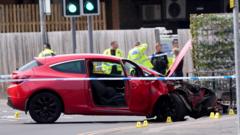
Media outlets handle vehicle-pedestrian fatalities with a scripted, almost religious ritual. They focus on the tragedy—the "26-year-old man" whose life was cut short—while framing the event as an act of God or a mechanical glitch. They use passive language like "a car hit a group of pedestrians."
Cars do not hit people. Drivers hit people. Or, more accurately, infrastructure and psychology collide at high speeds.
The "lazy consensus" in modern reporting and urban planning suggests that if we just lower speed limits or add a few more high-vis vests, these "accidents" will vanish. This is a lie. It's a comfortable lie that protects the status quo of car-centric design and the fundamental misunderstanding of kinetic energy. We aren't dealing with a safety crisis; we are dealing with a design and accountability vacuum that no amount of thoughts and prayers can fill.
The Myth of the "Accident"
The word "accident" should be stripped from the vocabulary of every newsroom in the country.
In aviation, when a plane goes down, we don't call it an accident until a black box proves no human or systemic negligence was involved. Yet, on our streets, we default to the idea that a 26-year-old dying is just a statistical hiccup. This is a refusal to acknowledge the physics of probability.
When you design a road like a runway—wide lanes, clear sightlines, minimal friction—drivers will treat it like a runway. If that road happens to be in a high-density pedestrian area, a fatality isn't an accident. It is a mathematical certainty. I have consulted on urban transit projects where millions are spent on "beautification" while ignoring the fact that the turning radii at intersections are wide enough for a semi-truck to maintain 30 mph. You are literally building a kill zone and then acting shocked when someone dies in it.
The competitor article focuses on the "group of pedestrians" as if their presence was the variable. It wasn't. The variable is a culture that prioritizes traffic throughput over human survivability.
The False Security of Modern Safety Tech
We are told that "Advanced Driver Assistance Systems" (ADAS) are the savior. Emergency braking, lane assist, pedestrian detection—these are the industry’s favorite band-aids.
They don't work the way you think they do.
I’ve seen the raw data from sensor testing in inclement weather and low-light conditions. These systems have massive blind spots when it comes to "edge cases," which, in the real world, translates to "a person wearing a dark coat at 11:00 PM." Reliance on these tools creates Risk Compensation. This is a psychological phenomenon where humans take more risks because they feel a safety net is beneath them.
When a driver believes the car will stop itself, they look at their phone. When they look at their phone, their reaction time drops from 1.5 seconds to nearly 4 seconds. At 40 mph, you’ve traveled the length of a football field before you even touch the brake.
The tech isn't a game-changer; it's a crutch that is currently breaking.
Kinetic Energy Doesn't Care About Your Feelings
Let’s talk about the math that news articles ignore because it's "too dry."
The survivability of a pedestrian strike follows a non-linear curve. If a car hits you at 20 mph, you have a 90% chance of survival. At 30 mph, that drops to about 50%. At 40 mph, it’s a 10% chance.
Most "safety" advocates focus on the 30-to-40 range. They argue about 5 mph differences. They are missing the point. The issue isn't the speed limit; it's the mass. We are currently in an arms race of vehicle size. The average weight of a vehicle has ballooned, and with it, the height of the front grille.
When a 1990s sedan hits a pedestrian, it hits them at the legs. The person is thrown onto the hood. It’s grisly, but often survivable. Modern SUVs and trucks hit pedestrians in the chest and head. They don't throw the person; they run them over.
If you want to stop 26-year-olds from dying in "groups," you don't need more "Slow Down" signs. You need to tax vehicle mass and legislate the height of front bumpers. But no one wants to tell the suburban dad that his "safety" vehicle is a literal battering ram for everyone else on the street.
Stop Asking "Why Did This Happen?"
People always ask the same flawed questions after a tragedy:
- Was the driver distracted?
- Were the pedestrians in a crosswalk?
- Was alcohol involved?
These questions are irrelevant to the core problem. They seek to assign individual blame to avoid looking at systemic failure. If a road allows a human to make a single mistake that results in multiple deaths, the road is defective. Period.
Imagine a scenario where a factory worker dies because they tripped into an unguarded machine. We don't ask if the worker was "distracted." We fine the company for not having a guardrail. Yet, our streets have no guardrails—literally or figuratively. We allow 5,000-pound machines to operate inches away from unprotected humans with nothing but a painted white line for "protection."
The Brutal Reality of Urban Speed
We have been conditioned to believe that moving cars quickly through a city is a sign of a "functioning" economy. It is actually a sign of an inefficient one.
"Stroads"—a term coined by Charles Marohn of Strong Towns—are the culprit. These are part street (a place where people live and shop) and part road (a high-speed connection between two points). They are the most dangerous environments in the developed world. They encourage high speeds while introducing constant points of conflict: turn-offs, driveways, and pedestrians trying to cross six lanes of traffic to get to a bus stop.
The man who died in that "accident" was a victim of a stroad. He was a victim of an engineering philosophy that treats a human being as an "obstacle" to the flow of traffic rather than the primary reason the city exists in the first place.
The Actionable Truth
If you actually want to solve this, stop supporting "Awareness Campaigns." Awareness is a myth. Everyone knows cars are dangerous. The problem is that our environment masks that danger until it's too late.
- Narrow the Lanes: If a driver feels uncomfortable going fast because the road feels tight, they will slow down. You don't need a sign; you need a curb.
- Daylighting: Remove parking spaces at every intersection. If a driver can't see the corner, they can't see the person standing on it.
- Strict Liability: In many European jurisdictions, the larger vehicle is legally presumed at fault in a collision with a more vulnerable road user. This forces the person with the most power (the driver) to exercise the most caution. In the US and UK, we do the opposite, often blaming the dead for not wearing "reflective clothing."
The competitor article treats the death of a young man as a sad, isolated event. It isn't. It is a predictable outcome of a system that values the convenience of the commute over the sanctity of life.
Stop mourning the "accident" and start sabotaging the design that made it inevitable.
Every time we call these events accidents, we give the engineers and the distracted drivers a free pass. We accept that a certain number of dead bodies is the "cost of doing business" for a mobile society.
It isn't a cost. It's a choice. And right now, we are choosing the wrong side of the equation.