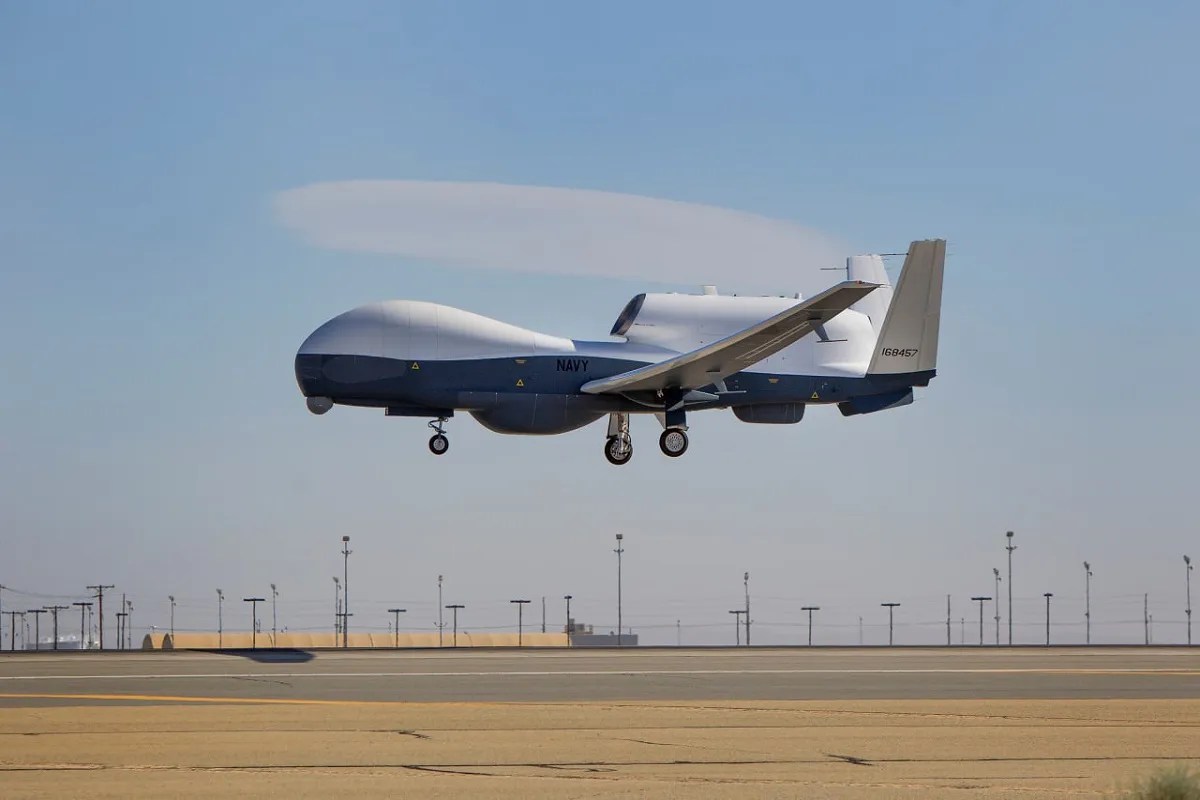
The headlines are screaming about a 1.8 thousand crore loss. They are obsessed with the price tag of the MQ-4C Triton. They treat the disappearance over the Strait of Hormuz like a tragic financial accident or a mysterious technical glitch.
They are missing the point. The price tag isn't the story. The failure of the philosophy behind the price tag is.
Spending $200 million on a single uncrewed airframe is no longer a flex. It is a liability. While the mainstream media fawns over the "sophistication" of high-altitude long-endurance (HALE) platforms, the reality on the ground—and in the water—has shifted. We are watching the sunset of the "Exquisite Platform" era, and the Strait of Hormuz is the graveyard where these gold-plated birds go to die.
The Fallacy of the Invincible Eye
The MQ-4C Triton is marketed as the ultimate maritime watcher. It’s packed with sensors designed to track everything from a carrier strike group to a lone fisherman’s dinghy from 60,000 feet. But there is a fundamental flaw in the logic of deploying a slow, non-stealthy, massive target into contested airspace.
The "lazy consensus" suggests that because these drones fly high, they are safe. This is 1990s thinking applied to a 2026 reality.
Modern integrated air defense systems (IADS) do not care about your altitude. If you are broadcasting high-powered radar signals and moving at the speed of a Cessna, you aren't a ghost. You are a lighthouse. We have reached a point where the cost to kill a Triton is roughly 0.05% of the cost to build one. That is not a sustainable defense strategy; it is a math problem that the Pentagon is currently losing.
Why 1.8 Thousand Crore Drones are Obsolete
The MQ-4C is built on the Global Hawk backbone. It was designed for "permissive environments"—military speak for "places where the enemy can't shoot back."
When you fly this over the Strait of Hormuz, you are essentially daring a regional power to take a potshot. And when they do, you don't just lose a pilot (the supposed benefit of drones); you lose a strategic asset that takes years to replace.
- The Replacement Lag: You cannot "mass produce" a Triton. The supply chain is brittle. If you lose five of these in a month, your maritime awareness in the Pacific or the Middle East evaporates.
- The Signal Burden: These drones require massive bandwidth. They are tethered to satellite links that are increasingly vulnerable to jamming and spoofing.
- The Detection Paradox: To see the enemy, the Triton must emit. The moment it turns on its Multi-Function Active Sensor (MFAS), it announces its precise coordinates to every electronic support measure (ESM) suite within hundreds of miles.
Stop Asking Where the Drone Went
The "People Also Ask" sections of the internet are obsessed with how it disappeared. Was it a missile? Was it a laser? Was it electronic warfare?
You’re asking the wrong question.
The real question is: Why are we still sending $200 million targets to do a job that $50,000 worth of distributed sensors could do better?
The future isn't a single, expensive, "all-seeing" eye in the sky. The future is a "cloud" of disposable, low-cost autonomous systems. If I lose a $10,000 drone, I don't even file a report. If I lose a Triton, the Secretary of Defense has to answer questions on Capitol Hill.
We have become "platform-centric" instead of "capability-centric." We fell in love with the shiny toy and forgot that the goal is simply data. You don't need a 130-foot wingspan to get data anymore.
The Counter-Intuitive Truth About Maritime Surveillance
Industry insiders love to talk about "persistence." They claim the Triton is necessary because it can stay airborne for 30 hours.
Here is the truth: persistence is a weakness if you are predictable.
A Triton flying a predictable orbit is a sitting duck. Truly effective surveillance in 2026 relies on "unpredictable presence." This means using small, undersea gliders, low-earth orbit (LEO) satellite constellations like Starshield, and "attritable" (military-speak for cheap enough to lose) UAVs that launch from the back of a standard shipping container.
Imagine a scenario where instead of one MQ-4C, the US Navy deployed 2,000 small, networked drones across the Gulf. You could shoot down 500 of them and the network would still function. That is resilience. Losing one Triton and losing 100% of your coverage in that sector is fragility.
The Stealth Myth
Critics will argue that the Triton’s value lies in its sensor fusion. They will tell you that the AN/ZPY-3 radar can "see through clouds."
Newsflash: So can a $500 SAR (Synthetic Aperture Radar) chip on a CubeSat.
We are over-engineering solutions for problems that have already been commoditized. The Triton is a relic of the "Big Defense" era, where success was measured by the complexity of the contract rather than the utility on the battlefield.
We see this same pattern in the F-35 program and the Zumwalt-class destroyers. We build a Swiss Army knife that costs as much as a mountain, then we are too afraid to use it in a real fight because we can't afford to lose it.
The High Cost of Risk Aversion
The irony of the MQ-4C Triton is that its extreme cost makes the military less likely to use it effectively.
When a platform costs 1.8 thousand crore, the rules of engagement become paralyzed by bureaucracy. Commanders become risk-averse. They fly the drone further away from the action to "protect the asset." But if you fly further away, the quality of your intelligence drops.
You end up with a very expensive camera that is too far away to see anything useful because you're scared someone might break it.
Compare this to the way modern conflicts are being fought in Eastern Europe or the Red Sea. Cheap, "dirty" tech is winning. Loitering munitions and modified commercial drones are doing the heavy lifting while the multi-billion dollar programs sit in hangars waiting for "optimal conditions."
The Financial Sunk Cost Trap
Taxpayers and analysts look at the $200 million price tag and think, "We have to make this work, we've already spent billions."
This is a classic sunk cost fallacy. The money is gone. The MQ-4C Triton was designed for a world that no longer exists—a world where the US had an absolute monopoly on high-altitude flight. That monopoly is dead.
The proliferation of long-range surface-to-air missiles (SAMs) like the S-400 or even indigenous Iranian systems means that high-altitude, non-stealthy drones are essentially target practice.
If we continue to double down on these "Exquisite Platforms," we aren't just wasting money. We are creating a false sense of security. We are building a Maginot Line in the sky.
The Actionable Pivot
If we want actual maritime security in the Strait of Hormuz, we need to stop obsessing over the loss of a single drone and start dismantling the procurement process that created it.
- Divest from HALE: Stop buying massive, slow drones. They are the battleships of the 21st century—impressive to look at, but ultimately useless in a real shooting war.
- Invest in Swarms: Move the funding to mass-produced, autonomous systems that operate on mesh networks.
- Decentralize the Data: Move away from single points of failure. If the "brain" of your surveillance operation is one drone, you've already lost.
The disappearance of the Triton isn't a mystery. It’s a warning. The era of the billion-dollar bird is over, and the sooner we admit we’re buying overpriced targets, the safer we’ll be.
Stop mourning the 1.8 thousand crore. Start questioning why we bought a glass chin and expected it to win a heavyweight fight.