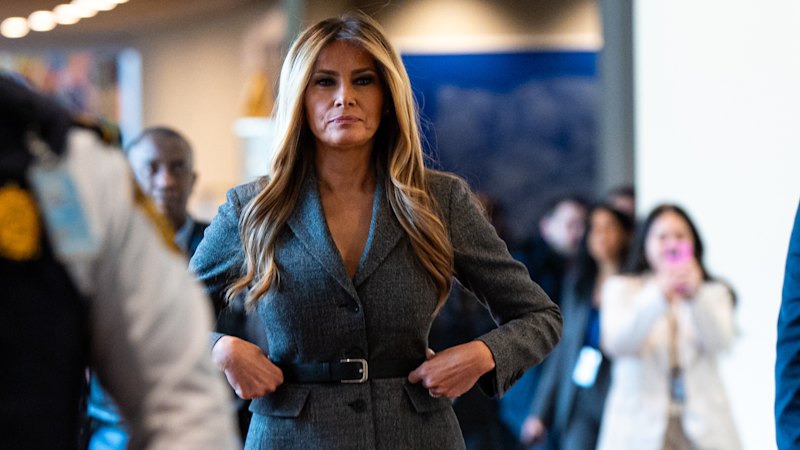
The air in the East Wing usually smells of floor wax and history. It is a heavy, silent atmosphere that suggests everything within those walls belongs to the American people, preserved in a sort of eternal amber. But in early 2022, Melania Trump broke the glass. She did something that no First Lady in the history of the United States had ever dared to do: she stepped into the digital marketplace to sell a piece of her own legacy while the ink on her husband's administration was still drying.
This wasn't a donation to a presidential library. It wasn't a gift to the Smithsonian. It was an auction.
To understand why this mattered, you have to look past the wide-brimmed Hervé Pierre hat that served as the centerpiece of the "Head of State" collection. You have to look at the intersection of a 250-year-old tradition and the volatile, often confusing world of blockchain technology. For the first time, the prestige of the White House was being tokenized.
The White Hat in the Digital Wild
Imagine a collector sitting in a sleek office in Dubai or a high-rise in Manhattan, scrolling through a website. They aren't looking at oil paintings or rare coins. They are looking at an NFT—a non-fungible token. This digital asset represented a watercolor painting of Melania wearing that famous white hat during the 2018 visit of French President Emmanuel Macron.
But the "lot" included more than just code. It included the physical hat itself, signed by the former First Lady, and a digital artwork with motion.
The move sent shockwaves through the small, insular world of White House historians. Traditionally, First Ladies are the curators of the national "vibe." they manage the china, the garden, and the transition of the family’s personal effects into the national archives. There is an unspoken rule: you don't monetize the tenure. You write a memoir, maybe. You start a foundation. You don't put the wardrobe from an official State Visit on the block for Solana cryptocurrency.
But Melania Trump has always operated on a different frequency.
Her decision to launch this auction wasn't just about fashion. It was a litmus test for the value of a modern political brand. She was testing whether the aura of the presidency could be chopped up into digital bits and sold to the highest bidder. It felt less like a public service and more like a startup launch.
A Question of Value and Virtual Currency
The auction opened with a minimum bid of $250,000. That is a staggering number for a hat, even one that stood next to a French President. However, the catch was the currency. The bids had to be made in SOL, a token on the Solana blockchain.
During the auction period, the crypto market did what it does best: it swung wildly.
Think of a hypothetical bidder—let's call him Marcus—who had budgeted a quarter-million dollars for this piece of history. As he watched the clock tick down, the value of his SOL tokens dropped. By the time the auction closed, the "winning" bid appeared to meet the minimum requirements, but because of the crash in crypto prices, the actual value in US dollars had shriveled.
Then came the twist that felt like a plot point from a prestige drama.
Blockchain ledgers are public. They are the "unseen ledgers" where every transaction is recorded for those who know how to look. Data sleuths began tracing the digital "wallet" that won the auction. The trail led back to the very creators of the NFT itself. In the world of high-stakes art, this is a gray area. It suggested that when the public failed to meet the lofty price tag, the entity behind the auction essentially bought it back to maintain the appearance of a high-value sale.
It was a mirror of the modern era: a spectacle designed to look like a triumph, even if the math beneath the surface told a much more complicated story.
The Weight of the Hat
Why does it feel so jarring to see a First Lady sell her clothes?
Consider the 2018 State Visit. It was a moment of peak diplomacy. The white hat was a deliberate choice—sharp, architectural, and commanding. It was a costume of power. When that object moves from a state event to a private auction, something shifts in the way we view the office.
The physical hat is felt, fabric, and sweat. The NFT is math, pixels, and scarcity.
By merging the two, Melania Trump bypassed the traditional gatekeepers of history. She didn't wait for a museum to tell her what her items were worth. She didn't wait for the decades of "cooling off" that usually precede the sale of presidential memorabilia. She went straight to the market.
This represents a broader shift in how we view public figures. We are moving away from the "public servant" model and toward the "personal brand" model. In the personal brand model, everything is an asset. Your image, your clothes, your presence at a dinner—these are not just parts of a job. They are inventory.
The Ghost in the Machine
There is a specific kind of loneliness in a digital auction. There is no gavel, no crowded room of people in tuxedos holding up paddles. There is only the glow of a screen and the movement of data across a decentralized network.
For the former First Lady, this was a way to maintain autonomy. Throughout her four years in Washington, she was often described as an enigma, a woman who lived behind a series of carefully constructed veils. The auction was another veil. It was a way to participate in the world on her own terms, using a technology that most people over the age of fifty still struggle to explain at Thanksgiving dinner.
But the "Head of State" auction also highlighted the precariousness of the digital age.
When you buy a physical painting, you hang it on a wall. When you buy an NFT, you own a pointer to a digital file. If the server goes down, if the blockchain forks, if the hype dies, what are you left with? You are left with a very expensive hat and a very complicated receipt.
The invisible stakes here aren't just about money. They are about the precedent. If a First Lady can sell her wardrobe via crypto, what stops a former Secretary of State from selling digital "moments" from a peace treaty? What stops a General from auctioning the NFT of a battlefield map?
The boundary between public history and private profit has become a thin, digital line.
Beyond the Silk and Solana
We often look at these events through a political lens, but the human element is far more interesting. It is the story of a woman who has spent her life navigating the worlds of high fashion and high power, two industries that are obsessed with the concept of "exclusive access."
The auction was the ultimate expression of that obsession.
It was an invitation to own a piece of the most exclusive club in the world. But as the crypto market cooled and the digital sleuths poked holes in the transaction records, the "Head of State" collection became a metaphor for the Trump era itself: a bold, flashy disruption of the status quo that left the traditionalists fuming and the rest of the world trying to figure out what was actually real.
History is usually written by the winners, but in the twenty-first century, history is being minted on the blockchain.
We are no longer just spectators of the presidency; we are potential shareholders. The white hat, once a symbol of diplomatic poise, became a token in a global game of speculation. It sits now as a reminder that the things we think are permanent—tradition, decorum, the sanctity of the East Wing—are often just as volatile as the currency we use to buy them.
The ledger is open. The bids are in. But the true cost of turning the White House into a digital storefront is a bill that hasn't been fully calculated yet.
In the end, the hat remains a physical object, a white circle against a sea of dark suits. But the story of how it was sold is a ghost in the machine, a digital footprint that can never be erased, marking the moment the First Lady became a tech entrepreneur and changed the rules of the American legacy forever.