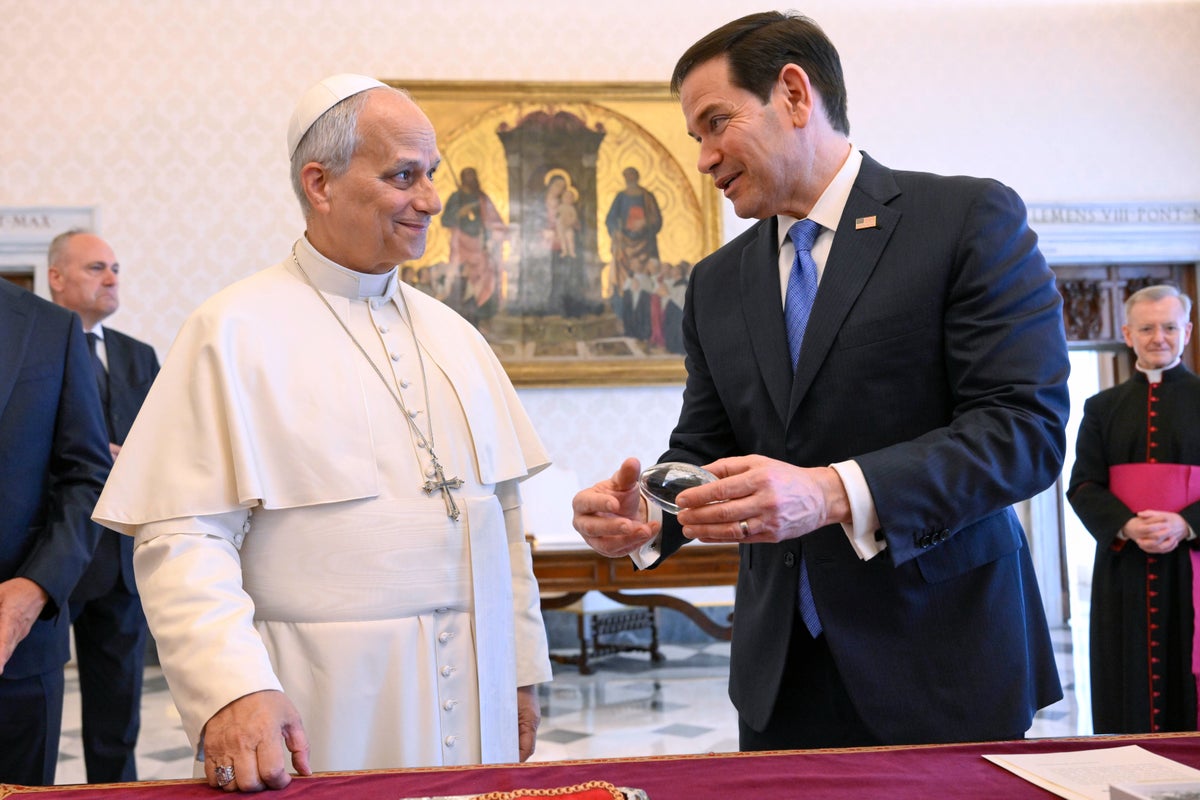
The Punditry Trap
Political commentators love a good grudge match. They see Marco Rubio walking through the Apostolic Palace and immediately start counting scorecards. The narrative is always the same: Rubio is the "bridge builder," the "moderate whisperer," or the guy trying to smooth over the jagged edges of a populist's feud with the Holy See.
It’s a neat, tidy story. It’s also completely wrong. Building on this theme, you can also read: The Germany Withdrawal Gamble and the End of the Atlantic Shield.
The mainstream media is obsessed with the surface-level friction between high-profile politicians and the papacy. They treat the Vatican like a typical diplomatic stop, a place to snap a photo and issue a press release about "shared values." But focusing on the personality clash between a former president and a reigning pontiff misses the structural reality of how power actually operates between D.C. and Rome. Rubio isn't there to apologize for anyone. He’s there because he understands that the Catholic vote isn't a monolith—it's a battlefield.
Stop Treating the Vatican Like a PR Firm
Most articles on this meeting dwell on the "tension." They frame Rubio’s visit as an attempt to "reconcile" two warring factions. This is a fundamental misunderstanding of Catholic geopolitics. The Vatican operates on a timeline of centuries, not news cycles. They don't care about a "feud" that will be a footnote in ten years. Observers at Al Jazeera have provided expertise on this trend.
Rubio’s presence in Rome is about continuity of influence, not damage control. While the talking heads focus on the optics of the "massive feud," the actual work happens in the quiet hallways where policy on Latin American stability, human rights, and religious freedom is hammered out.
The "lazy consensus" suggests that a politician must choose between their party leader and their faith leader. It’s a false binary. In reality, effective operators use the friction between these two poles to create their own gravity. Rubio isn't a mediator; he’s an independent actor building a resume that transcends any single administration.
The Math of the Catholic Voter
Let’s look at the numbers people ignore. We aren't talking about a single "Catholic block." We are talking about:
- The Traditionalists: Who often find themselves more aligned with conservative political movements than with the current resident of the Santa Marta.
- The Social Justice Wing: Who view the papacy as a mandate for radical economic change.
- The Cultural Catholics: Who show up on Ash Wednesday and vote based on local economic factors.
The media paints the Pope as the ultimate influencer for all three groups. He isn't. Data shows that for many American Catholics, political identity has become the primary lens through which they view their faith, not the other way around. Rubio knows this. He isn't there to get the Pope's "permission" to be a conservative; he’s there to signal to the voters back home that he is the serious adult in the room who can navigate both worlds.
The Counter-Intuitive Truth About the Feud
Everyone thinks the Trump-Pope tension is a liability for the GOP. It isn't. It’s a branding opportunity.
When a populist leader pushes back against the Vatican, it reinforces their "outsider" status to a base that is increasingly skeptical of all global institutions—including the hierarchy of the Church. Rubio’s role isn't to end the feud, but to provide a parallel track.
I have seen political consultants spin their wheels trying to "fix" religious optics. They fail because they try to make the politician look like a saint. The smarter move—the one Rubio is executing—is to look like a statesman. A statesman can disagree with a leader's rhetoric while still doing business with their office.
The Latin America Factor
This isn't just about domestic votes. Rubio’s specific interest in Cuba, Venezuela, and Nicaragua makes the Vatican an essential partner. The Church is often the only institution left standing in failing states.
If you want to move the needle on Western Hemisphere policy, you don't go through the UN; you talk to the Nuncios. The "feud" makes for great headlines, but the "nitty-gritty" of statecraft requires Rubio to maintain these channels. He isn't being a "rebel" or a "loyalist." He’s being a realist.
Why the "Bridge Builder" Label is Insulting
Calling Rubio a "bridge" implies he is a passive structure for others to walk across. It strips him of agency. This meeting is an assertion of power. It says: "I can stand in the heart of the Church and the heart of the GOP simultaneously, and I don't need either to change for me to be effective."
The press wants a drama. They want a scene where the Pope scolds Rubio or where Rubio begs for a blessing on behalf of his party. Neither happened. What happened was a cold, calculated exchange of interests.
The Flawed Premise of "Religious Alignment"
We need to stop asking if a politician's platform "aligns" with the Gospel. It’s a trap question. No political platform in human history has ever fully aligned with any major religion's core texts.
- Left-wing politicians ignore the Church’s stance on life and traditional structure.
- Right-wing politicians ignore the Church’s stance on capital punishment and radical hospitality for migrants.
The "contrarian" take here is simple: Hypocrisy is the baseline of political engagement with religion. Instead of pointing out the gaps, we should be looking at how those gaps are utilized. Rubio uses the gap between his party’s immigration stance and the Pope’s rhetoric to highlight his own focus on "ordered liberty." He isn't trying to close the gap; he’s living in it. That’s where the power is.
The Intellectual Lazy Way Out
The easiest thing for a journalist to do is write about "clashing titans." It requires no deep knowledge of canon law, no understanding of the Roman Curia, and no grasp of the shifting demographics of the American South.
If you want to understand the Rubio-Vatican dynamic, stop reading about the "feud." Start reading about the Subsidiarity Principle. This is the Catholic social teaching that matters are should be handled by the smallest, lowest, or least centralized competent authority. Conservative Catholics use this principle to justify smaller government, even when the Pope calls for more global cooperation.
Rubio isn't at the Vatican to listen to a lecture on globalism. He’s there to represent a specific, Americanized version of Catholicism that prioritizes the individual and the family over the global collective. He’s not a student in that room; he’s a rival philosopher.
Stop Looking for a Winner
In the battle between the Pope and the Populist, the media wants to declare a victor. They want to see who "blinked" first.
The reality is that both sides benefit from the friction. The Pope gets to assert his moral authority against a world-leading power. The populist gets to show his base he won't be intimidated by "global elites." And Rubio? Rubio gets to be the only person who can talk to both.
He isn't fixing a problem. He’s exploiting a division to ensure his own relevance in a post-feud world.
If you’re waiting for a "reconciliation" or a "triumph," you’re watching the wrong show. This is about the cold, hard maintenance of influence in an era where institutional loyalty is dead. Rubio knows the institution is crumbling, so he’s making sure he’s the one holding the keys to the exit.
The Vatican isn't a cathedral in this scenario. It’s a boardroom. And Rubio just walked in with the biggest stack of chips.
The feud isn't a hurdle. It’s the fuel.


