The sky over the San Francisco Bay Area is about to get significantly more crowded as Walmart and Alphabet-owned Wing prepare to launch a massive drone delivery offensive. After years of quiet testing and regional pilot programs in the Sun Belt, the partnership is moving into Google’s own backyard to prove that autonomous flight can survive the logistical nightmare of a dense, high-traffic coastal metro. This isn't just a trial for a few tech enthusiasts in Mountain View; it is the first major step in a 2026 expansion that aims to put 150 more Walmart stores on the flight map, targeting a footprint of 40 million Americans by the end of next year.
The move marks a shift from experimental "moonshots" to a hard-nosed retail infrastructure play. While previous drone headlines focused on the novelty of a flying burrito, the current reality is a calculated attempt to fix the broken economics of the last mile. Delivering a single bottle of ibuprofen or a dozen eggs via a two-ton van is a financial drain. Drones solve this by removing the driver, the traffic, and the fuel cost from the equation for small, high-urgency orders.
The Logistics of the Five Pound Limit
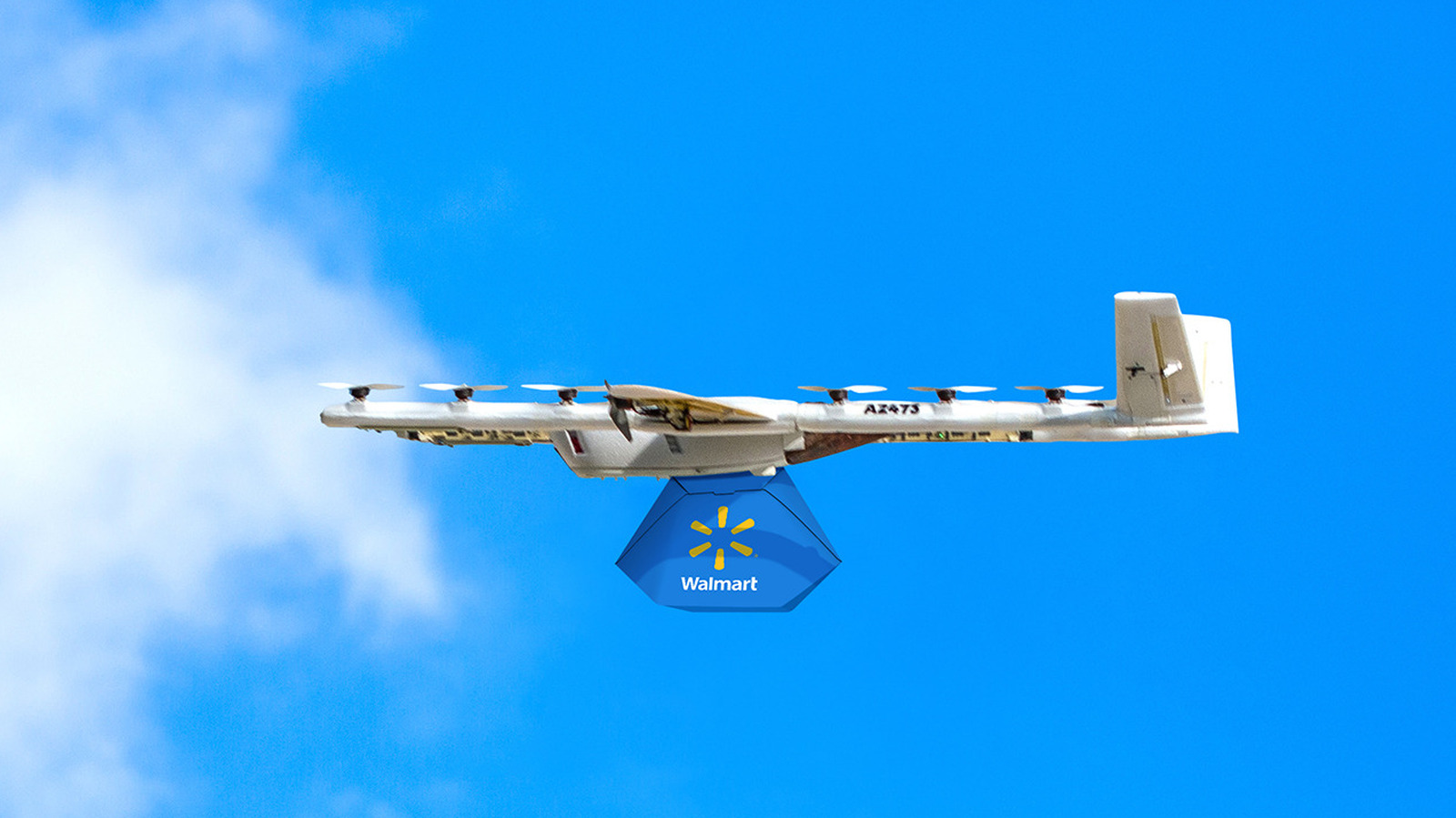
The engineering behind the Wing aircraft is a hybrid of fixed-wing efficiency and multi-rotor precision. These drones do not land at the customer's home. Instead, they hover at roughly 23 feet and lower a tethered package to a precise spot—a driveway or a backyard—before winching the line back up and returning to base.
It is a specialized tool for a specific problem. The current payload is capped at roughly five pounds. This weight limit fundamentally dictates what Walmart can sell through the air. You aren't getting a patio set or a bulk pack of bottled water delivered this way. Instead, the data from existing hubs in Dallas-Fort Worth and Atlanta shows that the "drone basket" consists of three primary categories:
- Emergency Ingredients: The single missing onion for a stew or a carton of milk.
- Health and Wellness: Over-the-counter medications, rapid tests, and baby supplies.
- Last-Minute Tech: Charging cables and batteries.
In the Dallas market, the top 25% of users have already integrated the service into their weekly routine, ordering an average of three times per week. This level of stickiness is exactly what Walmart needs to justify the capital expenditure of installing drone "nests" in Supercenter parking lots.
The Regulatory Breakthrough and the BVLOS Hurdle
The Bay Area expansion is happening now because the regulatory environment has finally thawed. For years, the Federal Aviation Administration (FAA) required "visual observers" to keep eyes on the aircraft at all times, a rule that effectively killed the cost-savings of automation.
The game changed with the broad implementation of Beyond Visual Line of Sight (BVLOS) authorizations. Wing now operates under FAA Part 135 certification, allowing a single pilot to oversee multiple autonomous flights from a remote operations center. In the Bay Area, this means drones can navigate around the micro-climates and complex terrain of the Peninsula and East Bay without a human standing on every street corner.
However, the "neighborhood vs. noise" battle remains the industry’s greatest existential threat. While Wing claims its aircraft are quieter than a standard leaf blower, the psychological impact of a persistent buzzing overhead is a different matter. In some early test markets, community pushback regarding privacy and acoustic "pollution" has been the primary barrier to 24/7 operations. If the service cannot win over the highly vocal residents of Palo Alto and Berkeley, the national rollout faces a significant PR bottleneck.
The Quiet Death of the DroneUp Partnership
To understand why the Alphabet partnership is so vital, one must look at Walmart's recent retreat from its other drone bets. Earlier this year, Walmart scaled back its involvement with DroneUp, a move that signaled a shift away from decentralized, multi-vendor experiments toward a more integrated, high-tech approach with Alphabet.
Wing’s technology is inherently more automated and designed for higher throughput. Unlike earlier iterations that required more manual intervention, Wing’s software handles the routing and collision avoidance with minimal human oversight. This efficiency is the only way to reach the 270-store goal Walmart has set for 2027.
Weather and the Reliability Gap
The Bay Area presents a unique challenge that the sunny suburbs of North Texas did not: the marine layer. High winds and heavy fog can still ground these lightweight aircraft. While the 2026-model drones have improved sensors for flying in light rain and mist, they are still fair-weather machines.
A delivery service that only works 85% of the time is a difficult sell for a consumer who needs a fever reducer at 9:00 PM on a rainy Tuesday. For Walmart, the drone is not a replacement for the van, but a high-speed relief valve for the logistics network.
The expansion into San Francisco and its surrounding cities will be the ultimate test of whether the "convince and convenience" model can scale. If the drones can navigate the fog and the local zoning boards, the 40-million-customer target becomes a reality rather than a projection.
Check your address on the Wing app to see if your neighborhood is slated for the initial Bay Area flight paths.