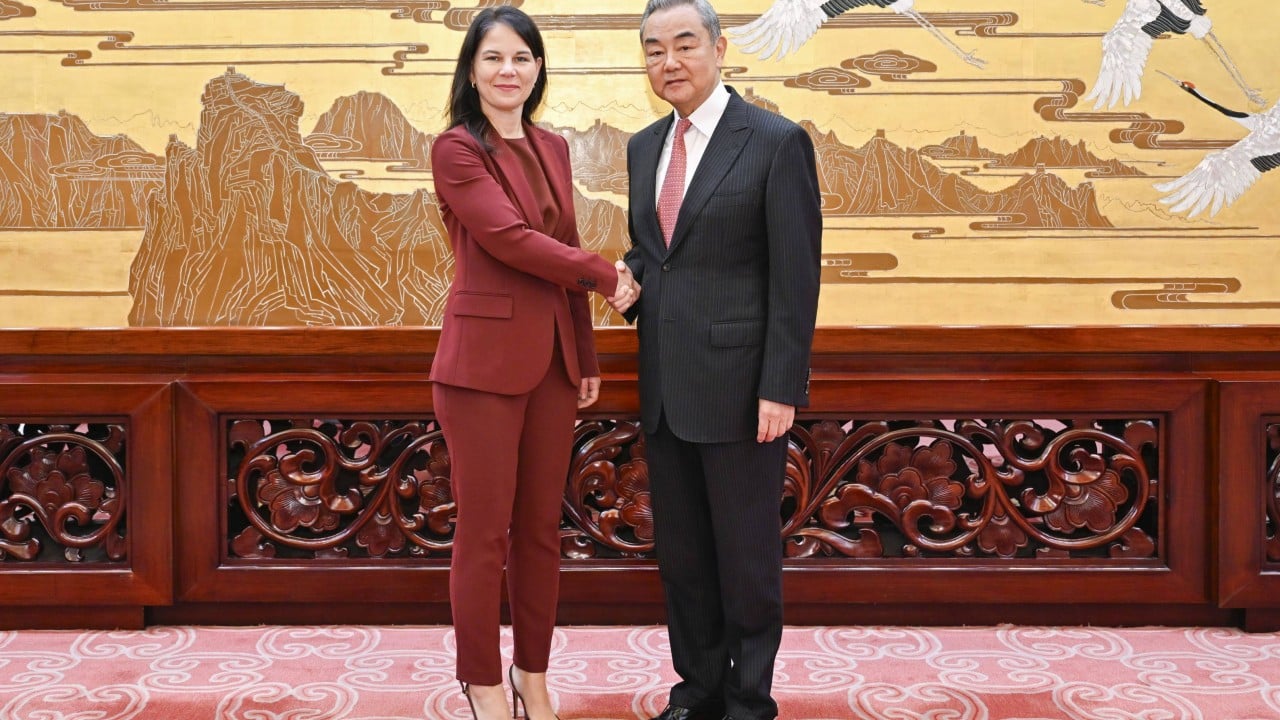
The collision between Chinese Foreign Minister Wang Yi and German Foreign Minister Annalena Baerbock at the United Nations was not a simple diplomatic disagreement. It was a fundamental clash over who gets to define justice on a global scale. When Wang Yi warned that "might over right" is imperiling international justice, he was not merely defending small nations. He was signaling a systemic pivot in how Beijing intends to bypass Western-led legal frameworks. This is not about a sudden devotion to the rule of law; it is about a calculated effort to redefine "right" to mean "state sovereignty" rather than "universal human rights."
The Sovereignty Shield
For decades, the post-Cold War era operated on the assumption that international law could occasionally pierce the veil of national borders. This was the era of the "Responsibility to Protect." Wang Yi’s recent statements represent the final nail in that coffin. By framing the current state of international justice as a victim of Western "might," Beijing is constructing a defensive wall that prioritizes the absolute authority of the state over any external legal or moral oversight.
This strategy works because it appeals to the Global South. Many nations in Southeast Asia, Africa, and Latin America have legitimate grievances regarding the selective application of international law by Western powers. When Wang Yi speaks of "might over right," he is tapping into a deep-seated resentment toward what many see as the "rules-based international order"—a system where the rules are written in Washington and Brussels but enforced elsewhere.
However, the Chinese interpretation of "right" is essentially a return to a strict Westphalian system. In this view, a state's internal actions are beyond the reach of international courts. This is a direct challenge to the International Criminal Court (ICC) and various UN human rights bodies. If Wang’s vision prevails, international justice becomes a series of bilateral handshakes rather than a set of enforceable universal standards.
Germany and the Defense of Liberal Institutions
Annalena Baerbock’s position represents the increasingly fragile consensus of the European Union. Germany has tied its post-WWII identity to the strength of international institutions. For Baerbock, the "right" in "might over right" refers to the UN Charter and the Geneva Conventions. She views these not as tools of Western power, but as the only things standing between the world and a return to raw, imperialistic land grabs.
The friction in the room during their meeting was palpable. Germany sees China’s support for Russia—however "neutral" it is framed—as a direct violation of the very principles Wang Yi claims to defend. You cannot talk about the sanctity of international justice while providing the economic and dual-use technological lifeline to a country actively redrawing borders by force. This hypocrisy is the central tension of modern diplomacy.
The Weaponization of Double Standards
Wang Yi’s most effective weapon is the charge of inconsistency. It is a tactic he uses with surgical precision. By highlighting instances where Western powers have ignored international law—such as the invasion of Iraq or certain aspects of the conflict in Gaza—he creates a vacuum of moral authority.
When the West loses its moral high ground, the "right" becomes whatever the strongest local power says it is. This is the "might" that Wang Yi is actually building. By dismantling the idea that there is a single, objective standard of justice, China clears a path for a multipolar world where power centers dictate the law within their own spheres of influence.
The Mechanics of the Multipolar Legal Push
China is not just talking; it is building. We are seeing the rise of alternative dispute resolution forums and regional security architectures that bypass traditional Western-dominated channels.
- The Global Security Initiative (GSI): This is Beijing’s blueprint for a world where security is "indivisible," a term that effectively gives major powers a veto over the security arrangements of their neighbors.
- Expansion of the BRICS: By growing this bloc, China is creating a critical mass of nations that agree on one thing: the current international financial and legal systems need to be overhauled.
- Legal Warfare (Lawfare): Beijing has become adept at using the language of international law to justify its claims in the South China Sea, even when those claims are explicitly rejected by international tribunals like the Permanent Court of Arbitration in The Hague.
Wang Yi’s rhetoric at the UN serves as the intellectual packaging for this expansion. It provides a "just" veneer for the pursuit of national interest. It suggests that China is the true guardian of the UN Charter, while the West is its primary transgressor.
The Erosion of Universalism
The real casualty in this rhetorical war is the concept of universalism. If justice is merely a reflection of a nation's power or its specific cultural context, then universal human rights cease to exist. They become "Western values" that are being "forced" on the rest of the world.
Baerbock’s challenge is that she is defending a system that is, in fact, flawed and often applied inconsistently. However, the alternative offered by Wang Yi is not a more consistent application of law, but a world where the law is subordinate to the state. In this framework, "justice" is whatever maintains the stability of the ruling party.
The Economic Leverage Behind the Law
We cannot ignore the role of the Belt and Road Initiative (BRI) in this legal restructuring. Nations heavily indebted to Chinese state banks are far less likely to vote against Chinese interests in the UN General Assembly or the Human Rights Council.
Economic power creates its own kind of "right." When a country depends on Beijing for its 5G infrastructure, its rail lines, and its port management, its definition of international justice begins to align with Beijing’s. Wang Yi knows that he does not need to win an argument in a courtroom if he has already won the argument in the treasury.
The Future of the United Nations
The UN is currently a house divided against itself. One side, led by the US and the EU, wants to strengthen the UN's ability to intervene and punish violations of international law. The other side, led by China and Russia, wants to return the UN to its origins as a consultative body that protects the absolute sovereignty of its members.
Wang Yi’s meeting with Baerbock was a microcosm of this struggle. There was no middle ground to be found because they were using the same words to describe completely different realities. When Wang Yi says "international justice," he means a world where no one can tell China what to do. When Baerbock says it, she means a world where China must follow the same rules as everyone else.
The Hard Truth of Global Diplomacy
The uncomfortable reality is that "might" has always played a role in "right." The international order was built by the victors of 1945. What we are witnessing now is the emergence of a new power that no longer feels obligated to honor the terms of that old victory.
China is not trying to destroy international law; it is trying to perform a hostile takeover of it. By positioning itself as the defender of the "oppressed" nations against "Western hegemony," Beijing is attempting to rewrite the global rulebook in its own image. This is a sophisticated, long-term play that uses the language of the UN to undermine the spirit of the UN.
The battle for international justice is moving out of the courtrooms and into the realm of narrative control. If Beijing can convince the majority of the world that the West is the true threat to justice, the actual substance of the law becomes irrelevant. Power becomes the only law that matters, and in that world, Wang Yi’s warning about "might over right" becomes a self-fulfilling prophecy orchestrated by the very person delivering it.
The Western response has largely been to preach about values. But values without the backing of consistent action and economic partnership are failing to move the needle in the Global South. As long as there is a gap between Western rhetoric and Western action, Wang Yi will continue to find a receptive audience for his version of justice. This is not a debate over legal technicalities; it is a fight for the moral architecture of the next century.
The current trajectory suggests a fragmentation of the global legal order. We are moving toward a world of "legal blocs," where justice is defined differently depending on which trade zone you inhabit. This fragmentation does not protect the weak from the strong. It simply ensures that the strong can exercise their might without the inconvenience of a universal moral standard.
Nations are being forced to choose between a flawed universalism and a stable authoritarianism. The middle ground is disappearing. International law, once envisioned as a shield for the vulnerable, is being forged into a sword for the powerful.