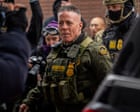
The desert doesn’t care about politics. It doesn’t have a stance on sovereignty or a philosophy on human rights. It only knows how to be indifferent. When you stand on the edge of the brush in the Rio Grande Valley, the silence is so heavy it feels physical. It’s a dry, crackling heat that tastes like copper and old wood. For a man who spent decades trying to hold back the tide of a shifting world, that silence is the hardest part to stomach.
Raul Ortiz sat in the quiet of his post-retirement life, looking back at a career defined by the pursuit of an impossible math. In the world of border security, success is a ghost. You can measure the people you caught. You can count the pounds of fentanyl stacked like cordwood in an evidence locker. But you can never truly account for the ones who slipped through the mesquite, the ones who vanished into the vast, humming arteries of the American interior.
"I wish I’d caught more," he said, reflecting on his exit. It sounds like a cold statement. To some, it sounds like a provocation. But if you look at the calloused reality of the job, it’s the lament of a craftsman who realizes the dam he was building was never going to be high enough.
The job of a Border Patrol Chief isn't just about badges and sensors. It is about managing a pressure cooker that spans two hemispheres. Consider a hypothetical agent named Miller. Miller isn't a politician. He’s a guy with a gallon of lukewarm water, a dusty Ford F-150, and a section of fence that feels like it’s a thousand miles long. When Miller spots a group of twenty people emerging from the scrub—mothers holding toddlers, young men with eyes hollowed out by three weeks of walking—he isn't thinking about the national GDP. He is thinking about the logistics of human survival and the breakdown of a system that wasn't designed for this volume.
The numbers aren't just digits on a spreadsheet. They are a relentless, rhythmic pulse. In recent years, the encounters at the southern border spiked into the millions. To the public, these are "flows" or "surges." To the men and women in the olive-drab uniforms, they are a series of individual crises. Every person not caught is a variable lost. Every person who evades detection is a potential tragedy—either for the community they enter or for themselves, lost to the heat of a ranch in Brooks County where the cell service dies and the vultures circle.
Ortiz’s defense of his record isn't a claim of perfection. It’s an admission of the sheer scale of the struggle. He inherited a machine that was being asked to do the work of a surgeon with the tools of a construction worker. The Border Patrol was built to catch single men looking for seasonal work in the 1990s. It was not built to be a massive processing center for global migration, a sanctuary for the displaced, and a frontline defense against a chemical warfare crisis in the form of synthetic opioids.
Fentanyl changed the stakes. This isn't the marijuana of the seventies or the cocaine of the eighties. This is a substance so potent that a handful of it can quiet a mid-sized city forever. When a Chief says he wishes he caught more, he is thinking about the blue pills that didn't get seized. He is thinking about the parents in Ohio or Oregon who will wake up to a house that is too quiet because a shipment moved through a blind spot while his agents were busy changing diapers and processing asylum paperwork for five hundred people at once.
The frustration is visceral. Imagine trying to guard a door while also being required to act as a social worker, a medic, and a clerk. The focus shifts. The line thins. The "gotaways"—that haunting term for those detected but not apprehended—become the metric of failure that keeps a leader awake.
Critics point to the optics. They see the uniforms and the steel and they see an ideology. But the people on the ground see a breakdown of physics. There is only so much space. There are only so many hours in a shift. When the policy in Washington fluctuates like a fever dream, the man in the dirt is the one who feels the chill. Ortiz’s tenure was marked by this constant whiplash. One day the mandate is deterrence; the next, it’s humanitarian processing. The mission becomes a blur.
The human element extends to the agents themselves. There is a specific kind of exhaustion that comes from doing a job where the goalposts move every four years. Suicide rates among those who patrol the border have historically outpaced almost every other branch of federal law enforcement. You are the villain in one narrative and the failed hero in another. You are the wall, and yet you are porous.
Let’s look at the reality of the "invisible stakes." When a border is overwhelmed, it isn't just about who comes in. It’s about the collapse of the rule of law as a concept. If a border is a suggestion rather than a boundary, the very idea of a sovereign state begins to fray at the edges. This isn't a "far-right" talking point or a "progressive" critique; it’s a fundamental observation of how societies function. A country without a defined edge is a house without walls. You can be the most welcoming host in the world, but you still need to know who is sitting at your table.
Ortiz stepped away from the noise, but the noise followed him. He defended his record because, in his mind, the men and women under his command performed a miracle every day just by keeping the system from total a collapse. They caught millions. They saved thousands of lives from the river and the brush. They seized enough poison to kill the population of the planet several times over.
Yet, the "more" haunts him.
That "more" is the ghost in the room. It’s the truck that wasn't searched. It’s the canyon that wasn't monitored because the sensors were down or the personnel were diverted. It’s the realization that while we argue over the semantics of "illegal alien" versus "undocumented migrant," the actual physical reality of the border remains a raw, bleeding wound of human desperation and criminal opportunism.
The cartels are the only ones who don't have an identity crisis. They are cold, efficient, and better funded than many small nations. They use the human surge as a tactical diversion. They send a wave of families into one sector to draw the agents away, then they run the high-value cargo through the gap. It’s a shell game played with human lives. To be the one tasked with winning that game, while your hands are tied by shifting legal interpretations and a lack of resources, is a recipe for a specific kind of bitterness.
The sun sets over the scrubland, turning the dust into a golden haze that looks almost beautiful if you don't know what it’s hiding. The trail of a discarded water bottle, a single shoe, a scrap of a backpack—these are the breadcrumbs of a journey that doesn't always have a destination.
We talk about the border as a political theater, a stage where candidates go to wear outdoor vests and point at the horizon. But for those who lived it, it’s a place of heavy choices. Do you chase the runner, or do you perform CPR on the child who just pulled out of the Rio Grande? Do you secure the perimeter, or do you spend your day inputting data into a computer system that crashed three hours ago?
Ortiz’s legacy isn't found in a press release. It’s found in the tension between the duty he felt and the reality he faced. He left the post not with a victory lap, but with the heavy, honest admission of a man who knows that in the battle between a line in the sand and the sheer force of human will, the line is always at a disadvantage.
The wind picks up, erasing footprints as fast as they are made. The border remains—a jagged, complicated, and deeply human scar across the earth. It demands more than we are willing to give it, and it takes more than we are willing to lose.
Deep in the brush, a sensor trips. A light flashes on a console miles away. Somewhere, an agent sighs, puts on their hat, and heads back out into the dark, chasing a shadow they know they might never catch.