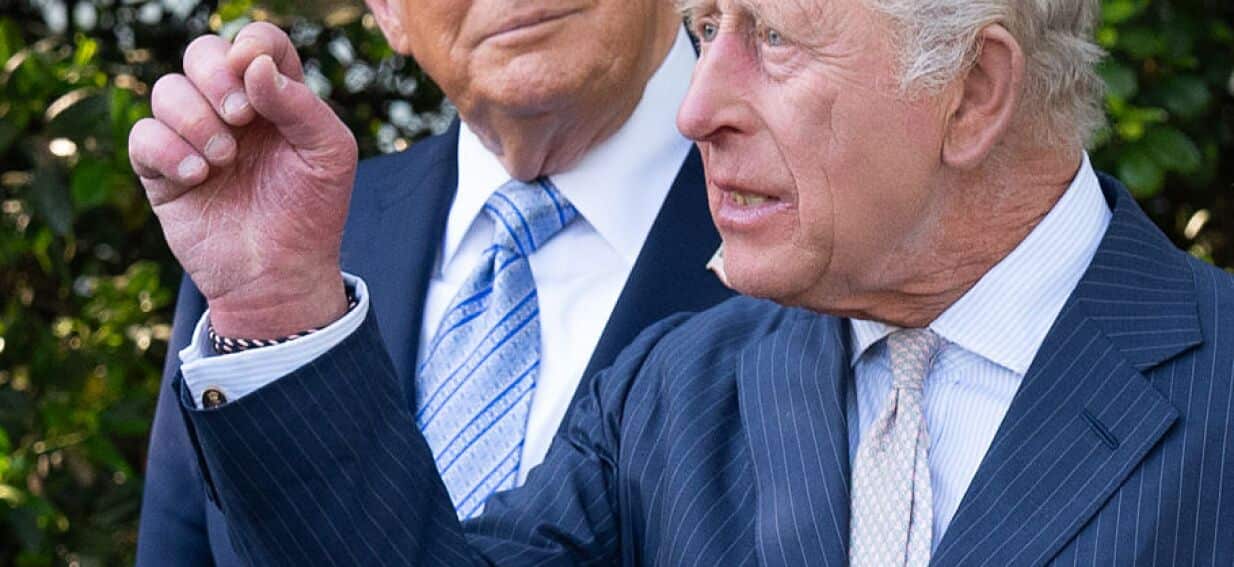
Donald Trump and King Charles III have spent the last forty-eight hours rewriting the rules of the "Special Relationship" in real time. While official diplomatic channels between Washington and London are currently frozen by disputes over the war in Iran and the status of the Chagos Islands, the two men have bypassed the bureaucracy to stage what the White House has branded a meeting of "Two Kings." It is a calculated piece of theater designed to project stability at a moment when the traditional alliances of the Western world are fraying.
The optics are unmistakable. By welcoming the British monarch for a four-day state visit that includes the first-ever state dinner in his newly built ballroom—constructed after he ordered the demolition of the East Wing—Trump is signaling that he values personal lineage over institutional protocol. This isn't just about tea on the South Lawn; it is a strategic bypass of Prime Minister Keir Starmer, whom Trump has publicly mocked as "no Winston Churchill."
The Diplomacy of the Ballroom
Behind the gold-trimmed curtains and the 21-gun salutes, a more complex game is being played. King Charles is the first British sovereign to address the U.S. Congress since 1991, and he did so while walking a razor-thin line. His speech, delivered on Tuesday, was a masterpiece of royal subtext. He spoke of the dangers of "inward-looking" policies and "isolationism," a clear but veiled critique of the "America First" agenda.
Yet, for every subtle warning from the King, there was a public embrace from the President. Trump’s decision to post a photo of the two men with the caption "TWO KINGS" is more than just a flourish of ego. It serves a specific political purpose: it validates Trump’s standing as a world leader who deals only with equals, while simultaneously framing the British monarchy as the true partner of the United States, rather than the elected government in Downing Street.
The Iran Divide
The central tension of this visit is the ongoing conflict in Iran. Trump has spent months lambasting the UK for its refusal to commit ground troops to the offensive, at one point suggesting that Washington might review its support for British claims to the Falkland Islands as a result. By hosting the King with such fervor, Trump is effectively isolating Starmer. He is showing the British public that he loves their King while loathing their Prime Minister.
This creates a massive headache for the Foreign Office. Usually, a royal visit is a tool of "soft power" used to smooth over policy differences. In this instance, the "soft power" is being weaponized by the host. When the King spoke about the "unbreakable bond" between the two nations, he was trying to preserve a century of cooperation. When Trump called him a "fantastic person" and a "friend," he was making sure that if the relationship breaks, the blame lands squarely on the politicians, not the figureheads.
The Environmental Elephant
It is no secret that the two men occupy different universes regarding climate change. Charles has spent decades advocating for nature conservation; Trump has spent his career dismantling environmental regulations. During the tour of the White House grounds, which now features a massive new beehive near the kitchen garden, the contrast was on full display.
Republican lawmakers remained largely silent during the environmental portions of the King’s Congressional address. However, the King’s focus on "safeguarding nature" as a security issue—rather than just a moral one—showed his evolution. He is no longer just talking about organic farming; he is framing the environment as a "precious asset" that requires the same defense as a national border.
A Monarch Under Pressure
This visit comes at a personal cost for the House of Windsor. The King, now 77 and continuing his recovery from cancer, is being asked to do the heavy lifting that the diplomats cannot. He is also operating under the long shadow of the Jeffrey Epstein scandal, which continues to haunt his brother, Prince Andrew. For Charles, the trip is a grueling endurance test intended to prove that the monarchy is still relevant in a world dominated by populist giants.
The "Two Kings" narrative serves Trump’s domestic agenda perfectly. It counters the "No Kings" protests that have followed his administration and provides a visual of high-status legitimacy that no legislative win could match. For Charles, it is a gamble. By leaning into the "Two Kings" branding, he risks being seen as an accessory to Trump’s political brand, potentially alienating the half of the UK that remains skeptical of the current U.S. administration.
The Final Exchange
As the King and Queen Camilla prepare to depart for New York to lay a wreath at the September 11 memorial, the balance sheet of this visit remains in flux. Trump has successfully used the monarchy to bypass a hostile Prime Minister. Charles has successfully used the White House to deliver a message of internationalism directly to the American people.
The "Special Relationship" hasn't been fixed, but it has been rebranded. It is no longer a partnership of two governments, but a pact between two men who believe they are the only ones capable of holding their respective worlds together. The fallout from this shift will be felt the moment the King’s plane leaves American airspace and the reality of the Iran conflict returns to the front page.
Buckingham Palace calls it diplomacy. The White House calls it a celebration. The rest of the world calls it a warning.