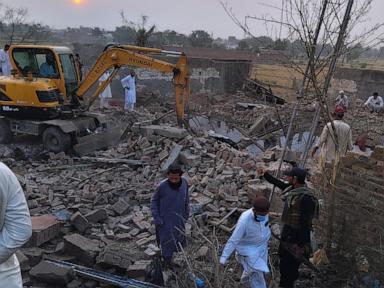
The tea was still warm when the earth shook. In the North Waziristan district of Pakistan, the morning ritual usually involves the sharp scent of cardamom and the low hum of distant trucks navigating the jagged mountain passes. But on this particular morning, the silence was shattered by a sound that has become a recurring nightmare for those stationed along the Durand Line.
Fifteen men. They weren’t just statistics on a government ledger or names in a diplomatic protest. They were sons who sent money home to villages in Punjab, fathers who promised to be back for the next harvest, and brothers who joked about the cold mountain air to mask the underlying tension of their posts. When the suicide bomber detonated his vest near their checkpoint, those lives were extinguished in a flash of heat and cordite. For an alternative perspective, see: this related article.
The immediate aftermath is a familiar, grisly choreography. There is the frantic call for medics. The sirens. The heavy silence of the morgue. But beyond the physical carnage lies a deeper, more corrosive wound: the fraying of a relationship between two neighbors who share a language, a faith, and a border that neither can truly control.
The Message in the Rubble
Pakistan did not wait for the dust to settle before sending a formal, stinging protest to the interim Afghan government in Kabul. The diplomatic note was more than a procedural requirement. It was a scream across the mountains. The message was clear: the attackers came from your side, they were harbored on your soil, and your inaction is killing our people. Related coverage on this trend has been shared by Associated Press.
For years, the border regions have functioned as a gray zone. This isn't a line on a map drawn with precision; it is a sprawling, porous expanse of limestone and scrub where militants move like ghosts through the mist. Pakistan’s claim is specific and weary. They point to the Tehrik-i-Taliban Pakistan (TTP) using Afghan sanctuaries to plan, train, and execute strikes.
Consider the logistical reality of such an attack. A suicide vest requires components. It requires a handler. It requires a safe house where a young man can be convinced that his life is worth less than the devastation he can cause. When Islamabad looks across the border, they don't see a sovereign neighbor struggling with internal chaos; they see a backyard being used by their worst enemies.
The Invisible Stakes of a Broken Promise
When the Taliban took Kabul in 2021, there was a tentative, perhaps naive, hope in some circles that cross-border militancy would subside. The logic was simple: a stable Afghanistan would have no interest in regional instability. That hope has evaporated.
The TTP has grown bolder. The attacks have become more frequent. The fifteen officers lost in this latest strike are part of a rising tide of violence that has seen hundreds of security personnel killed over the last twenty-four months. This isn't just a security failure; it’s a psychological war. Every time a checkpoint is hit, the message sent to the local population is that the state cannot protect its own.
The Afghan authorities usually respond with a mix of denial and deflection. They talk about internal security and their own battles with rival factions. But for the families of the fifteen officers, these diplomatic nuances are meaningless. They see a gate left open. They see a neighbor who looks the other way while a fire spreads.
A Geography of Grief
Imagine standing at the funeral of one of these men. The village is likely far from the border, tucked away in a quiet corner of the country where the war feels like something on the television—until the coffin arrives. The community gathers. There is no political debate here. There is only the weight of a wooden box and the wail of a mother who doesn't care about diplomatic protests or the intricacies of the TTP's command structure.
This is where the "dry facts" of a news report fail to capture the reality. A news ticker says "15 killed." A village says "our future is gone."
The tension is exacerbated by the fence. Pakistan has spent billions of dollars and years of labor erecting a massive chain-link and barbed-wire barrier along the 2,600-kilometer border. It was supposed to be the solution. It was meant to turn a fluid frontier into a hard wall. Yet, as this latest attack proves, fences are only as strong as the political will on either side of them. You can't fence out an ideology, and you certainly can't fence out a neighbor's indifference.
The Cycle of the Protest Note
The ritual of the protest note is becoming a grim tradition. Pakistan summons the Afghan charge d'affaires. The grievances are read. The evidence is presented. The demand for "decisive action" is issued. Then, the world waits for the next explosion.
The real problem lies in the disconnect between Kabul’s rhetoric and the reality on the ground. The Afghan Taliban are ideologically linked to many of the groups striking inside Pakistan. Expecting them to move forcefully against their former brothers-in-arms is like asking a man to cut off his own hand to stop a neighbor's house from burning. It is a fundamental conflict of interest that leaves Islamabad with few good options.
If diplomacy fails, what remains? There have been hints of more aggressive postures—intelligence-based operations, perhaps even cross-border strikes. But those carry the risk of a full-scale conflagration that neither nation can afford. Both economies are brittle. Both populations are tired.
Beyond the Cordite
As the sun sets over the Khyber Pass, the checkpoints are reinforced. The soldiers who remain on duty watch the ridgelines with narrowed eyes. They know that the protest sent to Kabul won't stop a bullet or intercept a shrapnel-filled vest.
The tragedy of the fifteen officers isn't just that they died; it’s that their deaths were entirely predictable. They are pawns in a long-standing geopolitical game where the rules are written in blood and the winners are never the ones standing at the border.
The tea in the cups has gone cold. The mountains remain silent, holding the secrets of the men who move through them in the dark, while the families of the fallen are left to wonder if the next protest note will be the one that finally brings a different kind of quiet.
In the end, a border is just a line. But when that line is soaked in the blood of fifteen men who were just trying to make it to their next shift, it becomes a canyon that no amount of diplomacy can easily bridge. The grief doesn't stay at the border; it travels home, settling into the bones of a nation that is running out of patience and out of sons.