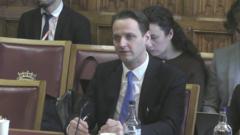
It happened during a routine session in the House of Commons. A government minister sat there, momentarily stunned by a question that should’ve been a breeze for anyone representing the capital’s interests. How tall is the London Eye? The silence that followed wasn't just a lapse in memory. It was a perfect microcosm of how disconnected policy-makers can sometimes be from the very landmarks that define the British skyline and tourism economy.
You’d think 135 meters is a number burned into the brain of every official in the Department for Culture, Media and Sport. It isn't. You might also find this connected coverage interesting: Strategic Asymmetry and the Kinetic Deconstruction of Iranian Integrated Air Defense.
The London Eye isn't just a big wheel. It's a massive feat of engineering that changed how we view urban planning. When it opened in 2000, it was the tallest cantilevered observation wheel in the world. People often confuse "cantilevered" with just being a "Ferris wheel." The distinction matters. A traditional Ferris wheel is supported on both sides. The Eye is supported by an A-frame on one side only, allowing it to hang over the River Thames.
The actual scale of the South Bank giant
Let’s get the hard numbers out of the way so you’re never caught off guard like a flustered MP. The London Eye stands exactly 135 meters tall. In imperial measurements, that’s about 443 feet. To give you some perspective, that’s roughly the same as 64 London buses stacked on top of each other. As highlighted in detailed coverage by The Washington Post, the implications are worth noting.
It’s taller than Big Ben’s Elizabeth Tower, which reaches 96 meters. It used to be the highest point in London until the BT Tower and then The Shard came along to snatch the crown. Even if it isn't the tallest building anymore, its position on the South Bank makes it feel more imposing than the skyscrapers tucked away in the City or Canary Wharf.
The wheel has 32 capsules. There’s a bit of superstition involved here. They’re numbered 1 to 33, but they skipped number 13 for luck. Each capsule represents one of the 32 London boroughs. You can fit 25 people in each one, meaning the wheel carries 800 people per revolution. It moves at a walking pace—about 26 centimeters per second. It’s slow. It’s steady. It’s designed so you don't even have to stop the wheel for people to hop on and off.
Why ministers get these questions
Parliamentary questions often feel like a game of "gotcha." When an MP asks a minister about the height of a landmark or the price of a pint of milk, they aren't looking for data. They have Google. They’re testing for a connection to reality.
In this specific instance, the question about the London Eye's height was tied to a broader debate about planning permissions and the visual impact of new developments. If a minister doesn't know the height of the most famous observation wheel in the country, how can they make informed decisions about the "protected views" of St. Paul’s Cathedral or the heritage status of the South Bank?
Politics is often about optics. Failing to answer a question about a structure that draws over 3.5 million visitors a year looks bad. It suggests a lack of grip on the tourism sector, which contributes billions to the UK GDP. The Eye isn't just a tourist trap. It’s a symbol of "Cool Britannia" that somehow managed to stick around long after the Millennium Dome—now the O2—lost its original purpose.
Engineering secrets most people miss
The height is impressive, but the weight is staggering. The entire structure weighs 2,100 tonnes. The "spoke" cables that hold the wheel together are similar to the ones you see on suspension bridges. If you laid all the cable out in a straight line, it’d stretch from London to Windsor.
The way they built it was a logistical nightmare. They didn't build it standing up. They built it lying down on platforms in the river. Then, they had to pull it up into a vertical position. This process, called "The Big Lift," took several days and moved the structure at just 2 degrees per hour until it reached its final 65-degree angle.
Many people don't realize the Eye was originally only supposed to stay for five years. It was a temporary landmark. Because it became so popular so fast, Lambeth Council granted it a permanent license. It’s now a fixed part of the London identity, as much as the Tower of London or the red phone boxes that tourists still queue to use.
The tourism impact by the numbers
If you're looking at why this matters for the economy, consider the throughput.
- 3.5 million+ annual visitors.
- 30 minutes for one full rotation.
- 25 miles of visibility on a clear day (you can see Windsor Castle).
- £30 to £40 for a standard ticket, depending on when you book.
When a minister fumbles these details, they’re fumbling the stats of a major taxpayer. The London Eye has survived multiple owners, from British Airways to Merlin Entertainments. It’s been rebranded several times, but the physical reality of its 135-meter frame remains the constant anchor of the South Bank.
How to use this information next time
Don't just memorize the height. Understand the context. If you’re visiting or writing about London, the height tells you about the city’s evolution. We went from a city defined by church spires to a city defined by engineering marvels.
If you're planning a trip, go at sunset. The 135-meter vantage point hits differently when the lights of the Houses of Parliament kick in. You get a literal top-down view of the places where these ministers sit and argue about things they sometimes don't fully understand.
Next time you see a politician struggling with a "basic" fact, remember it’s usually because they’re focused on the brief and not the bridge. But for the rest of us, knowing the scale of our surroundings helps us appreciate the complexity of the cities we live in.
Check the weather before you book your tickets. High winds can actually cause the Eye to close for safety, though it takes a serious gale to move a 2,100-tonne bike wheel. Look for clear skies to ensure you actually get your money's worth of that 135-meter elevation. Book your slot online at least 48 hours in advance to avoid the massive queues that snake along the Thames.