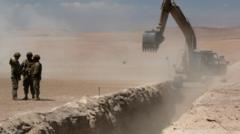
Gabriel Boric entered La Moneda promising a humane, rights-based approach to migration that would set Chile apart from the reactionary impulses of the global right. That vision lasted less than a week. Faced with a collapsing security situation in the northern provinces and a populist backlash that threatened to derail his entire legislative agenda, the youngest president in Chilean history pivotally shifted toward a policy of physical containment. The construction of border barriers and the deployment of military hardware to the Andean plateaus mark the end of the Latin American Left’s experiment with "open doors."
This is not merely a logistical response to a surge in arrivals. It is a fundamental reassessment of Chilean sovereignty in an era of failed states. The Colchane crossing, sitting at an altitude of over 12,000 feet, has become the focal point of a crisis that the previous administration ignored and the current one is now forced to militarize. By erecting physical obstacles and deepening trenches along the Bolivian frontier, Boric is attempting to reclaim the narrative of "order" from his conservative rivals.
The Colchane Pressure Valve
For years, the small village of Colchane served as a quiet outpost. Now, it is the primary entry point for thousands of Venezuelans, Colombians, and Haitians who have trekked across the Atacama Desert. The geography is lethal. Temperatures swing from scorching sun to sub-zero winds in a matter of hours. When Boric took office, the expectation among his base was a dismantling of the "State of Exception" inherited from Sebastián Piñera. Instead, the reality of local governance intervened.
Northern mayors, many of them politically aligned with the President, sounded the alarm. They reported that local clinics were overwhelmed, public spaces were occupied by makeshift camps, and a new, more violent brand of transnational crime was following the migration routes. The Tren de Aragua, a Venezuelan mega-gang, began establishing cells in the north, using the porous border to move drugs, weapons, and people. Boric’s decision to build barriers is a direct response to this specific security vacuum.
The barrier is not a wall in the North American sense. It is a sophisticated network of expanded trenches, thermal surveillance towers, and reinforced fencing designed to funnel human traffic toward official checkpoints. The goal is documentation. In the eyes of the current Ministry of Interior, a migrant who is "unseen" is a migrant who cannot be integrated or monitored. By forcing the flow through specific gates, the government hopes to strip the "coyotes" (human smugglers) of their business model.
The Failure of Regional Diplomacy
Chile’s hardening stance is a symptom of a much larger breakdown in South American cooperation. For decades, the region prided itself on the "Patria Grande" philosophy—the idea of a borderless continent with shared destiny. That ideal has shattered against the reality of the Venezuelan exodus, which has seen over seven million people flee their homes.
Santiago has tried to negotiate with La Paz to facilitate reconductions—the process of sending undocumented arrivals back across the border. Bolivia has largely refused to cooperate. This diplomatic stalemate left Boric with two choices: allow the northern border to remain a chaotic free-for-all or invest in the infrastructure of exclusion. He chose the latter. This move signals to the rest of the continent that Chile’s patience with "regional solidarity" has reached its limit.
The Military Dilemma
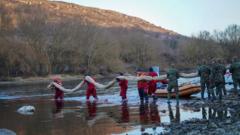
Deploying the Army to the border was a move Boric once criticized as a deputy. Now, as Commander-in-Chief, he is relying on the military to provide the logistics that the Carabineros (national police) simply cannot handle. The Army brings satellite communication, heavy earth-moving equipment, and long-range optics. However, the presence of soldiers at the frontier creates a new set of risks.
The Rules of Engagement (ROE) in these high-altitude zones are notoriously difficult to manage. Soldiers are trained for combat, not for processing families with small children. Any escalation or accidental shooting at the barrier could ignite a diplomatic firestorm with Bolivia or Peru. The government is walking a tightrope, trying to project strength to a domestic audience while avoiding a human rights catastrophe that would alienate its international supporters.
Economic Costs of the Barrier
Building in the high Andes is an expensive endeavor. The logistics of transporting steel, concrete, and personnel to the remote northern fringes of the Tarapacá region are staggering. Critics argue that the hundreds of millions of pesos being funneled into physical barriers would be better spent on streamlining the visa process or funding municipal services in Iquique and Antofagasta.
However, the political cost of doing nothing is higher. The Chilean economy, while more stable than its neighbors, is cooling. Inflation and housing shortages have made the public less tolerant of large-scale, unregulated migration. A recent survey indicated that over 80% of Chileans favor stricter border controls. For Boric, the barrier is a down payment on political survival. It is an attempt to prove that the Left can be "tough on crime" without sacrificing its soul.
The Coyote Economy
The irony of border barriers is that they often increase the profitability of smuggling. As the "easy" routes are blocked by trenches and fences, migrants are forced into more dangerous terrain. This allows smugglers to charge higher fees for "specialized" knowledge of the mountain passes. The Chilean government is betting that the sheer difficulty of the Andean geography, combined with the new barriers, will eventually act as a deterrent.
History suggests otherwise. From the US-Mexico border to the edges of the European Union, physical barriers rarely stop migration; they simply reroute it and make it more clandestine. In the Atacama, "clandestine" often means "deadly." The government’s challenge is to balance the visual optics of a secure border with the moral obligation to prevent a trail of bodies in the desert.
The Technology Factor
Beyond the physical trenches, the Boric administration is leaning heavily into "smart border" technology. This includes drones equipped with night vision and biometrics at processing centers. The intent is to create a digital wall that complements the physical one. By digitizing the frontier, Chile hopes to create a database that can track arrivals and identify individuals with criminal records in their home countries.
This data-driven approach is a departure from the previous government’s more haphazard methods. It reflects a technocratic shift within the Chilean executive branch. They aren't just building a fence; they are building an integrated surveillance apparatus. If successful, this could become the blueprint for other South American nations facing similar pressures. If it fails, it will be remembered as a costly monument to political desperation.
The Transformation of the Chilean Identity
The decision to build is also a psychological shift for Chile. For much of the 20th century, Chile viewed itself as an "island," protected by the desert to the north, the ice to the south, the mountains to the east, and the ocean to the west. That geographic isolation was a core part of the national character. The recent migration wave broke that isolation.
The barrier is an attempt to rebuild that sense of being "protected," even if the protection is artificial. It is a physical manifestation of a nation coming to terms with the fact that it can no longer hide from the instability of its neighbors. The "Chilean Miracle" was built on stability and rule of law; the government believes that without a controlled border, those foundations will crumble.
The Impact on Trade and Tourism
The militarization of the border has immediate consequences for the Zofri (Free Trade Zone) in Iquique. Much of the commerce in Northern Chile relies on the fluid movement of goods and people across the Andean passes. Increased scrutiny and physical obstacles threaten to slow down the supply chains that feed the northern economy. Truck drivers have already complained about lengthy delays at the Colchane crossing, where security checks now take three times longer than they did two years ago.
For the travel sector, the image of a militarized border is a deterrent. The northern regions of Chile are home to some of the most spectacular landscapes on earth, including the world’s highest geyser fields and salt flats. If the region becomes synonymous with "border crisis" and "military barriers," the burgeoning eco-tourism industry could face a sharp decline. The government must find a way to secure the perimeter without turning the entire north into a "green zone" that scares off legitimate visitors.
Sovereignty in the Age of Displacement
The Chilean border project is a microcosm of a global trend. From the Balkans to the Mediterranean, the 21st century is becoming the era of the wall. What makes the Chilean case unique is the ideological profile of the builder. Gabriel Boric is a man of the global Left, a student leader who rose to power on the promise of radical inclusion.
His pivot to border barriers is a cold admission that in the current geopolitical climate, a state that cannot control its territory is a state that cannot govern. The barrier is not just about keeping people out; it is about defining where Chile begins and ends in a world that feels increasingly fluid and dangerous. The construction crews in the Atacama are not just moving dirt; they are drawing a line in the sand that Boric once promised would never be there.
Invest in the infrastructure of the state or lose the state itself. That is the calculation currently being made in the halls of La Moneda.