The Islamic Republic of Iran has crossed its own ideological Rubicon. By naming Mojtaba Khamenei as the successor to his father, the late Ayatollah Ali Khamenei, the regime has abandoned the very anti-hereditary principles that fueled the 1979 Revolution. This transition, orchestrated under the shadow of a devastating US-Israeli air campaign, is not merely a change in management. It is a desperate consolidation of power by the Islamic Revolutionary Guard Corps (IRGC), aimed at ensuring survival as the domestic death toll reportedly surpasses 1,300.
The decision was hammered out in a series of clandestine, virtual sessions by the Assembly of Experts, a body that historically prides itself on deliberate clerical oversight. Instead, sources indicate the process was bypassed by raw military necessity. IRGC commanders, facing an existential threat from the Trump administration’s "regime change" posture, effectively installed a figurehead who lacks traditional clerical seniority but possesses deep, shadowy ties to the security apparatus.
The Myth of Clerical Consensus
The elevation of the 56-year-old Mojtaba is a move that many in the Shia establishment view with quiet horror. For decades, the Islamic Republic marketed itself as the antithesis of the Pahlavi monarchy. By passing the mantle from father to son, the regime has signaled that it value loyalty over legitimacy.
Mojtaba Khamenei has spent years as the gatekeeper to the Office of the Supreme Leader. He is a man of the shadows, having never held an elected office or a formal government post. His power base is not in the seminaries of Qom, but in the intelligence wings of the IRGC and the Basij paramilitary. This makes him a "war leader" by proxy, but it leaves him vulnerable to a population that already views the clerical class as a stagnant aristocracy.
Markets in Freefall
The global financial response has been clinical and brutal. As news of the succession broke alongside reports of intensified strikes on Iranian infrastructure, Brent crude surged past $114 per barrel. This is the highest level seen since the 2022 invasion of Ukraine.
- Global Shares: The Nikkei and Hang Seng both saw drops exceeding 2%, while European markets braced for a sustained energy shock.
- Inflationary Pressure: Central banks, already struggling with a fragile recovery, are now staring at a "fertilizer shock" and rising transport costs that could derail growth for the remainder of 2026.
- Supply Chains: Force majeure declarations at major Gulf refineries, including Bahrain's Bapco, have sent tremors through the shipping industry.
Wall Street's initial resilience has evaporated. While defense contractors like Northrop Grumman and RTX saw immediate gains, the broader S&P 500 is feeling the weight of a potential multi-month conflict. Donald Trump’s rhetoric on Truth Social—claiming that high oil prices are a "small price to pay" for the destruction of the Iranian nuclear threat—has done little to soothe institutional investors who fear a protracted regional quagmire.
The Human and Military Cost
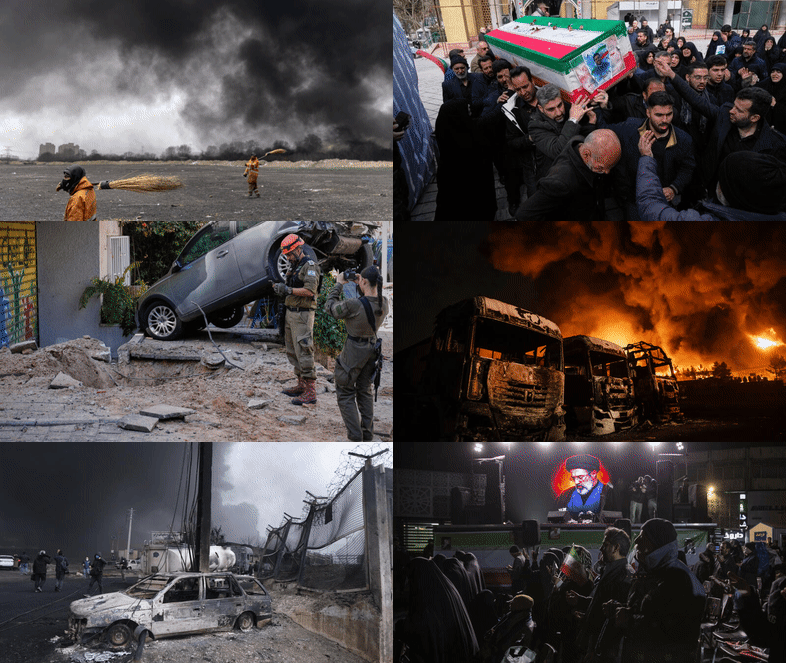
The statistics emerging from the Iranian Red Crescent are grim. With over 1,300 dead, including a significant number of civilians caught in strikes on cities like Tehran, Isfahan, and Kermanshah, the humanitarian crisis is accelerating. A strike on a primary school in Minab during the opening hours of the conflict remains a flashpoint for international condemnation, yet the military operations show no sign of tapering.
The US-Israeli strategy appears to be a "decapitation" of the command structure. By neutralizing Ali Khamenei on February 28, the coalition hoped to trigger a collapse. Instead, they triggered a hardening. The IRGC has responded by activating its regional proxies, with missile strikes hitting US assets in Kuwait and Bahrain.
A Collision Course with Washington
The White House has already labeled Mojtaba Khamenei an "unacceptable" leader. This sets the stage for a diplomatic dead end. If Washington refuses to recognize the new Supreme Leader, there is no one left to negotiate with. The Trump administration is betting that the Iranian people will see the dynastic shift as the final betrayal of the 1979 ideals and rise up. However, the IRGC’s grip on the internal security apparatus remains ironclad, even as bombs fall on their headquarters.
The irony is thick. A revolution born to end a monarchy has ended by creating a new one, just as the external forces claiming to bring democracy are overseeing a campaign that has displaced thousands and sent the global economy into a tailspin.
Watch the Strait of Hormuz. If the new regime in Tehran decides that its survival depends on closing the world's most vital energy artery, the $114 barrel will seem like a bargain.