The humidity in Bali doesn't just sit on your skin. It presses. It is a thick, floral weight that carries the scent of burning incense, clove cigarettes, and salt spray. For most, this air signifies the beginning of a dream—a temporary escape from the grey reality of a Melbourne winter. But for Troy Johnston, a father who had built a life on the hard-edged docks of Western Australia’s mining industry, that air became a shroud.
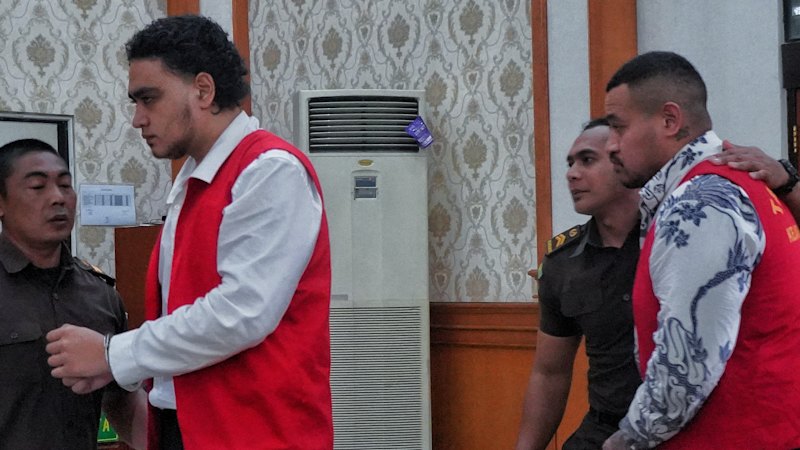
On a Tuesday in Denpasar, the tropical heat was filtered through the sterile, air-conditioned silence of a courtroom. Two men, Oliver Woods and Joshua Jenkins, sat with their heads bowed. They were young. They were Australians. And they were now officially the architects of a nightmare that has shattered two families and left a permanent stain on the limestone cliffs of the Bukit Peninsula.
The sentence handed down was sixteen years.
Numbers like that are easy to print in a headline. They are clean. They provide a sense of mathematical justice. But sixteen years does not account for the silence at a dinner table in Melbourne where a young son waits for a father who will never walk through the door. It doesn't capture the slow, agonizing decay of a family's hope in an Indonesian prison cell.
The Midnight Knock
The story didn't start in a courtroom. It started in the velvet dark of a villa in Uluwatu. Troy Johnston had come to Bali to find something different—a shift from the mechanical rhythm of his life as a rigger. He was a man known for his strength, both physical and of character. He was a father. He was a son. He was an Australian who, like thousands of others, saw the Indonesian archipelago as a second home.
Then came the confrontation.
In the world of international travel, there is a dangerous, unspoken assumption: that the rules of gravity and grace change once you cross the Indian Ocean. People sometimes leave their common sense at the luggage carousel in Denpasar. They drink. They argue. They let the heady atmosphere of "Island Time" blur the lines of consequence.
But the consequence of that night was permanent.
Woods and Jenkins weren’t career criminals. They weren’t international hitmen. They were two men whose lives collided with Johnston’s in a flurry of violence that defied logic. The details of the struggle in that villa are jagged and cruel. There was a fight. There were weapons. There was a moment—one single, horrific pulse of time—where a choice was made that could never be retracted.
The Cost of a Life
When the judge’s gavel hit the wood, it wasn't just a legal pronouncement. It was the sound of a door slamming shut on three lives.
Consider the math of sixteen years. It is nearly six thousand days. It is the time it takes for a toddler to become a man. It is a lifetime of birthdays spent behind the wire of Kerobokan or another Indonesian penitentiary. For the families of Woods and Jenkins, the sentence is a different kind of prison. They are the ones who must now navigate the labyrinth of international law, the staggering cost of legal defense, and the crushing weight of knowing their sons took a life.
But the true weight is carried by the Johnstons.
The victim’s family has spoken of a hole that cannot be filled by any number of years behind bars. Their grief is not a news cycle. It is a permanent condition. They are the ones who have to explain to a child why his father stayed in Bali forever. They have to reconcile the image of the man they loved with the stark, violent reality of his end.
A Culture of Consequence
Why does this story resonate so deeply? Because every Australian who has ever stepped off a plane in Kuta or Seminyak sees a piece of themselves in this tragedy. We see the vulnerability of being far from home. We see the terrifying speed at which a holiday can turn into a tragedy.
There is a myth that "what happens in Bali stays in Bali."
The truth is much darker. Bali is a place of deep spiritual tradition and a complex, often misunderstood legal system. The Indonesian courts do not view a drunken brawl or a "misunderstanding" with the same leniency that a Western magistrate might. They value the sanctity of life and the peace of their island. When that peace is shattered by foreigners, the hammer falls hard.
The sixteen-year sentence was actually a reduction. The prosecutors had wanted more. They had seen the CCTV footage. They had seen the evidence of a life taken with brutal efficiency. The judge, in a moment of what some might call mercy, took their ages and their lack of prior criminal history into account.
But there is no mercy for the man who was left on the floor of that villa.
The Invisible Stakes
We often talk about "travel safety" in terms of pickpockets or lost passports. We rarely talk about the psychological shift that occurs when we are untethered from our home base. We forget that the people we meet in a bar at 2:00 AM are not just characters in our holiday story; they are real people with their own histories, their own tempers, and their own capacity for violence.
The tragedy of the Melbourne dad is a cautionary tale, but not in the way you might think. It’s not just about staying safe. It’s about the fragility of the human social contract. It’s about how quickly a life built over decades—years of hard work, of raising a family, of being a friend—can be extinguished by a few minutes of rage.
Woods and Jenkins will likely serve their time. They will eventually emerge from the gates of a prison, older, hardened, and marked. They will try to find a place in a world that has moved on without them. They will carry the ghost of Troy Johnston for the rest of their lives.
The Long Walk Home
The courtroom in Denpasar eventually emptied. The cameras were packed away. The lawyers folded their briefs and walked out into the afternoon sun. For the media, the story was over. The sentence was delivered. The "Melbourne dad" was now a statistic in the long, complicated history of Australians in Indonesia.
But for those left behind, the clock has only just begun to tick.
Imagine the plane ride back to Australia for the families involved. The flight path is the same one Troy Johnston took, soaring over the turquoise waters and the white-sand beaches. From thirty thousand feet, Bali looks like a postcard. It looks like a paradise. It looks like a place where nothing bad could ever happen.
Then the plane descends. The lights of Melbourne appear on the horizon. The wheels touch down on the tarmac. And the reality of the empty chair at the table finally, completely sinks in.
Justice is a word we use to feel better about the chaos of the world. We want to believe that sixteen years equals one life. We want to believe that a judge’s ruling can balance the scales.
But as the sun sets over the Indian Ocean, casting long, orange shadows across the cliffs where a father once walked, the scales remain stubbornly, tragically uneven. There is only the silence of the room, the weight of the air, and the knowledge that some trips are never truly finished.