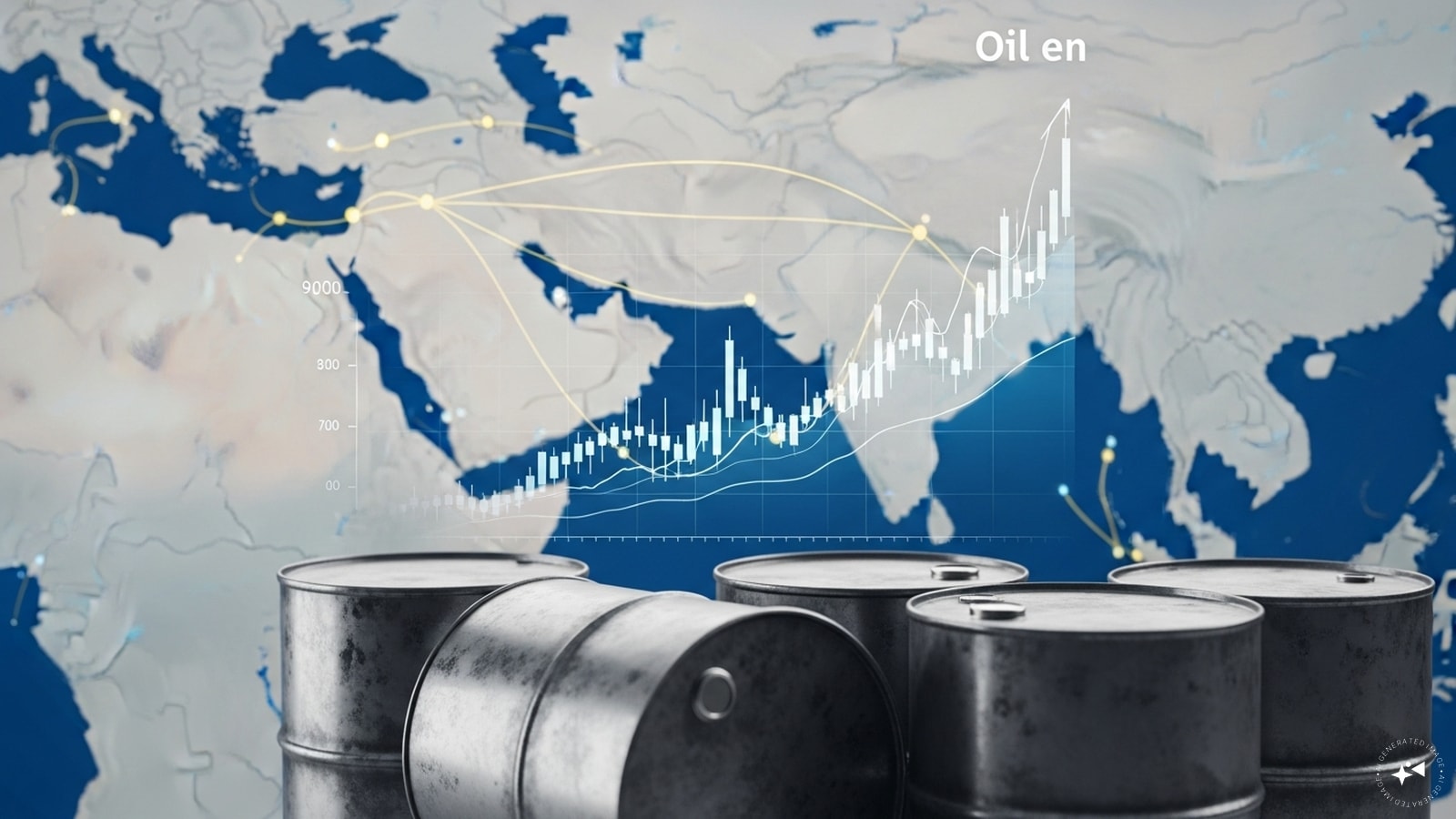
The escalating friction between the United States, Israel, and Iran has moved beyond the realm of regional skirmishing and into the heart of the global supply chain. For Asian commodity markets, this isn't a speculative risk. It is a fundamental shift in the cost of doing business. While Western headlines focus on geopolitical posturing, the real story lies in the physical movement of crude oil, liquefied natural gas (LNG), and industrial metals through the Strait of Hormuz and the Bab el-Mandeb.
Asia consumes more than 70% of the world’s seaborne crude. When tensions rise in the Middle East, the immediate spike in Brent crude prices is only the first domino. The secondary and tertiary effects—surging insurance premiums, rerouted shipping lanes, and the sudden scarcity of refined products—threaten the industrial backbone of China, India, and Japan. This is the reality of a continent that has offshored its energy security to one of the most volatile regions on earth. Discover more on a similar issue: this related article.
The Insurance Tax and the Death of Cheap Shipping
Most analysts look at the price per barrel. They should be looking at the cost of the hull. As the threat of drone strikes and naval seizures increases, maritime insurers are rewriting the rules for "War Risk" zones. In some cases, premiums for tankers transiting the Persian Gulf have jumped fivefold within a single week.
This is a hidden tax on Asian economies. A refiner in South Korea or a power plant in Gujarat doesn't just pay for the oil; they pay for the risk of that oil never arriving. When a vessel is forced to bypass the Suez Canal and round the Cape of Good Hope, it adds roughly 10 to 14 days to the journey. This delay ties up global shipping capacity. It creates a synthetic shortage of tankers, driving up "spot" freight rates even for routes that have nothing to do with the Middle East. Additional analysis by The Motley Fool explores comparable views on the subject.
The LNG Vulnerability
While oil gets the spotlight, the danger to the LNG market is arguably more acute. Japan and Taiwan rely on a steady, just-in-time heartbeat of LNG shipments to keep their power grids stable. Unlike oil, which can be stored in massive strategic reserves for months, LNG storage is technically difficult and expensive.
If the Strait of Hormuz were to see a prolonged closure or a significant reduction in traffic, the scramble for non-Middle Eastern gas would be Darwinian. We would see Asian buyers outbidding European utilities for American and Australian cargoes, sending global gas prices into a vertical climb. This isn't just about expensive electricity; it's about the survival of energy-intensive industries like semiconductor manufacturing and heavy chemicals.
China's Strategic Dilemma
Beijing has spent the last decade trying to build a "Malacca Dilemma" bypass. They’ve invested in pipelines through Central Asia and Russia to reduce their reliance on the narrow waters of Southeast Asia and the Middle East. However, the sheer volume of Chinese energy demand makes these pipelines look like straws trying to empty an ocean.
China remains the largest importer of Iranian crude, often using "dark fleet" tankers to circumvent sanctions. If the conflict widens to involve direct strikes on Iranian energy infrastructure, this back-channel supply vanishes. China would then be forced into the open market, competing for the same barrels as its regional rivals. This creates a fascinating geopolitical paradox: China needs regional stability to fuel its economy, yet it benefits from the US being bogged down in Middle Eastern security commitments.
The India Factor
India’s position is even more precarious. With a refining capacity that serves as a global hub, India needs a constant flow of heavy sour crudes that are synonymous with Middle Eastern production. The Indian government has attempted to diversify by importing record amounts of discounted Russian oil, but logistics have their limits.
If the US-Israel-Iran triangle breaks into open warfare, the "Russia-to-India" trade route becomes a logistical nightmare. The Suez Canal becomes a high-risk bottleneck. India's miracle of 7% GDP growth is built on the assumption of $80 oil. At $120, that growth evaporates, replaced by a widening current account deficit and a weakening rupee.
Metals and the Forgotten Supply Chain
We often forget that the Middle East is becoming a major player in the aluminum and fertilizer markets. Massive smelters in the UAE and Saudi Arabia rely on cheap local energy to produce primary aluminum that feeds Asian automotive and aerospace sectors.
A regional war doesn't just stop the oil; it stops the power. If the regional grid is compromised or if feedstock gas is diverted to domestic emergency use, the global supply of aluminum could tighten overnight. This happens at a time when the world is already struggling with low inventories of industrial metals. The "green transition" in Asia—the batteries, the electric vehicles, the wind turbines—requires an uninterrupted flow of these commodities. War in the Middle East is, effectively, a tax on the future of Asian technology.
The Illusion of the Strategic Petroleum Reserve
Governments often point to their Strategic Petroleum Reserves (SPR) as a safety net. This is a comforting thought, but the math doesn't hold up under the pressure of a total regional blockade.
- Duration: Most SPRs are designed to cover 60 to 90 days of net imports. In a modern industrial economy, 90 days passes in a heartbeat.
- Quality: Not all oil is created equal. An SPR might hold light sweet crude, while a refinery is calibrated to process heavy sour grades. You cannot simply swap one for the other without losing significant efficiency and output.
- Refining Bottlenecks: Even if you have the crude, you need the power and the chemicals to refine it. In a total energy crisis, the entire industrial ecosystem faces a cascade failure.
The hard truth is that an SPR is a bridge, not a destination. If the "bridge" leads to a world where Middle Eastern supply is permanently diminished or significantly more expensive, the reserve only delays the inevitable economic contraction.
The Shadow of the Petro-Yuan
One of the more subtle shifts we are witnessing is the acceleration of non-dollar trade. As the US uses its financial system as a tool of statecraft in the Middle East, Asian nations are looking for exits. Iran and Russia are already trading in local currencies. China is pushing the yuan for energy settlements.
However, this isn't a simple swap. The liquidity of the US dollar remains its greatest strength. If commodity markets fracture into currency blocs, the "pressure" on Asian markets becomes one of extreme complexity. A trader in Singapore would need to manage not just the price risk of the commodity, but the volatile exchange rate risk of multiple non-convertible currencies. This fragmentation adds friction, and friction is the enemy of profit.
The Fertilizer Crisis and Food Security
The most dangerous ripple effect of a Middle Eastern conflict isn't energy—it's food. The region is a titan in the production of urea and phosphates. Asia, with its massive populations, is the primary destination for these fertilizers.
If production in the Gulf is interrupted, the cost of farming in Vietnam, Thailand, and Indonesia sky-rounds. We saw a preview of this during the initial stages of the Ukraine conflict, but a Middle Eastern shutdown would be far more targeted toward Asian agricultural cycles. This moves the crisis from the boardroom to the dinner table. Food inflation is a historically reliable trigger for social unrest in the region.
The Narrow Path
There is no easy diversification for Asia. You cannot move a continent away from its primary energy source in a fiscal quarter. The current conflict isn't just a "headwind" for commodity markets; it is a structural challenge to the Asian economic model of high-energy, high-growth manufacturing.
The real winners in this scenario are the producers in the "safe" zones—Australia, Canada, and the United States. But for the manufacturing hubs of the East, the Middle East remains a geographical destiny they cannot escape. The reliance on the Strait of Hormuz is a permanent vulnerability that no amount of diplomatic maneuvering can fully erase.
Companies across the continent are currently forced to choose between two unappealing options: pay the exorbitant "stability tax" of long-term contracts at high prices, or gamble on the spot market and risk a total shutdown. In a world of tightening margins, neither choice leads to prosperity. The era of cheap, predictable commodity flows to Asia is over, replaced by a permanent state of high-alert logistics.
Assess the current storage capacity of your primary suppliers and calculate the impact of a 30% increase in freight costs over a six-month period to see the true vulnerability of your margin.