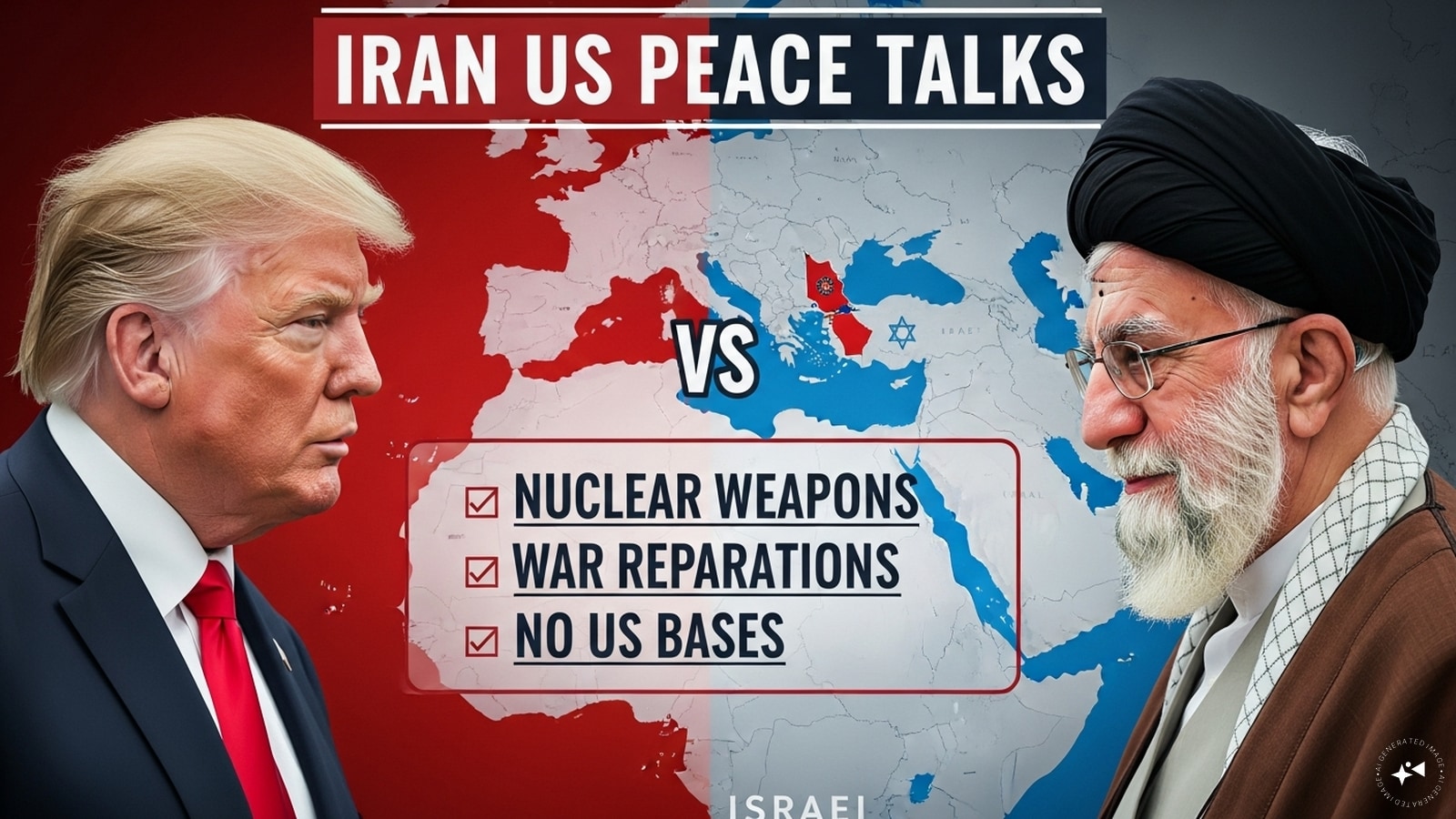
The current friction between Washington and Tehran is not a failure of communication but a rational byproduct of misaligned incentive structures. When the United States signals that a "deal is on" while Iranian leadership claims the US is "negotiating with itself," they are describing a fragmented bargaining table where the primary stakeholders are not just two nation-states, but competing domestic factions and regional proxies. This divergence exists because the cost of agreement for one party often exceeds the cost of continued low-level kinetic friction for the other.
To understand why traditional diplomacy is stalling, we must deconstruct the current engagement through the lens of three specific analytical frameworks: the Credibility Gap in Executive Commitments, the Proxy Agency Problem, and the Asymmetric Value of Nuclear Latency. Expanding on this idea, you can find more in: Why the Green Party Victory in Manchester is a Disaster for Keir Starmer.
The Credibility Gap in Executive Commitments
A fundamental bottleneck in US-Iran relations is the temporal inconsistency of American foreign policy. Under the US constitutional system, an administration can offer sanctions relief via executive order, but it cannot guarantee that a subsequent administration will not reverse those orders. This creates a high-risk environment for Iranian long-term capital investment.
- The Snapback Risk: For Tehran, the value of any deal is discounted by the probability of a "policy pivot" in the next US election cycle. If the discount rate is high, the immediate relief of lifted sanctions does not offset the long-term structural risk of re-integration into a global financial system that might be severed again in four years.
- Legislative Paralysis: The inability of the US Executive Branch to secure a formal treaty—which requires a two-thirds Senate majority—means any agreement is legally fragile.
- The Sunk Cost of Resistance: Iran has invested decades into building a "Resistance Economy" designed to bypass Western financial nodes. Abandoning these shadow networks for transparent, regulated trade carries an institutional switching cost that requires more than "temporary" sanctions relief to justify.
The Proxy Agency Problem
The "table" mentioned in diplomatic circles is rarely occupied by just the principals. Both Washington and Tehran operate through a complex web of secondary actors whose interests often diverge from the central government’s objectives. Experts at Al Jazeera have shared their thoughts on this situation.
The Iranian security apparatus, specifically the Islamic Revolutionary Guard Corps (IRGC), derives its domestic legitimacy and budget from a state of perpetual external threat. A comprehensive "Grand Bargain" would theoretically diminish the IRGC’s internal leverage. Similarly, regional allies like Hezbollah or the Houthis possess their own tactical autonomy. When Tehran negotiates, it must account for whether it can actually enforce the compliance of these proxies without fracturing its regional influence.
On the American side, the "negotiating with itself" critique stems from the tension between the State Department’s desire for a diplomatic win and the Department of Defense’s requirement to maintain a credible military deterrent. When one arm of the US government offers an olive branch while another increases a carrier strike group’s presence in the Persian Gulf, it sends a contradictory signal that Tehran interprets as a lack of unified command.
The Asymmetric Value of Nuclear Latency
Negotiations are currently stuck in a loop regarding Iran’s uranium enrichment levels. To analyze this, we must define "Nuclear Latency"—the technical ability to produce a weapon without actually assembling one.
- The Deterrence Threshold: Iran views 60% enriched uranium as a "bargaining chip" rather than a final product. The closer they get to "breakout capacity," the more leverage they believe they hold at the table.
- The Red Line Paradox: For the US and Israel, the "Red Line" is often defined by technical milestones (e.g., the number of IR-6 centrifuges or the stockpile of 90% enriched material). However, moving the red line too frequently erodes the credibility of the military threat.
- Monitoring vs. Sovereignty: The core of the stalemate is the International Atomic Energy Agency (IAEA) access. Iran treats inspections as a variable to be toggled based on the level of sanctions pressure, while the US views inspections as a non-negotiable prerequisite for any dialogue.
The Cost Function of Regional Kinetic Friction
Economic sanctions are often characterized as a tool to "force" a party to the table. However, this ignores the internal adaptation of the target state. The Iranian economy has developed a high tolerance for specific types of economic pain, particularly through "Oil-for-Goods" swaps with non-Western powers.
The US strategy relies on a "Maximum Pressure" cost function where:
$$C_{resistance} > C_{concession}$$
However, if Tehran’s internal stability is tied to its image of defiance, then $C_{concession}$ includes the risk of regime-threatening internal dissent if they appear to "surrender" to the West. In this scenario, the cost of concession is actually higher than the cost of enduring sanctions.
The Emergence of the Multipolar Buffer
A significant shift that the "negotiating with itself" narrative misses is the role of third-party facilitators. In previous decades, the US could effectively isolate the Iranian economy. Today, the rise of alternative financial clearing systems (such as those being developed by the BRICS bloc) provides Iran with a strategic buffer.
- China as a Liquidity Provider: Beijing’s continued purchase of Iranian crude provides a baseline of hard currency that prevents the total collapse of the Iranian Rial, regardless of US Treasury actions.
- Russia as a Security Partner: The deepening of the Russo-Iranian defense industrial complex (evidenced by drone and missile technology exchanges) gives Tehran a high-tech partner that is also sanctioned by the West. This "Sanctioned Bloc" reduces the efficacy of unilateral US economic statecraft.
Verification Bottlenecks and Information Asymmetry
Even if a political agreement is reached, the technical implementation faces a verification bottleneck. The US requires "anytime, anywhere" access to military sites to prevent a "Manhattan Project" style breakout. Iran views this as a backdoor for Western intelligence to map their conventional defenses.
This creates a classic security dilemma:
- To prove they are not building a bomb, Iran must expose their conventional vulnerabilities.
- If they expose their conventional vulnerabilities, they become more susceptible to a conventional strike.
- Therefore, they refuse inspections, which leads the US to believe they are building a bomb.
Strategic Execution: Moving Beyond the Stalemate
To break the cycle of "negotiating with itself," the United States must shift from a strategy of "maximum pressure" to one of "maximum clarity." This involves moving away from vague promises of future prosperity and toward a staged, irreversible de-escalation ladder.
The first step is the creation of a "Limited Purpose Clearinghouse." Instead of broad sanctions relief, the US should facilitate a specific, monitored channel for humanitarian and industrial equipment that is immune to future executive-order reversals. This "Locked Escrow" model would provide Iran with the immediate economic proof-of-concept needed to justify further concessions to its hardline domestic factions.
Simultaneously, the US must decouple the nuclear file from regional proxy activity in the short term. Attempting to solve for nuclear enrichment, ballistic missile development, and regional militias in a single "Grand Bargain" creates too many veto points for the deal to survive. A modular approach—solving for nuclear breakout time first, then addressing regional stability through a separate, multilateral Gulf security framework—is the only path that accounts for the reality of the fragmented bargaining table.
The "deal" is not on or off; it is being recalculated daily in a high-stakes environment where the primary currency is not trust, but verifiable, interest-aligned action.