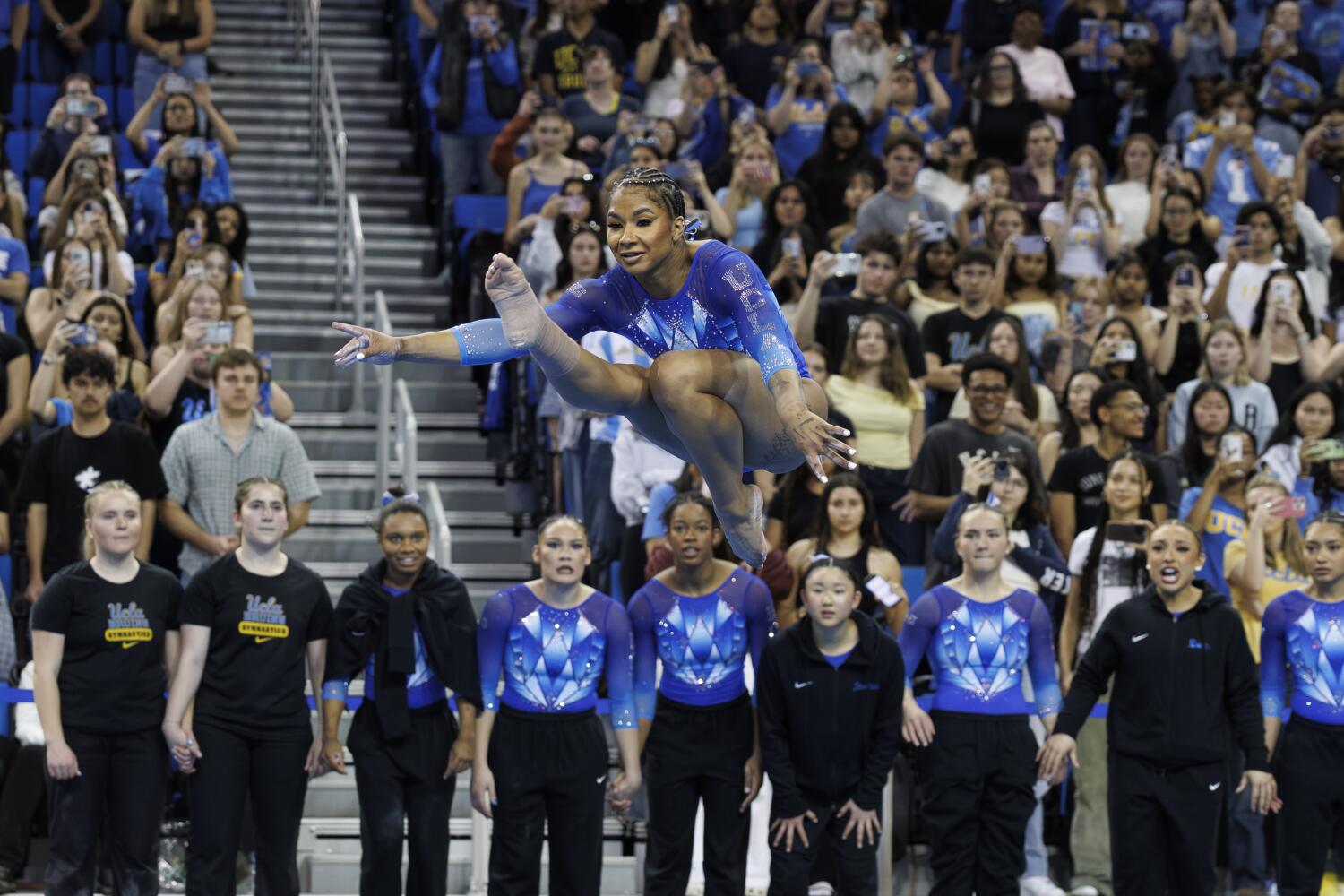
The scoreboard at Pauley Pavilion told one story, but the atmosphere inside the arena told another. When Jordan Chiles stuck her final landing to clinch a victory over Utah in her home finale, it wasn’t just a win for the record books. It was a hostile takeover of the narrative. For years, the UCLA Bruins had been drifting, caught between a legacy of greatness and a modern identity crisis. Chiles didn't just provide high scores; she acted as the primary engine for a cultural overhaul that restored the program’s status as a powerhouse in the Pac-12.
Beating Utah is never a small feat. The Utes arrived in Los Angeles as a disciplined, mechanical force, the kind of team that rarely beats itself. To take them down, UCLA needed more than just technical precision. They needed an edge. By the time the final rotation ended, the Bruins had posted a season-high score that signaled to the rest of the NCAA that the "Chiles Era" had achieved its primary objective: making UCLA dangerous again. Meanwhile, you can read similar events here: The Structural Anatomy of Elite Athletic Attrition.
The Strategic Value of an Olympic Return
When Jordan Chiles decided to return to college gymnastics after winning silver in Tokyo, the move was viewed by some as a victory lap. That assessment was wrong. In the world of elite athletics, returning to the NCAA level is often a grueling transition. The scoring systems are different, the volume of competition is higher, and the physical toll of performing every weekend can be more taxing than the elite circuit's sporadic schedule.
Chiles treated the move like a business merger. She brought the branding and the difficulty of a world-class athlete, but she traded the isolation of individual training for the collective power of a collegiate team. This synergy transformed UCLA from a group of talented individuals into a cohesive unit that thrived on the pressure she absorbed. To see the complete picture, check out the excellent article by ESPN.
Why the Utah Rivalry Matters
Utah has long been the gold standard for consistency in collegiate gymnastics. They don't rely on superstars as much as they rely on a deep roster of 9.900 earners. For UCLA to bridge the gap, they couldn't just match Utah’s consistency; they had to exceed it with "wow" factors.
This meet was the culmination of that strategy. Chiles and her teammates didn't just play it safe. They attacked their routines, knowing that a single slip would hand the victory to a waiting Utah squad. The victory marked a shift in the West Coast hierarchy. It proved that the Bruins' flashy style, often criticized by traditionalists as being "too much," could hold up against the most disciplined programs in the country when the stakes were highest.
Deconstructing the Perfect 10
The quest for the "Perfect 10" in NCAA gymnastics is often shrouded in subjectivity. Critics argue that judges are too lenient, especially in home arenas. However, looking at the technical data from Chiles' performances reveals a level of execution that transcends home-floor bias.
On the bars, Chiles demonstrates a "counter-rotation" technique that most collegiate gymnasts simply cannot replicate. Her release moves are higher, giving her more time to find the bar and prepare for a landing. When she sticks a dismount, she isn't just stopping her momentum; she is neutralizing it with a physics-defying lack of movement.
The Mechanics of the Floor Exercise
The floor exercise is where the UCLA identity truly lives. It is a mix of high-level tumbling and performance art. While Utah often favors a more classical, balletic approach, UCLA—led by Chiles—embraces hip-hop, contemporary movement, and high-energy storytelling.
- Tumbling Difficulty: Chiles performs passes that would be competitive on the world stage, not just the NCAA floor.
- Stamina: The ability to maintain energy during the dance elements after two massive tumbling runs is what separates the elites from the specialists.
- Presence: There is an intangible quality to how Chiles commands the floor. She forces the judges to watch her, making it nearly impossible for them to look for small deductions.
This isn't just about entertainment. It’s a tactical advantage. When an athlete performs with that much confidence, it creates a psychological "halo effect" that can influence how the rest of the rotation is scored.
The Coaching Pivot under Janelle McDonald
You cannot discuss the resurgence of UCLA without analyzing the leadership of Janelle McDonald. Taking over a program with a storied history but recent internal friction is a minefield. McDonald’s approach has been one of surgical precision. She didn't try to strip away the "showmanship" that defined the Valorie Kondos Field era; instead, she anchored it with a level of technical accountability that had been missing.
The win over Utah was a validation of McDonald’s philosophy. It showed that a team can be vibrant, loud, and expressive while still maintaining the fundamental discipline required to win championships. The staff managed Chiles’ workload perfectly, ensuring she peaked exactly when the team needed a statement win to secure their postseason positioning.
The Recruitment Ripple Effect
The "Jordan Chiles effect" extends far beyond the scoreboard. In the world of NIL (Name, Image, and Likeness) and transfer portals, stars attract stars. By seeing Chiles thrive at UCLA, top-tier recruits see a roadmap for how to balance professional aspirations with the collegiate experience.
The Bruins aren't just winning meets; they are winning the long-term war for talent. Every time Chiles lands a vault or celebrates with her teammates on the sidelines, she is providing a high-definition commercial for the program's future. The impact of this single season will likely be felt in the UCLA recruiting classes for the next half-decade.
The Myth of the Easy Path
There is a common misconception that for an Olympian, NCAA gymnastics is "easy." This narrative ignores the immense pressure placed on these athletes. When Jordan Chiles steps onto the mat, she isn't just representing herself; she is representing the gold standard of the sport. Every 9.950 feels like a failure to a public that expects a 10.0 every time.
Managing that expectation is a mental grind that few athletes can handle. Chiles didn't just survive that pressure; she used it as fuel. In the meet against Utah, there were moments where the momentum could have swung. A slightly off-balance beam routine or a hopped landing on vault could have opened the door for the Utes. Chiles slammed that door shut.
Comparative Performance Metrics
| Event | Chiles Average | Team Impact |
|---|---|---|
| Vault | 9.925 | Sets the ceiling for the rotation. |
| Bars | 9.975 | The "anchor" score that erases early mistakes. |
| Beam | 9.900 | Stabilizes the most volatile event. |
| Floor | 9.980 | The psychological finisher for the opponent. |
The data shows that Chiles isn't just a high scorer; she is a stabilizer. Her presence in the lineup allows her teammates to compete with more freedom. They know that even if they have an "off" day, the back end of the lineup has the firepower to recover the lost ground.
The Road to the Postseason
Winning a home meet against a rival is a high-water mark, but it is not the finish line. The victory over Utah serves as a proof of concept for the postseason. It proves that the Bruins have the "hit" capacity to compete with the likes of Oklahoma or LSU on a neutral floor.
The real challenge for UCLA will be maintaining this intensity outside the friendly confines of Pauley Pavilion. The energy of a home crowd is a potent drug, but championships are won in quiet arenas where the only sound is the thud of the mat. Chiles has proven she can lead in the spotlight. Now, the rest of the roster must prove they can follow her lead when the lights aren't quite as bright.
This specific win dismantled the idea that Utah was the untouchable titan of the conference. It reminded the gymnastics world that when UCLA is firing on all cylinders, they operate at a level of athleticism that few can match. The transition from the regular season to the playoffs is always fraught with risk, but the Bruins have found their rhythm at exactly the right time.
The legacy of Jordan Chiles at UCLA won't just be defined by the rings or the trophies. It will be defined by the fact that she took a program at a crossroads and forced it to remember its own greatness. She didn't just compete; she conducted a masterclass in how to transition from an individual icon to a foundational team leader.
The Bruins aren't just back. They are evolving. As the focus shifts toward the national stage, the rest of the field has been put on notice. The era of playing it safe is over. The era of the high-stakes, high-reward Bruin is in full swing. If you want to see the future of the sport, you stop looking at the history books and start looking at the way this team carries itself after a 10.0. They aren't surprised by perfection anymore; they expect it.
Analyze the footage of that final rotation one more time. Look past the score. Watch the way the team moves before the green light even flashes. That is the sound of a program that has regained its soul.
Direct your attention toward the upcoming regional qualifiers to see if this momentum holds.