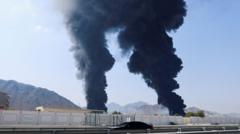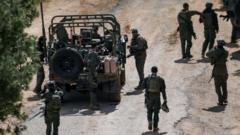
Military history is littered with the corpses of "limited" operations. When Israeli tanks crossed the Blue Line into Southern Lebanon, the official messaging from Jerusalem was calibrated for a global audience nervous about a regional conflagration. The word "limited" was used as a shield, a verbal sedative intended to suggest a surgical, temporary, and manageable disruption of Hezbollah’s border infrastructure. But on the ground, the mechanics of war rarely respect the adjectives of diplomats.
The reality of this incursion is not found in the press releases but in the shifting geography of the Levant. Israel's stated objective is the destruction of "Radwan Force" outposts—the tunnels, caches, and jump-off points that have made the Galilee uninhabitable for 60,000 displaced civilians for nearly a year. Yet, any commander who has navigated the rocky, honeycombed terrain of South Lebanon knows that you cannot simply "prune" a guerrilla army. You either occupy the ground or you concede it.
The Friction of the Blue Line
The border between Israel and Lebanon is not a wall; it is a pressure cooker. For two decades, the United Nations Interim Force in Lebanon (UNIFIL) has stood as a symbolic barrier that both sides largely ignored when it suited them. Hezbollah spent that time turning the rugged hillsides into a fortress. This is not a conventional army waiting in trenches to be counted by satellite imagery. It is a decentralized, deeply embedded force that views the very soil of the south as its primary weapon.
Israel’s tactical approach involves high-intensity, short-duration raids. The goal is to strip away the immediate threat to the northern kibbutzim. By clearing the thickets and destroying the shafts leading to underground bunkers, the Israel Defense Forces (IDF) hope to create a buffer zone through sheer physical devastation rather than permanent presence.
It is a gamble.
The "why" behind this timing is clear. The decapitation of Hezbollah’s leadership, including the strike that killed Hassan Nasrallah, created a window of institutional chaos. In the world of intelligence, a headless giant is the easiest to trip. Israel is moving now because the traditional command-and-control structures of their adversary are in tatters, leaving local cells to fight without the overarching strategic guidance they have relied on since 2006.
The Architecture of an Escalation
We must look at the "how" to understand the danger of the current trajectory. Modern warfare in this region relies on a synergy of signals intelligence and overwhelming kinetic force. Before a single boot touched Lebanese soil, the digital battlefield was won. The mass detonation of communication devices weeks prior wasn't just a Hollywood-style stunt; it was a systematic blinding of the mid-level officer corps.
However, tactical brilliance does not always translate to strategic victory.
Hezbollah’s strength has always been its resilience in the face of attrition. While their long-range missile capabilities have been degraded by constant bombardment, their short-range tactical assets—anti-tank guided missiles (ATGMs) and IEDs—remain potent. The "limited" nature of the operation is designed to keep Israeli troops out of the range of the deepest, most dangerous ambushes, but as the perimeter of the "safe zone" expands, so does the risk of entanglement.
There is a grim irony in the term "surgical." In a medical theater, a surgeon cuts to heal. In Lebanon, every cut leaves a scar that serves as a recruitment poster for the next generation of militants. The IDF is currently focused on the physical infrastructure, but they are fighting an ideological ghost that thrives on the very destruction they are currently meting out.
The Washington Variable
The United States finds itself in a familiar, uncomfortable position. Publicly, the Biden administration supports Israel’s right to defend itself and remove the threat of an October 7-style raid from the north. Privately, the corridors of the State Department are echoing with the fear of the "mission creep" that defined the 1982 invasion.
That war also began as a limited operation. It ended with an eighteen-year occupation and the birth of Hezbollah itself.
The current geopolitical landscape is different, primarily because of the direct involvement of Iran. Tehran’s "Ring of Fire" strategy, which sought to encircle Israel with proxies, is being tested to its breaking point. If Hezbollah falls too far or too fast, Iran faces a binary choice: watch its most expensive and effective deterrent be dismantled, or intervene directly and risk a total war that could threaten the regime's survival in Isfahan and Tehran.
Logistics and the Human Cost
While the world watches the flashes over Beirut, the logistical reality of a ground war is unfolding in the mud and dust of the border. Moving an armored division into Lebanon requires more than just tanks. It requires a tail of fuel trucks, ammunition carriers, and medical evacuation units. These are the soft targets that Hezbollah’s guerrillas are trained to hunt.
For the Lebanese civilian population, the nuances of "limited" operations are a cruel joke. Over a million people have been displaced. The social fabric of a country already reeling from economic collapse and political paralysis is being shredded. This mass movement of people isn't just a humanitarian crisis; it is a tactical variable. Displaced populations clog roads, complicate targeting, and create a vacuum that radicalization quickly fills.
The IDF is using a technique known as "active defense," where the best way to stop an incoming threat is to physically remove the source. But when the source is integrated into a civilian village, the moral and legal costs skyrocket. International law demands proportionality, yet in the heat of a "limited" incursion, the line between a military necessity and a war crime becomes dangerously thin.
The Buffer Zone Fallacy
History suggests that buffer zones are rarely stable. They are no-man's-lands that invite infiltration. If Israel clears a five-mile strip of South Lebanon and then withdraws, Hezbollah will return the moment the last tank crosses back over the fence. If Israel stays to prevent that return, they become an occupying force, providing a stationary target for an insurgency that has spent eighteen years preparing for exactly this scenario.
The only way to break this cycle is a diplomatic framework that actually has teeth—something the previous UN Resolution 1701 conspicuously lacked. Without a Lebanese Army capable of actually policing its own south, or an international force willing to use its weapons to enforce a demilitarized zone, the "limited" operation is merely a reset button. It clears the board for a few years, but it doesn't change the game.
The soldiers on the front lines know what the politicians in the air-conditioned rooms in Tel Aviv and Washington often forget: war has a momentum of its own. Once the first shot is fired and the first casualty is taken, the "limits" of the operation are dictated by the enemy’s response, not the initial mission statement. We are seeing the beginning of a process that is much easier to start than it is to finish.
The objective is to return citizens to their homes. The price of that return is currently being tallied in high-explosives and blood. Whether this remains a localized skirmish or becomes the opening chapter of a systemic regional realignment depends entirely on whether the "limited" label holds, or if it dissolves under the heat of a Mediterranean summer turned into a winter of discontent.
Watch the supply lines. Watch the reserve call-ups. If the IDF begins moving heavy engineering equipment and establishing semi-permanent fire bases inside Lebanese territory, the word "limited" will officially be retired to the archives of military euphemisms.