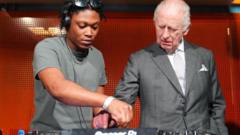
The appearance of a sitting monarch at a municipal arts venue, specifically engaging with modern subcultures like electronic music, represents more than a ceremonial gesture. It is a calculated deployment of institutional capital intended to validate the "Creative Economy" as a legitimate pillar of national GDP. When King Charles III visited a city arts hub and engaged with digital music production, the event signaled a shift in the state’s approach to urban regeneration. The objective is to bridge the gap between traditional high-culture patronage and the decentralized, technology-driven creative sectors that currently drive urban migration and local tax bases.
The Triple Bottom Line of Cultural Patronage
To understand the mechanics of this visit, one must decompose the event into three distinct value drivers: social cohesion, economic signaling, and brand modernization.
Validation of the Digital Creative Class
By interacting with DJ equipment and digital mixing consoles, the Crown provides a formal endorsement of non-traditional career paths. This reduces the "prestige gap" between classical arts (opera, ballet) and modern digital exports. In a post-industrial economy, the ability to export "cool" is a tangible asset.Infrastructure De-risking
Arts venues often struggle with high overhead and inconsistent funding. Royal attention acts as a powerful signal to private investors and local authorities that a specific venue is a "key strategic asset." This lowers the perceived risk for future grants or commercial partnerships.The Demographic Pivot
The institutional survival of the monarchy depends on its perceived relevance to younger, urban populations. Engaging with electronic music—a genre rooted in inclusivity and youth culture—functions as a strategic outreach tool to maintain a broad-based social contract.
The Operational Logic of the Arts Hub
Arts venues like the one visited serve as "Incubators of Human Capital." They do not merely provide entertainment; they function as decentralized R&D labs for the experience economy. The logic of these spaces follows a specific conversion funnel:
- Access: Low-barrier entry points for local talent (studios, workshops).
- Skill Acquisition: Technical training in digital literacy, sound engineering, and event management.
- Aggregation: Bringing disparate creators together to create "cluster effects," where the proximity of talent leads to spontaneous innovation.
- Export: Moving local talent into the global marketplace (streaming, international touring).
The King’s participation in a DJ session was a recognition of the Technical Competency required in modern artistry. It shifts the narrative from art as a "hobby" to art as a "highly skilled technical profession."
Calculating the ROI of Royal Engagement
While the immediate impact of a royal visit is measured in media impressions, the long-term value is found in the Local Multiplier Effect. When a high-profile figure validates an arts center, it triggers a chain reaction in the local micro-economy:
- Increased Footfall: Higher visibility leads to increased ticket sales and café revenue.
- Surrounding Property Value: Thriving cultural hubs correlate with increased desirability in the immediate real estate market.
- Talent Retention: Creative individuals are less likely to migrate to capital cities if their local ecosystem feels supported and prestigious.
The bottleneck in this system is often "Perception-Based Underfunding." Traditional financial models struggle to quantify the value of a community recording studio. The Royal visit attempts to solve this by providing "Cultural Certifiability," a non-monetary asset that can be leveraged during future budget negotiations.
The Mechanism of Modern Statecraft
The interaction between a traditional monarch and a DJ deck creates a "Cognitive Dissonance" that is useful for statecraft. It breaks the stereotype of the Crown as a static, historical artifact and rebrands it as a dynamic participant in the contemporary world. This is not about the King "learning to DJ"; it is about the King acknowledging that the tools of the modern economy are digital, rhythmic, and decentralized.
The second layer of this strategy is Social Engineering. By visiting a "City Arts Venue" rather than an elite private gallery, the state emphasizes "Levelling Up"—the political theory that economic growth must be distributed outside of traditional power centers. The venue serves as a microcosm of this theory: a place where local youth are given the tools to compete on a global stage without leaving their zip code.
Structural Challenges to the Model
Despite the symbolic success of such visits, several structural friction points remain that a single event cannot resolve:
- Sustainability of Funding: Royal visits provide a temporary spike in visibility but do not address the underlying fragility of arts funding models which rely heavily on discretionary government spending.
- The Gentrification Paradox: As a venue becomes more "validated" and prestigious, the surrounding area often becomes more expensive, potentially pricing out the very "grassroots" talent the venue was designed to serve.
- Digital Saturation: The barriers to entry for digital music are lower than ever, leading to a surplus of content. The challenge for these hubs is no longer just "production," but "curation" and "distribution" in a crowded global market.
The Strategic Shift in Institutional Alignment
This visit marks the transition from the Patronage Model (where the elite fund the arts out of charity) to the Investment Model (where the state supports the arts as a prerequisite for economic competitiveness). The King’s engagement with the DJ decks is the visual shorthand for this transition. It recognizes that the future of national influence is as much about digital audio workstations (DAWs) as it is about heavy industry or traditional diplomacy.
For the arts venue, the mandate is now to convert this "Royal Moment" into "Institutional Momentum." This requires:
- Data Capture: Using the surge in interest to build a more robust donor and partner database.
- Programmatic Expansion: Moving from "community interest" to "vocational excellence" by formalizing the training offered.
- Private Sector Integration: Bridging the gap between the nonprofit arts world and the tech companies that profit from the content created in these hubs.
The move is to treat the cultural sector not as a luxury to be maintained during periods of surplus, but as a critical infrastructure project that generates its own self-sustaining economic energy. The King’s visit was the signal; the subsequent integration of these hubs into the broader industrial strategy will be the proof of success.
Maximize the "Validation Dividend" by immediately pivoting from the high-profile publicity of the visit toward a multi-year "Strategic Partnership Framework" that ties venue outcomes to regional employment targets and digital export metrics.