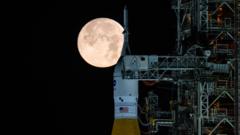
NASA just made it official. After a string of annoying technical gremlins and some nail-biting repairs, the agency is targeting April 1, 2026, for the launch of Artemis II. This isn't just another rocket launch. It’s the first time humans will leave Earth’s orbit since the Nixon administration. We’re talking about four people strapped to the top of a 322-foot tower of explosives, heading 230,000 miles away to loop around the back of the Moon.
Honestly, the road here has been messy. If you’ve been following the news, you know this mission was supposed to happen much sooner. February was the original goal. Then March. But spaceflight is brutal. Between liquid hydrogen leaks that felt like a bad case of déjà vu from Artemis I and a finicky helium valve in the upper stage, the hardware has been stubborn. Meanwhile, you can read related developments here: The Anthropic Pentagon Standoff is a PR Stunt for Moral Cowards.
Engineers had to roll the entire Space Launch System (SLS) rocket and Orion capsule back into the Vehicle Assembly Building (VAB) just to fix a seal they couldn't reach on the pad. But the latest Flight Readiness Review ended with a "go." The teams are confident. The rocket rolls back out to Launch Complex 39B on March 19. If everything holds together, we’re going back.
The Crew Making History
This mission isn't just about the machine; it’s about the four people inside. This crew is a massive departure from the "all-white, all-male" era of Apollo. To explore the bigger picture, we recommend the recent analysis by ZDNet.
- Reid Wiseman (Commander): A veteran who’s already spent nearly half a year on the ISS. He’s the guy steering the ship.
- Victor Glover (Pilot): He’s making history as the first person of color to leave Earth orbit. He previously piloted the first operational SpaceX Crew Dragon to the ISS.
- Christina Koch (Mission Specialist): She holds the record for the longest single spaceflight by a woman. Now, she’ll be the first woman to reach the Moon’s vicinity.
- Jeremy Hansen (Mission Specialist): Representing the Canadian Space Agency, he’s the first non-American to ever head into deep space.
They’re going to be cramped. The Orion capsule is bigger than the old Apollo modules, but four adults living in a space the size of a large SUV for ten days is no vacation. They’ll be testing life support systems, manual piloting, and how the ship handles the intense radiation of the Van Allen belts.
What Actually Happens During Those Ten Days
The mission profile is surprisingly simple but incredibly high-stakes. It’s a "free-return trajectory." Basically, NASA is throwing the spacecraft around the Moon like a cosmic slingshot. If the engines fail after they leave Earth, the Moon’s gravity naturally pulls them back toward home.
The First 24 Hours
After liftoff from Florida, the crew won't head for the Moon immediately. They’ll spend the first day in a high Earth orbit. This is the "safe" phase. They’ll check if the oxygen is flowing, the electronics aren't frying, and the toilets work. If something breaks here, they can de-orbit and come home in hours.
The Big Burn
Once they get the green light, the Interim Cryogenic Propulsion Stage (ICPS) fires one last time. This is the Trans-Lunar Injection. It pushes them out of Earth’s grip. For the next four days, they’ll be coasting through the void, watching the Earth shrink to a marble.
The Far Side
They’ll fly about 6,400 miles above the lunar surface. They aren't landing—that’s for Artemis III—but they’ll see the cratered landscape with their own eyes. They’ll pass over the "dark" side, losing all radio contact with Earth for a brief, quiet window. It’s the ultimate test of the Orion’s autonomous systems.
The Risks Nobody Wants to Talk About
Let’s be real. NASA leadership is being very transparent about the "risk posture" for this mission. During the recent briefings, officials admitted that the lack of a "regular cadence"—meaning we don't launch these giant rockets every month—increases the chance of something going wrong.
John Honeycutt, the Artemis II mission management chair, didn't sugarcoat it. He mentioned that while the theoretical safety numbers look good, the reality of a first-of-its-kind crewed flight is always unpredictable. They’ve spent weeks "cherry-picking" the best seals and double-checking every valve because they know there’s no repair shop in lunar orbit.
One of the biggest concerns has been the heat shield. On the uncrewed Artemis I mission, the shield charred more than expected. NASA has spent the last year analyzing that data, convinced that while the erosion was ugly, it didn't compromise the cabin's safety. April 1 is the day we find out if they’re right.
Why This Matters Right Now
You might ask why we’re spending billions just to loop around the Moon and come back. It’s because you can't build a lunar base if you don't know how to survive the trip. Artemis II is the stress test for the entire architecture.
If this mission succeeds, it clears the path for Artemis III, where NASA intends to land the first humans near the lunar South Pole. That’s where the ice is. Ice means water. Water means oxygen and rocket fuel. This is the first step in a much longer game that ends with a permanent human presence on another world.
How to Watch the Launch
If you want to see this in person, you'd better move fast. The Kennedy Space Center is selling viewing packages, but they aren't cheap.
- Main Visitor Complex: $99. You’ll see the rocket once it clears the trees.
- Apollo/Saturn V Center: $250. This is the prime spot, only 3.5 miles from the pad. You’ll feel the shockwave in your chest.
For the rest of us, the launch is scheduled for 6:24 pm EDT on April 1. It’ll be a sunset launch, which usually makes for the most spectacular photos as the rocket plume hits the high-altitude sunlight.
Clear your calendar for early April. We’re about to see if the years of delays and billions in investment finally pay off. Keep an eye on the weather reports starting March 28; Florida's humidity is the only thing NASA can't control.