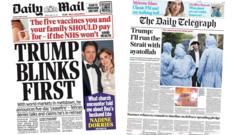
The sirens in London start as a low hum, a vibration in the floorboards before they become a scream. They are the sound of a city that hasn't quite forgotten what it means to be under fire. On a Tuesday night, as the printing presses began to churn, those sirens weren't physical, but they were felt in every newsroom from Fleet Street to the digital hubs of Canary Wharf. Two stories, seemingly worlds apart, collided on the front pages with a singular, crushing weight. One was a political collapse; the other was a human catastrophe.
Donald Trump had blinked.
For months, the air had been thick with the static of a looming trade war, a standoff that felt less like diplomacy and more like a game of high-stakes poker played with other people's livelihoods. The rhetoric was a wall of sound—bold, unyielding, and terrifyingly certain. But then, the silence. The retreat. To "blink" in the theater of global power isn't just a change of mind; it is a fracture in the persona. It is the moment the mask slips and the world sees the calculation behind the chaos.
While the pundits began dissecting the fallout of a presidency hitting a sudden, jarring brake, another headline was bleeding through the ink. In a place where the dirt is stained by more than just rain, ambulances belonging to a Jewish charity were targeted. Not just damaged. Devastated.
The Weight of a Windshield
Consider the glass.
Safety glass in an ambulance is designed to withstand the vibrations of a high-speed sprint to a trauma center. It is meant to be a barrier between a dying human being and the indifference of the outside world. When that glass is shattered by intent, it isn't just a repair bill. It is a message.
Imagine a paramedic—let's call him David, a man who has spent twenty years navigating the narrow, breathless margins between life and death. David doesn't care about trade tariffs. He doesn't care about the ego of a man in a gold-trimmed office thousands of hours away. David cares about the oxygen levels in the tank behind his seat. He cares about the bridge of his nose, which is currently pressed against a steering wheel covered in shards of light.
The attack on the Jewish charity ambulances was described by the morning papers as "horrific," a word that has been used so often it has begun to lose its teeth. But horror isn't a headline. Horror is the smell of burnt rubber and the realization that the vehicle meant to save your neighbor has been turned into a monument of hate. This wasn't a random act of urban decay. It was a surgical strike against the concept of mercy.
When a charity is targeted, the stakes aren't financial. They are existential. These organizations exist in the gaps where the state fails to reach, powered by the kind of quiet, stubborn altruism that doesn't usually make the front page. To break their tools is to tell a community that even their grief is not safe.
The Art of the Retreat
Back in the corridors of power, the "blink" was being treated as a seismic shift.
Politics is often sold to us as a series of grand, inevitable movements, like the tides. In reality, it is a series of fragile egos bumping into one another in the dark. Trump’s sudden reversal on the border or the trade deals—the specifics matter less than the optics—revealed a truth we often choose to ignore: the most powerful people in the world are often just as scared of the consequences as we are.
The "blink" is a fascinating human reflex. It’s involuntary. It happens when the dry heat of the spotlight becomes too much to bear. For a leader who built a brand on never backing down, the pivot was more than a policy shift. It was a confession. It suggested that the grand narrative of "America First" or "No Compromise" had finally hit the cold, hard wall of economic reality.
Markets don't care about rallies. They care about supply chains. They care about the price of grain and the cost of steel. When those numbers started to scream, the bluster had to stop. The bully pulpit became a very lonely place to stand.
The Invisible Threads
It is tempting to see these two stories—the political retreat and the ambulance attack—as separate entities. One is a matter of statecraft; the other is a matter of hate crime. But they are bound together by a single, fraying thread: the loss of the middle ground.
We live in an era where the extreme is the new baseline. When leaders use language like a bludgeon, it creates a climate where the unthinkable becomes common. If the man at the top can threaten to upend the global order on a whim, why shouldn't the man on the street feel emboldened to throw a brick through the window of a charity?
Violence and political volatility are siblings. They feed off the same energy—the sense that the old rules no longer apply, that the "other" is not just a neighbor with a different opinion, but an obstacle to be removed.
The ambulances were more than just vans. They were symbols of a specific kind of resilience. In the Jewish tradition, the concept of Pikuach Nefesh—the preservation of human life—overrides almost every other religious law. To save a life is to save a world. By attacking those vehicles, the perpetrators weren't just hitting a charity; they were trying to break a world.
The Cost of the Morning After
The papers will be recycled by noon. The digital cycle will move on to the next outrage, the next "blink," the next tragedy. But the resonance of this particular Tuesday night lingers.
There is a specific kind of exhaustion that comes from watching the world tear itself apart at the seams. It's the exhaustion David feels as he sweeps the glass out of the driver's side footwell. It's the exhaustion a small business owner feels when they realize the trade war they were told was "easy to win" has just cost them their legacy.
We are told that these are "unprecedented times." They aren't. History is a repeating loop of ego and aftermath. What is different is the speed. We see the blink in real-time. We see the blood on the pavement before the ambulance can even arrive.
The real story isn't that a politician changed his mind or that a group of radicals committed an atrocity. The story is the quiet, terrifying realization that the structures we thought were solid—the norms of diplomacy, the sanctity of medical aid—are actually as thin as a sheet of newsprint.
You can patch a windshield. You can draft a new trade agreement. But you cannot easily repair the trust that was lost in the hours between the sun setting and the first edition hitting the stands. The bluster broke, and in the sudden, cold clarity of the aftermath, we are left looking at one another, wondering who will be the first to start picking up the pieces.
The ink is dry. The coffee is cold. Somewhere, an ambulance is being towed into a garage, its lights dark, its mission paused by a hatred that doesn't know how to blink. And in a high-rise far away, a man prepares his next tweet, already forgotten that for a brief, flickering moment, he showed the world he was human enough to be afraid.
The silence that follows isn't peace. It's the sound of the world holding its breath, waiting for the next scream to begin.
Would you like me to analyze how the public's perception of these events shifted in the following week's polling data?