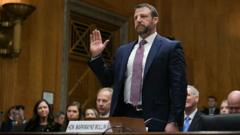
The United States Senate has officially confirmed Markwayne Mullin as the Secretary of Homeland Security, marking a definitive end to the era of career bureaucrats at the helm of the nation's most sprawling domestic agency. This isn't just another cabinet shuffle. It is a fundamental pivot in how the federal government views the intersection of trade, tribal sovereignty, and the physical border. Mullin, a former plumber and MMA fighter turned Senator, now inherits a department with a $60 billion budget and a workforce of 260,000 people who have spent the last decade caught in a perpetual state of identity crisis.
By confirming Mullin, the Senate has signaled a move toward a more aggressive, physically-oriented security posture. His mandate is clear: prioritize the completion of the southern border wall, streamline the deportation process, and overhaul the Department of Homeland Security (DHS) from a defensive posture to an offensive one. For critics, the move represents a dangerous politicization of law enforcement. For supporters, it is the long-awaited arrival of a leader who views the border not as a policy puzzle to be solved, but as a physical line to be defended.
The Plumber and the Border
Mullin’s background is his primary asset and his biggest liability. He does not come from the traditional pipeline of governors, federal prosecutors, or intelligence officials who usually run DHS. Instead, he brings a blue-collar pragmatism that resonates with the rank-and-file of Customs and Border Protection (CBP). The morale within CBP has hit historic lows over the last five years, largely due to a perceived lack of clear directives from Washington. Mullin’s first task is to stop the bleeding of personnel.
He understands the mechanics of large-scale operations. When you run a massive service company, you look for leaks. You fix the infrastructure first. Mullin views the border through this lens of mechanical failure. To him, the current system is a pipe that has burst, and the previous administration's attempts to patch it with temporary policy memos were never going to hold.
The Tribal Factor
One of the most overlooked aspects of Mullin’s appointment is his status as a member of the Cherokee Nation. This is not a mere biographical detail. It is a strategic pivot. The U.S. border crosses through dozens of indigenous lands, creating complex legal webs that have stalled enforcement efforts for years. Mullin is uniquely positioned to navigate these jurisdictional minefields.
He knows how to speak to tribal leaders as a peer. This could lead to unprecedented cooperation in areas where the federal government has historically been viewed with deep suspicion. If Mullin can successfully negotiate border security easements on tribal lands, he will have accomplished something that no career politician has managed in the history of the department.
A Department Out of Balance
DHS was born out of the 9/11 Commission’s recommendations, a Frankenstein’s monster of 22 different agencies stitched together to prevent another terror attack. Over time, the mission creep has been staggering. Today, the department is responsible for everything from the Secret Service and the Coast Guard to cybersecurity and disaster response through FEMA.
Mullin’s confirmation suggests a narrowing of focus. There is a growing consensus among his allies that DHS has become too heavy, distracted by missions that should arguably belong to the FBI or the Department of Energy. By placing a traditional "border hawk" at the top, the administration is telegraphing that the "H" in DHS now stands primarily for the physical perimeter of the country.
The Cybersecurity Question
This shift comes with significant risks. As Mullin focuses on the physical border, the invisible ones—our digital networks—remain under constant assault. Critics argue that a Secretary focused on concrete and steel may lack the nuance required to manage the Cybersecurity and Infrastructure Security Agency (CISA).
The threat from state-sponsored hacking and ransomware hasn't slowed down. If Mullin treats CISA as a secondary concern, he leaves the nation’s power grids and financial systems vulnerable. The challenge for the new Secretary will be to delegate the technical complexities of digital defense to experts while he spends his political capital on the Rio Grande.
The Logistics of Deportation
The most controversial part of Mullin's confirmed agenda is the promise of a massive increase in interior enforcement. This requires more than just will; it requires a logistical miracle. You cannot simply "deport millions" without an astronomical increase in judicial resources, detention space, and transport infrastructure.
- Judicial Backlog: There are currently over 3 million cases pending in immigration courts. Mullin will need to coordinate with the Department of Justice to surge immigration judges to the border, or find ways to bypass the traditional court system through expedited removal.
- Transportation: The "Plumber’s Logic" applies here. Moving thousands of people daily requires a fleet of aircraft and buses that currently does not exist in the federal inventory.
- International Cooperation: Deportation is a two-way street. If countries like Venezuela or Nicaragua refuse to accept return flights, the entire system grinds to a halt.
Mullin has hinted at using economic leverage to force compliance. He believes that foreign aid should be directly tied to a country's willingness to accept its citizens back. It is a hardline stance that will undoubtedly create friction with the State Department, which prefers the carrot to Mullin’s stick.
The Cost of the Wall
Building a wall is expensive. Maintaining it is even more so. The previous attempts to wall off the southern border were plagued by eminent domain battles and environmental lawsuits. Mullin’s strategy appears to involve a more aggressive use of federal authority to seize land, coupled with a streamlined environmental review process.
Budget hawks are already looking at the numbers. The cost per mile of the border wall has skyrocketed due to the rising price of steel and labor. Mullin will have to defend these expenditures before a divided Congress that is increasingly wary of the national debt. He will argue that the "cost of inaction"—in the form of fentanyl deaths and social services for undocumented migrants—far outweighs the price of the bricks and mortar.
Redefining the Mission
The confirmation of Markwayne Mullin is a signal that the time for debate is over. The administration is betting that a man who knows how to build things and fight will be more effective than a man who knows how to write white papers. It is a high-stakes gamble on the soul of the American bureaucracy.
Success for Mullin will be measured in numbers: miles of wall built, the number of successful deportations, and the decrease in illegal crossings. Failure will look like a department in chaos, mired in endless litigation and distracted from the evolving threats of the 21st century.
The plumbing is broken. The new Secretary has his tools out. Whether he can actually fix the leak without flooding the entire house remains the defining question of his tenure.
Watch the monthly CBP enforcement data for the first sign of a shift in the "got-away" numbers.