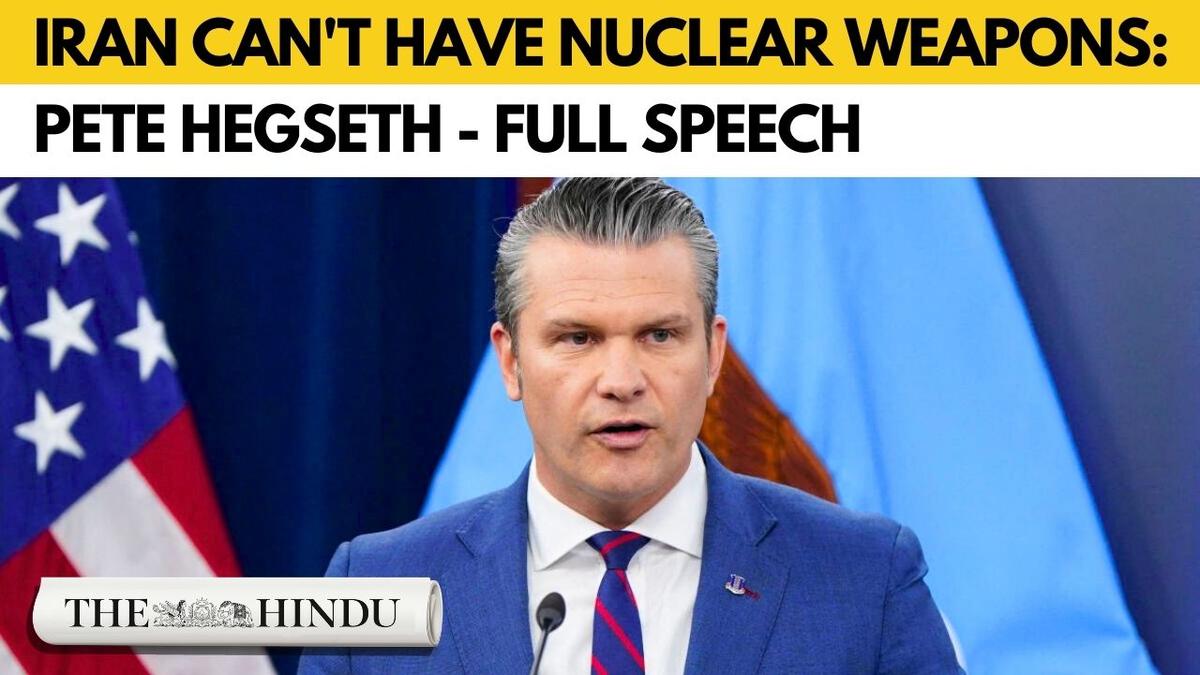
The era of strategic patience is officially dead. If you’ve been watching the recent shifts in U.S. military posturing, specifically the rhetoric coming from Defense Secretary Pete Hegseth, you’ve seen a fundamental change in how Washington talks to Tehran. It isn't just about "proportional response" anymore. It's about winning.
When Hegseth issued his recent warning to Iran following U.S. strikes on proxy targets, he didn't use the sterilized, academic language of a career diplomat. He used the language of a combat veteran. "We fight to win," he said. That four-word sentence carries more weight than a hundred-page white paper from a D.C. think tank. It signals to the Iranian regime—and the world—that the United States is moving away from the "manage the conflict" mindset that has defined the last two decades. For an alternative perspective, see: this related article.
Why the We Fight to Win Mantra Actually Matters
For years, the U.S. approach to Iranian aggression followed a predictable, almost rhythmic pattern. Iran’s proxies would fire rockets at a base, and the U.S. would strike an empty warehouse or a remote radar site. It was a game of tag where nobody wanted to get too serious. That approach failed. It didn't stop the Houthi attacks in the Red Sea, and it didn't stop Kata'ib Hezbollah from targeting American service members in Iraq and Syria.
Hegseth is betting that clarity is a better deterrent than ambiguity. By stating that the U.S. intent is to "win" rather than just "respond," he’s shifting the goalposts. In military terms, this means moving from a strategy of denial—trying to make it hard for the enemy to succeed—to a strategy of punishment. He's telling the IRGC (Islamic Revolutionary Guard Corps) that the cost of their next move might not just be a few drones or a localized facility. It might be the very infrastructure that keeps their regional influence alive. Similar reporting on this trend has been published by The Washington Post.
Breaking Down the Mechanics of the U.S. Strikes
The recent strikes weren't just a flash in the pan. They were surgical, multi-layered operations designed to degrade specific capabilities. We’re talking about command-and-control centers, munitions storage, and logistics hubs.
When you look at the hardware involved—likely a mix of F-15Es and potentially B-1B Lancers—the message is clear. The U.S. can reach out and touch anyone, anywhere, with devastating precision. But hardware is only half the story. The real "secret sauce" here is intelligence. To hit these targets effectively, the U.S. has to have "eyes on" inside these organizations. Hegseth’s warning implies that our visibility into their operations is much better than they’d like to believe.
- Precision over Volume: The goal isn't to level a city; it's to take out the specific guy holding the remote control.
- Speed of Attribution: We aren't waiting weeks to figure out who pulled the trigger anymore.
- Decoupling Proxies from Principals: The U.S. is increasingly holding Iran directly responsible for the actions of its "axis of resistance."
The Veteran Perspective in the Pentagon
It’s worth noting that Hegseth’s background as an infantry officer in Iraq and Afghanistan shapes every word he says. He’s seen what happens when the rules of engagement are too restrictive. He’s seen what happens when the mission is "stability" instead of "victory."
Critics argue that this kind of rhetoric is "saber-rattling" that could lead to an accidental war. They're wrong. Weakness and "measured" responses are what invite miscalculation. When an adversary thinks they can poke the bear without getting bit, they keep poking. Hegseth is making it clear the bear is awake, caffeinated, and ready to finish the fight. This isn't about starting a new war. It's about ending the cycle of low-level conflict that has bled American resources for years.
What Tehran is Really Thinking Right Now
Don't let the fiery speeches from Iranian officials fool you. They are pragmatists at heart. The Iranian regime’s number one priority is survival. They know they can't win a conventional war against the United States. Their entire strategy relies on staying just below the threshold of "total war."
Hegseth is essentially lowering that threshold. He's saying, "The line you thought was over there? It’s actually right here." This forces the IRGC to recalculate their risk-to-reward ratio. If the reward is a headline about a drone strike, but the risk is the loss of a major port or an oil refinery, the math doesn't work out for them anymore.
The Shift in Global Alliances
This "fight to win" stance has massive ripple effects beyond just the Middle East. Allies like Israel, Saudi Arabia, and the UAE are watching closely. They’ve felt abandoned by the "pivot to Asia" talk of previous years. Seeing a Defense Secretary take a hardline stance gives these partners the confidence to coordinate more closely with U.S. Central Command (CENTCOM).
It also sends a message to Moscow and Beijing. They use Iran as a tool to distract and de-center American power. If the U.S. demonstrates it can decisively handle Iranian provocations without getting bogged down in a "forever war" quagmire, the strategic value of Iran as a proxy for the larger powers diminishes significantly.
Getting Real About the Risks
Is there a risk of escalation? Of course. Military action always carries risk. But we’ve spent two decades trying the "softly, softly" approach, and it’s led us to a point where global shipping is being held hostage by a group of rebels in Yemen.
The mistake most people make is thinking that doing nothing is the "safe" option. In the Middle East, doing nothing is an active choice that usually results in more violence later. Hegseth’s "stark warning" is an attempt to break that loop. It’s an investment in long-term peace through the credible threat of overwhelming force.
Moving Toward a New Standard
Expect to see more of this. The Pentagon is being reshaped to prioritize lethality and readiness over bureaucratic box-ticking. You can see it in the way the current leadership talks about budget priorities and the way they're pushing for faster deployment of autonomous systems and next-gen tech.
If you’re a defense contractor, your focus better be on things that actually blow stuff up and protect our troops, not just "strategic partnership" frameworks. If you’re an adversary, you’re currently looking at a U.S. military that has been given a very simple, very dangerous directive: win.
Watch the movements in the Eastern Mediterranean and the Persian Gulf over the next few months. We’re going to see a higher tempo of carrier strike group rotations and more "freedom of navigation" operations. The U.S. isn't pulling back. It's leaning in.
Stop looking at these strikes as isolated events. They are part of a broader doctrine. The days of the "apology tour" military are over. If you want to stay ahead of where the geopolitical needle is moving, you need to ignore the noise and focus on the intent. The intent is now clearly stated.
Audit your own understanding of regional stability. If your baseline was the 2015-2022 era, toss it out. We’re in a different world now. The new rule is simple: if you hit us, we won't just hit back. We'll make sure you can't hit anything ever again.