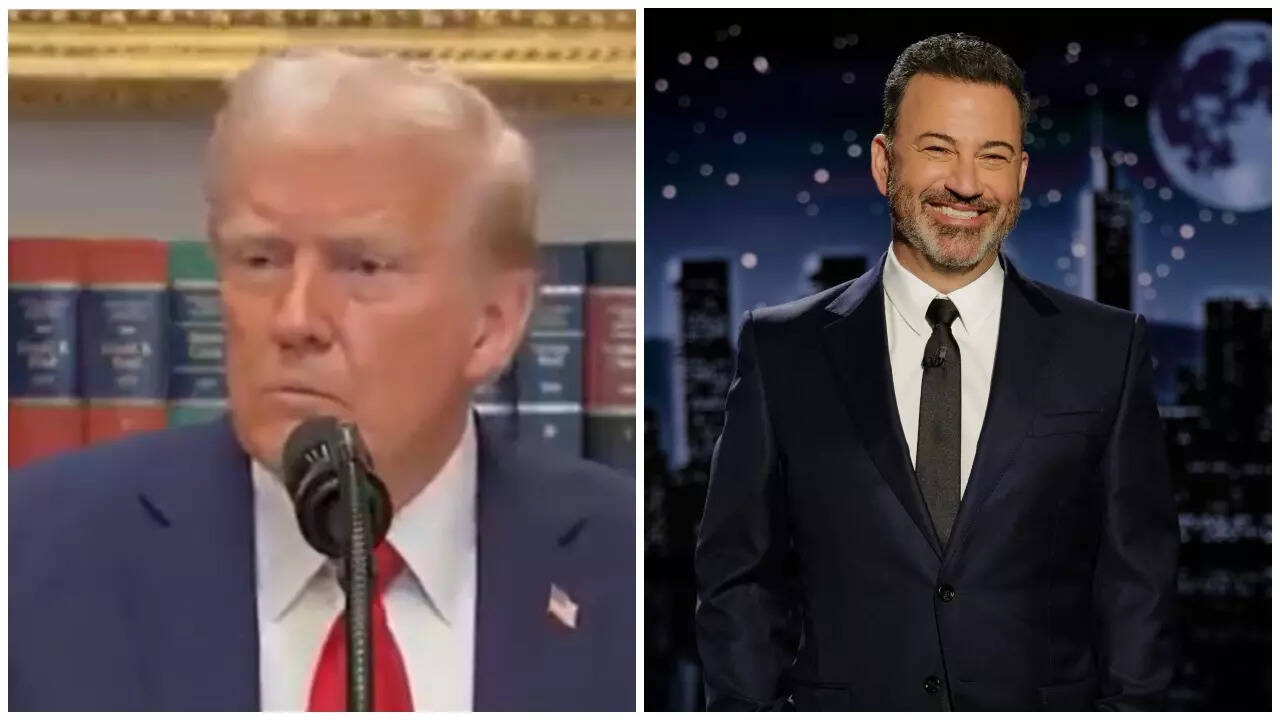
Jimmy Kimmel’s recent monologue targeting Donald Trump’s supposed frustration over the Oscars snub of the Melania documentary is more than just a late-night punchline. It is a calculated strike in an ongoing cultural war. While the comedian framed the snub as a personal ego bruise for the former president, the underlying reality reveals a deepening rift between the Hollywood establishment and the political right. Kimmel’s commentary serves as a barometer for how award season has morphed from a celebration of craft into a primary battlefield for narrative control.
The film in question, a documentary exploring the life of the former First Lady, was never a serious contender for Academy recognition. Industry insiders knew it. The producers knew it. Yet, the vacuum left by its absence provided the perfect opening for a seasoned satirist to needle a thin-skinned political figure. By suggesting Trump is "mad" about the omission, Kimmel isn't just making a joke; he is reinforcing the barrier between the "prestige" of the arts and the "populism" of the MAGA movement.
The Comedy as a Tactical Strike
Late-night hosts have abandoned the role of the neutral jester. In the current media environment, Kimmel and his peers act as unofficial communications directors for a specific ideological demographic. When Kimmel mocks the lack of an Oscar nomination for a film centered on a Trump family member, he is signaling to his audience that the Academy remains a safe fortress against the influence of the right.
This isn't about the quality of the filmmaking. Documentary filmmaking is a rigorous, often grueling discipline that requires years of access and a clear narrative arc. Most political documentaries produced by partisan outfits fail to meet the technical standards of the Academy’s documentary branch. However, the technicalities are irrelevant to the public discourse. The narrative being sold is one of exclusion versus inclusion. Kimmel uses the Oscars as a benchmark for legitimacy, knowing full well that a nomination for Melania would have been an institutional earthquake.
Why the Academy Rejects Political Hagiography
The Academy of Motion Picture Arts and Sciences has a very specific, if unwritten, set of rules for what constitutes a "serious" documentary. They prefer stories of individual struggle, environmental catastrophe, or deep-dive investigative journalism. Films that feel like extended campaign commercials or protective portraits of political figures rarely make the shortlist.
- Vetting the Source: The documentary branch is notoriously protective of its reputation. They look for independent financing and directorial autonomy.
- The Narrative Arc: A film that serves to polish an image rather than deconstruct a life is viewed as "content" rather than "cinema."
- The Peer Review: Voters in this category are often the most progressive and artistically rigid members of the Academy.
Donald Trump’s history with the Oscars is one of mutual obsession. He has frequently live-tweeted the ceremonies, critiquing the ratings, the hosts, and the political speeches. Kimmel’s joke works because it plays on a documented pattern of behavior. Trump values the "gold standard" of old-guard celebrity, even as he builds a brand on dismantling old-guard institutions. To be rejected by the very people he claims to despise is a recurring theme in his public life.
The Ratings Trap and the Cultural Divorce
There is a financial subtext to this mockery that Kimmel rarely mentions. The Oscars have seen a steady decline in viewership over the last decade, particularly in middle America. By turning the ceremony into a platform for partisan ribbing, the industry risks further alienating a massive segment of the domestic box office.
When a host spends his monologue mocking the leader of a movement followed by half the country, he is effectively telling that half that the awards are not for them. This creates a feedback loop. The right-wing media then spends the next week attacking the "woke" Oscars, which drives their audience further away, which in turn makes the Academy more reliant on a niche, coastal audience. It is a cycle of diminishing returns.
Kimmel’s jab about Trump’s anger over the Melania film is a low-risk, high-reward move for his specific brand. It secures his "clout" with his base and ensures his clips go viral on social media platforms favored by the left. But as an industry analyst, one has to ask if the short-term dopamine hit of a viral monologue is worth the long-term erosion of the Oscars' status as a universal cultural event.
The Myth of the Snub
To call the omission of the Melania film a "snub" is a massive stretch of the term. A snub implies that a worthy piece of work was intentionally overlooked for nefarious reasons. In this case, the film simply didn't exist in the same universe as the year's top contenders. It didn't play the festival circuit at Sundance or Telluride. It didn't have a massive critical push in Variety or The Hollywood Reporter.
The documentary was a product designed for a specific consumer base. Expecting it to land an Oscar nomination is like expecting a high-performing corporate training video to win an Emmy. Yet, by framing it as a "snub" that makes Trump "mad," Kimmel elevates the film's importance. He gives it a shadow-relevance that it never earned on its own merits. This is the paradox of modern political comedy: the more you mock the "other side," the more you center the entire conversation around them.
The First Lady’s Enigmatic Brand
Melania Trump has always been a difficult subject for filmmakers and journalists alike. Her "I really don't care, do u?" jacket remains the defining metaphor for her public persona. A documentary that tries to humanize or explain her faces an uphill battle because she provides so little raw material to work with.
The Academy loves a "reveal." They love the moment the mask slips. Melania Trump’s brand is the mask. Without the vulnerability that Oscar voters crave, any film about her was destined to be viewed as a sterile PR exercise. Kimmel knows this. He isn't just mocking the film; he’s mocking the very idea that there is something deep enough there to warrant a nomination.
A New Era of Celebrity Combat
We are no longer in an era where entertainers and politicians inhabit separate spheres. They are now competing for the same thing: attention. Kimmel isn't just a comedian; he is a competitor for the evening news cycle. Trump isn't just a politician; he is a former reality TV star who understands the mechanics of a "show" better than most producers.
This clash over a non-nominated documentary is a microcosm of the 2026 media landscape. It is an ecosystem where the lack of an award is more valuable for a joke than the award itself would be for the film’s credibility. The "outrage" is the product.
The Strategy of Irritation
Kimmel’s strategy is one of constant, low-level irritation. By focusing on the Oscars—a world Trump once craved entry into—he hits a specific nerve. It’s not about policy or law; it’s about social standing. In the high-society circles of Palm Beach and New York, an Oscar is still the ultimate currency. To be told your story isn't "good enough" for the theater is a social demotion.
While the competitor's article likely focused on the surface-level humor of the monologue, the deeper story is the death of the "universal" celebrity. We now have two separate star systems. One is centered in Los Angeles and revolves around traditional accolades. The other is centered in Florida and revolves around digital engagement and political loyalty. These two systems occasionally collide, and when they do, sparks fly in the form of late-night monologues and Truth Social rants.
The Impact on Documentary Credibility
The weaponization of documentary films for political point-scoring has a side effect: it cheapens the medium. When audiences see documentaries being used as pawns in a feud between a talk show host and a politician, they begin to view all documentaries through a skeptical lens. The "truth" becomes secondary to the "team."
If a film about a conservative figure is automatically dismissed by the Academy, and a film about a progressive figure is automatically praised, the Oscar loses its value as a mark of quality. It becomes a participation trophy for having the "correct" viewpoint. Kimmel’s joke, while funny to his target audience, reinforces the idea that the Academy is a closed shop.
The Future of the Hollywood-Washington Feud
Expect this trend to accelerate as we move closer to the next election cycle. Every red carpet will be a minefield of political questioning. Every snub will be analyzed for signs of bias. Every acceptance speech will be scanned for a "call to action."
Kimmel’s monologue was a opening salvo in what promises to be a very loud year. By mocking Trump’s relationship with the Academy, he is drawing a line in the sand. He is telling the world that Hollywood is not a neutral party. It is an active participant in the resistance. Whether that is a sustainable business model for an industry currently facing massive layoffs and a shrinking theater-going audience remains to be seen.
The true test will not be whether Trump responds to Kimmel’s barbs—he almost certainly will—but whether the public still cares about the opinion of the man holding the microphone once the cameras turn off. When the joke is the only thing left of the cultural conversation, the art itself has already lost.
Check the technical requirements for documentary eligibility on the official Academy site to see just how far the Melania project fell short of the mark.