The wind at RAF Valley doesn’t just blow. It scours. It carries the salt of the Irish Sea and the sharp, metallic scent of aviation fuel, whipping across the tarmac of Anglesey with a ferocity that can make a grown man lean forty degrees just to stay upright. For most, this is a harsh, desolate outpost. For a search and rescue pilot, it is the edge of the world where the stakes are life, death, and the mechanical reliability of a Sea King helicopter.
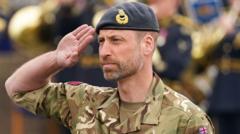
William stood on that tarmac recently. Not as the future King, though the titles trailed behind him like a heavy velvet cape, but as a man revisiting the place where his youth was forged in the cockpit.
He wasn't there for a ribbon-cutting ceremony or a dry briefing on procurement. He was there to see a new generation of pilots—specifically, those graduating from the No. 1 Flying Training School. But as he looked at the sleek, modern aircraft and the faces of young men and women whose careers are still all promise and no scars, you could see the flicker of a different man in his eyes.
Flight Lieutenant Wales.
The Weight of the Collective Memory
There is a specific kind of silence that exists inside a military hangar. It is a vast, echoing space that holds the ghosts of every engine start and every debrief. When William walked back into this environment, he wasn't just observing a milestone for others. He was stepping back into the only period of his life where he was judged primarily by his horizontal stabilizer control rather than his lineage.
Imagine the pressure. Not the pressure of the crown—that is an abstract, heavy thing—but the pressure of a night-time winch over a churning sea.
Consider a hypothetical pilot, let’s call him Sam. Sam is twenty-four. He is sitting where William sat fifteen years ago. Sam doesn't care about the constitutional implications of the guest of honor. He cares about the fact that his hands are sweating because he’s about to be handed wings that signify he is now responsible for the lives of his crew and the strangers he will eventually be sent to save.
When William speaks to these graduates, he isn't reciting a speech written by a committee. He is talking to the only people on earth who understand the specific vibration of a rotor head when the weather turns foul.
The Human Element of the High-Stakes Return
RAF Valley is where the Prince of Wales spent three years as a Search and Rescue pilot. Those were years of 24-hour shifts, greasy breakfast rolls in the mess hall, and the sudden, jarring adrenaline of the "scramble" bell.
It is easy to forget that beneath the tailored coats and the diplomatic smiles, there is a man who has looked down into the black abyss of the Atlantic searching for a flare. That kind of experience changes the way a person walks. It changes the way they look at a map.
During his visit, William met with crew members and their families. This is where the narrative shifts from a state visit to a human reunion. He spoke about "fond memories," a phrase that feels light but carries immense weight. Fondness in the military isn't about comfort. It’s about the bond formed when you are tired, cold, and doing something that matters.
The invisible stakes of this visit weren't about military funding. They were about the continuity of service. By returning, William validates the grueling path these young pilots have chosen. He signals that even from the heights of the monarchy, the most valuable thing a person can offer is their time in the service of others.
The Mechanics of Nostalgia
The air base has changed. The old Sea Kings, those bulbous, reliable workhorses that William flew, have been retired. They have been replaced by the Juno and Jupiter helicopters—sharper, faster, and more digital.
There is a quiet melancholy in seeing your old tools replaced by newer, better versions. It is the realization that time moves on even when you aren't looking. William walked through the state-of-the-art simulators, machines that can mimic a gale-force wind with terrifying accuracy without ever leaving the ground.
But a simulator cannot replicate the smell of the Welsh coast or the way the light hits the Snowdonia mountains at dawn.
The Prince spent time with the families of the graduates. This is the part of the story usually left out of the headlines. For every pilot receiving their wings, there is a partner, a parent, or a child who has spent the last year wondering if they would make the cut, or worrying about what happens when the training wheels come off.
William knows this perspective too. At the time he was stationed here, he was a newlywed. Kate Middleton was a familiar face at the local grocery store in Rhosneigr. They lived in a rented farmhouse. They were, for a brief window of time, almost normal.
The Bridge Between Two Worlds
What makes this return compelling is the collision of the extraordinary and the mundane.
One moment, William is the Royal Colonel of the air base, receiving salutes. The next, he is leaning in to hear a joke from an old technician who remembers him not as a Royal Highness, but as a pilot who probably made the same mistakes every trainee makes.
This visit serves as a reminder that expertise is earned, not inherited. You cannot be "born" into the ability to hover a multi-ton aircraft in a crosswind. You have to sweat for it. You have to fail and try again.
As he stood there, watching the flypast, the sound of the engines wasn't just noise. It was a rhythm he once lived by.
The graduates stood tall, their uniforms crisp, their futures unwritten. They looked at the Prince and saw a destination. He looked at them and saw his own beginning.
He didn't just leave a plaque or a signed guestbook. He left with the visible lightness of a man who had briefly touched base with his truest self. He walked back to his transport, the Welsh wind still scouring the tarmac, leaving behind the ghosts of his younger self to make room for the new names on the flight roster.
The rotors began to turn, a low hum growing into a roar, and for a split second, the Prince looked back at the hangar, a pilot once more, before the door closed and the world reclaimed him.