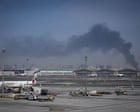
You probably didn't have "global energy heart attack" on your 2026 bingo card, but here we are. On March 2, 2026, QatarEnergy pulled the plug on its Liquefied Natural Gas (LNG) production. This wasn't some scheduled maintenance or a minor technical glitch. It's a direct response to Iranian drone strikes hitting the Ras Laffan and Mesaieed industrial hubs.
If you're wondering why this matters for your heating bill or the price of electricity, the math is pretty simple and scary. Qatar provides roughly 20% of the world’s LNG. Imagine one out of every five lightbulbs powered by gas suddenly going dark. That’s the scale of the hole in the market right now. Prices in Europe already shot up 50% in a single day. This isn't just a Middle East problem; it’s a "everyone who uses electricity" problem.
The moment the taps went dry
The strikes happened fast. Iranian drones targeted a water tank at a power plant in Mesaieed and an energy facility in Ras Laffan. While the physical damage might not have leveled the entire complex, the message was sent. Qatar didn't wait around to see if a second wave was coming. They shut it all down.
It’s a precautionary move, but "precautionary" doesn't stop the panic. Ras Laffan is the largest export facility on the planet. When it stops, the ripples hit Tokyo, Berlin, and New Delhi within hours. We aren't just talking about a few missed shipments. We're talking about a full-scale suspension of the world's most reliable gas supply.
Why the Strait of Hormuz is the real nightmare
Even if Qatar wanted to keep the gas flowing, they have a massive geography problem. Every single drop of Qatari LNG has to pass through the Strait of Hormuz. It's a narrow stretch of water that Iran can essentially turn into a parking lot whenever it wants.
Since the conflict escalated on February 28, tanker traffic has ground to a halt. Insurance companies are already pulling war-risk coverage. If a ship can’t get insured, it doesn’t sail. It’s that simple. Unlike Saudi Arabia, which has pipelines that can bypass the coast to reach the Red Sea, Qatar is effectively landlocked when the Strait closes. There is no "Plan B" pipeline for LNG.
Europe is walking on thin ice
The timing couldn't be worse for the EU. After the 2022 energy crisis, Europe spent billions trying to diversify away from Russian gas. They bet big on LNG, and much of that bet was placed on Qatar.
Current storage levels in Europe are sitting at about 30%. That’s dangerously low for this time of year. Usually, the spring is when countries start refilling their tanks for the next winter. With Qatari supply gone and prices for remaining cargoes hitting €46 per megawatt-hour, the "refill" is going to be eye-wateringly expensive.
I’ve seen analysts at Goldman Sachs warn that if this lasts a month, prices could double again. We’re looking at a scenario where the 2022 crisis looks like a dress rehearsal.
The Asian scramble for what’s left
Don't think this is just a European headache. China, Japan, and South Korea buy the vast majority of Qatari gas. They rely on long-term contracts that are now facing "force majeure"—a legal term basically meaning "we can't deliver, and it’s not our fault."
When Asian buyers lose their primary source, they don't just sit in the dark. They go to the "spot market" and outbid everyone else for the few cargoes available from the US or Australia. This creates a global bidding war. Your local utility provider is now competing with a billionaire industrialist in Shanghai for the same molecule of methane.
What actually happens next
We need to be realistic about how this ends. It’s not just about repairing a drone-damaged water tank. It’s about the security of the entire Persian Gulf.
- The US pressure cooker: President Trump has signaled that the bombing campaign against Iran could last weeks. If that's true, don't expect the Strait of Hormuz to open anytime soon.
- The "Golden Pass" factor: There’s a tiny bit of hope in the US Golden Pass LNG project, which is supposed to start up soon. But it won't be at full capacity until 2027. It’s too little, too late for this specific crisis.
- Internal Qatari politics: Qatar shares the North Field—the source of its gas—with Iran. This makes the situation incredibly delicate. They are literally pulling gas from the same giant underwater bubble as the country that just sent drones into their backyard.
Honestly, the "just wait and see" approach isn't going to work here. If you're running a business that depends on stable energy costs, you need to be looking at your hedging strategies right now. The era of cheap, reliable LNG just hit a massive, Iranian-shaped wall.
Watch the insurance markets. If the maritime insurance clubs don't return to the Gulf by Thursday, we’re in for a long, cold, and very expensive spring. Check your energy contracts today and prepare for surcharges. The market isn't just shaking; it's breaking.