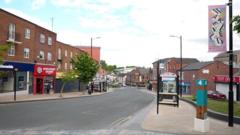
The air in Wakefield Cathedral precinct doesn’t smell like revolution. It smells of Greggs pasties, damp pavement, and the exhaust fumes of buses idling near the Ridings Shopping Centre. But if you stand long enough near the statue of Queen Victoria, you start to hear it. It isn’t a roar. It is a low, persistent hum of exhaustion.
For decades, this city was a fortress. It was built on coal, textiles, and a brand of Labour loyalty that felt as permanent as the stone foundations of the Chantry Bridge. Then came 2019, and the wall turned blue. Then came a by-election, and it turned red again. Now, the political map shows a different shade entirely. Reform UK has taken the reins of the local council, and the residents are staring at the results like a family looking at a strange new piece of furniture they aren't quite sure will hold their weight.
To understand why a city would hand the keys to a fledgling movement, you have to look past the polling data. You have to look at the shop shutters.
The Geography of Neglect
Consider a hypothetical resident named Arthur. He is seventy-two. He remembers when Westgate was the pulse of the North, a place where the "Wakefield Westgate Run" meant more than just a night of drinking—it meant a city with a future. Today, Arthur walks past empty units that have been vacant so long they’ve become part of the architecture. To Arthur, and thousands like him, the "major parties" are no longer political entities; they are distant management consultants who only visit when they want something.
The rise of Reform in Wakefield isn't necessarily a sudden lurch to the right. It is a collective shrug of the shoulders toward a status quo that stopped delivering. When people feel invisible, they eventually vote for the person who promises to turn the lights on, regardless of whose name is on the bulb.
The data supports Arthur’s malaise. Wakefield has seen a stagnation in real wages that mirrors much of the post-industrial North, but here, the psychological impact is sharper. The city sits in the shadow of Leeds, a glittering hub of finance and digital law. While Leeds reaches for the clouds with glass skyscrapers, Wakefield often feels like it is just trying to keep the puddles from deepening.
The Language of the Pub and the Doorstep
Mainstream politics often speaks in the dialect of the white paper and the focus group. Reform speaks the language of the pub. It is blunt. It is unpolished. Often, it is angry. In the cafes along Northgate, the conversation isn't about macroeconomic fiscal rules or international treaties. It is about why it takes three weeks to see a GP and why the high street looks like a graveyard.
There is a visceral sense that the social contract has been shredded. People in Wakefield aren't reading manifestos; they are reading their energy bills and the "Closing Down" signs on local businesses. Reform tapped into this not by offering a 500-page plan, but by validating the anger. They didn't tell people they were wrong to be frustrated. They told them they were right.
But validation is a temporary drug. The reality of governing a council is a messy, unglamorous business of bin collections, social care budgets, and planning permissions. The "insurgents" are now the incumbents. They are no longer throwing stones at the windows; they are responsible for fixing them.
A City of Contradictions
Walk down toward the Hepworth Gallery, a brutalist masterpiece of modern art that sits on the edge of the River Calder. Here, Wakefield looks sophisticated, global, and forward-thinking. It is a world-class institution in a city that often feels forgotten. This is the central tension of the city: a place that produces incredible culture and industry but struggles to retain the wealth those things generate.
The locals aren't a monolith. For every person who cheered the Reform win as a "reckoning," there is someone else—perhaps a younger voter working at the Pinderfields Hospital—who views the shift with genuine trepidation. They worry about the rhetoric. They worry that a protest vote has turned into a permanent reality that might isolate the city even further.
The "Red Wall" was always a clumsy metaphor. It suggested something rigid and impenetrable. In reality, the politics of towns like Wakefield are more like the river—constantly shifting, eroding old banks, and carving new paths when the old ones become blocked by silt and debris.
The Invisible Stakes
What happens when the protest becomes the power? This is the grand experiment currently unfolding in the shadow of the cathedral. If Reform can't fix the potholes, if they can't bring the footfall back to the city center, the disillusionment won't just return to Labour or the Conservatives. It will harden into something much more dangerous: total apathy.
The invisible stake here isn't just a council seat. It is the very idea of local democracy. If people feel that no matter who they vote for, the town still feels "managed" rather than "led," they stop participating entirely.
Wakefield is currently a laboratory for the rest of the country. Westminster is watching. Not because they care about the nuances of West Yorkshire life, but because they are terrified that what happened here is a preview of a national trend. They see a electorate that has stopped listening to the traditional "experts" and started listening to whoever speaks the loudest about the things they see through their own front windows.
The Sound of the Shift
On a Tuesday afternoon, the market is quiet. A vendor sells knock-off phone chargers and thick wool socks. He doesn't want to talk about "geopolitical shifts" or "populism." He wants to talk about the business rates. He wants to talk about the fact that his kids moved to Manchester because there was nothing for them here.
He is the human element that the spreadsheets miss. He is the reason the old maps are being burned.
The city isn't waiting for a hero. It is waiting for a sign that it still matters. For now, it has chosen a new voice to scream that message toward London. Whether that voice will be heard, or whether it will just become more noise in the wind blowing off the Pennines, remains to be seen.
The sun sets over the Kirkgate station, casting long, orange shadows over the tracks. Trains pull out, heading toward London, Leeds, and Sheffield, carrying people away from a city that is currently holding its breath. The residents go home, lock their doors, and wait to see if the world looks any different in the morning. They have done their part. They have broken the cycle. Now, they are waiting to see if anyone knows how to build something new from the pieces.
The hum of the city continues—low, steady, and expectant.