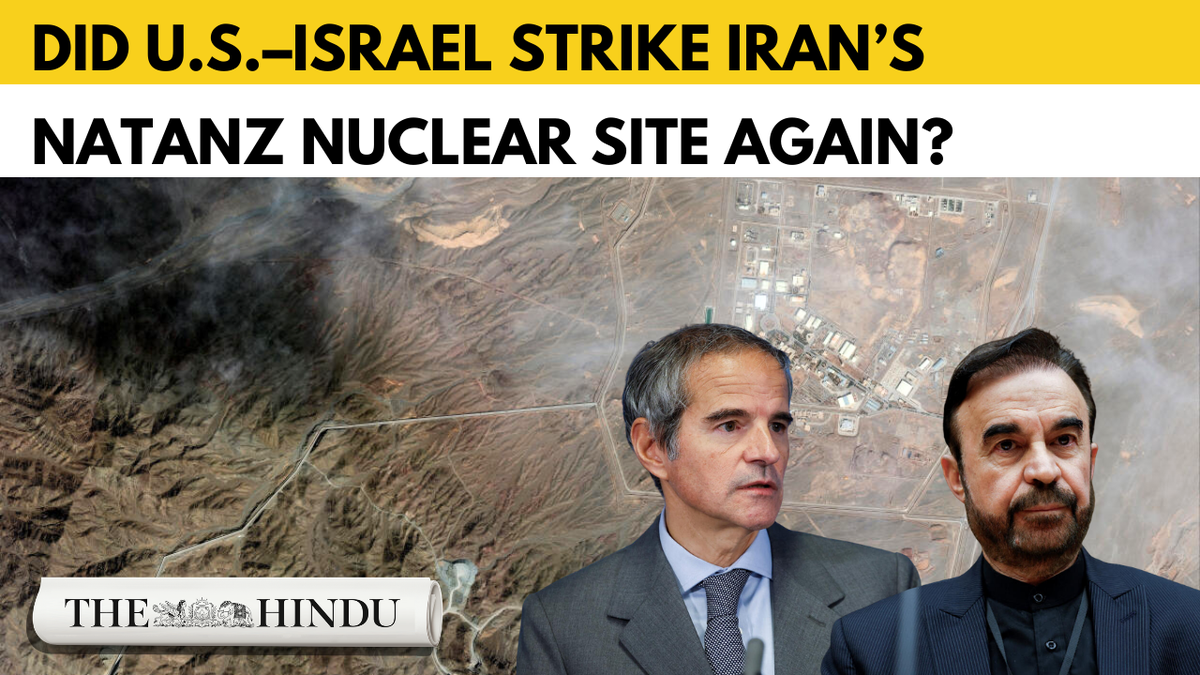
The ground does not scream when it is wounded. Deep beneath the salt flats of central Iran, under the watchful, jagged peaks of the Zagros Mountains, there is a facility called Natanz. To the diplomats in Vienna, it is a line item in a nuclear proliferation report. To the satellite technicians in Langley, it is a series of thermal signatures and concrete vents. But for the people living in the shadow of the mountain, and for the engineers walking its sterile corridors, it is a place where the air hums with a tension that never quite dissipates.
When the news broke that the site had been hit again, the world reacted with a practiced, cynical rhythm. Iran claimed a strike. The International Atomic Energy Agency (IAEA) offered a cautious shrug, noting they had no confirmation. It felt like a rerun of a movie we’ve all seen too many times.
Yet, there is a specific, bone-deep terror in the "unconfirmed." It is the sound of a phone ringing in the middle of the night in a Tehran suburb, a wife watching her husband dress in silence, knowing he is heading toward a hole in the earth that might be a tomb or a target.
The Ghost in the Machine
Natanz is not just a factory. It is a subterranean fortress built to protect thousands of IR-1 and IR-2m centrifuges—tall, silver cylinders that spin at supersonic speeds to separate isotopes. Imagine a ballet performed by machines, where the slightest vibration, a microscopic imperfection in a bearing, or a single line of malicious code can turn a masterpiece into a screaming pile of shrapnel.
In the past, the "hits" on Natanz haven't always looked like explosions. They looked like software glitches. They looked like a pump failing for no reason. This is the nature of modern conflict: the violence is often invisible until it is catastrophic. When Iran speaks of a new strike, they aren't necessarily talking about a missile screaming through the sky. They are talking about the compromise of their sanctuary.
The human cost of these technological shadows is heavy. Think of a technician named Arash—a composite of the many men who have worked these shifts over the last two decades. He has a degree in physics and a daughter who wants to be a painter. When he descends into the facility, he is entering a space that the rest of the world views as a chess piece. To him, it is a workplace where the lights flicker, and every hum of a cooling fan carries the weight of a potential geopolitical meltdown.
The Fog of the Report
The IAEA sits in a glass-walled building in Austria, trying to count atoms from thousands of miles away. Their silence in the wake of the recent reports isn't an admission of ignorance; it’s a reflection of the agonizingly slow pace of verification.
Inspectors cannot simply FaceTime into a high-security enrichment hall. They must negotiate. They must wait for visas. They must walk through layers of security while being watched by men with kalashnikovs who view them as spies. By the time an official report is filed, the "news" is already history.
This delay creates a vacuum, and in that vacuum, paranoia grows. If the IAEA hasn't confirmed a hit, does it mean it didn't happen? Or does it mean the damage is so internal, so sophisticated, that even the cameras installed by the UN haven't caught the flicker of the ghost?
The uncertainty is a weapon. By announcing a strike before it can be verified, Iran exerts a strange kind of power—the power of the victim and the defiant survivor simultaneously. By remaining silent, the alleged attackers (often whispered to be the Mossad or other intelligence agencies) let the imagination of the Iranian leadership do the heavy lifting.
The Weight of the Invisible Stakes
We often talk about "red lines" and "breakout times." We treat the nuclear program like a math problem. If X number of centrifuges spin at Y enrichment level, the result is Z. But the math ignores the atmospheric pressure of living in a state of perpetual "almost."
The real story of Natanz isn't found in the enrichment percentages. It’s found in the power grids of the surrounding province. When a cyberattack or a physical sabotage event hits the facility, it ripples. It’s the sudden blackout in a nearby village. It’s the surge of military convoys on the highway that keep families awake.
The invisible stakes are the degradation of trust. Every time a "hit" occurs, the circle of suspicion inside the Iranian government tightens. Who let the equipment in? Who talked to a stranger in a cafe? The facility becomes a pressure cooker not just for uranium, but for the human psyche.
Consider the irony of the mountain itself. The earth was excavated to provide safety. Millions of tons of rock were moved to ensure that no conventional bomb could reach the spinning cylinders. Yet, the most effective weapons haven't cared about the rock. They have traveled through power lines and fiber optic cables. They have arrived in the form of a "blind spot" in the security cameras. The mountain is a shield that has become a cage.
The Rhythm of Ruin
There is a specific cadence to these events.
First, the whisper on Telegram channels.
Then, a cryptic statement from a government spokesperson in Tehran.
Finally, the satellite imagery analysts begin scouring the desert for fresh scorch marks or the tell-tale presence of emergency vehicles.
In this latest cycle, the lack of IAEA confirmation adds a layer of surrealism. It is a "He Said, She Said" played out with the potential for nuclear fallout. If Iran says they were hit, they are admitting a vulnerability. Why would they do that unless the damage was too great to hide, or unless they are trying to justify a retaliation?
The technical reality of enrichment is that it is a process of extreme precision.
A centrifuge spinning at 60,000 RPM is a kinetic bomb waiting for an excuse.
The "hit" doesn't need to be a TNT blast.
A simple, forced fluctuation in the power frequency is enough to turn thousands of these machines into scrap metal in seconds.
The sound of that failure—the high-pitched whine of metal tearing into metal—is something that haunts the dreams of the people who work there. It is a sound that signifies years of work vanishing in a heartbeat. It signifies that the sanctuary has been violated again.
Beyond the Concrete
While the world focuses on the centrifuges, we miss the erosion of the diplomatic bridge. Every time a siren goes off at Natanz, the distance between Tehran and Washington grows by another thousand miles. The hawks on both sides find fresh soil to plant their arguments.
The IAEA's inability to confirm the event immediately highlights the fragility of the entire global oversight system. We have built a world where we can see the license plate of a car from space, yet we cannot know for certain if a major nuclear facility has been sabotaged until days or weeks after the fact. We are technically omniscient but practically blind.
The people of Iran, meanwhile, watch the headlines with a mixture of exhaustion and dread. They are the ones who bear the secondary effects—the sanctions that follow the tensions, the inflation that tracks with the rhetoric, and the persistent fear that one day, the "hit" won't be a surgical strike on a machine, but a spark that lights a much larger fire.
The mountain stays silent. The desert wind blows over the vents, carrying the faint, metallic scent of industry and the heavy, stagnant odor of a cold war that never thawed.
The centrifuges may be spinning, or they may be still. The IAEA may eventually find the truth, or they may find a carefully reconstructed facade. In the end, the facts of the strike matter less than the reality of the shadow it casts.
Deep underground, a technician checks a gauge. He looks at the needle. He listens for the hum. He waits for the vibration that tells him the world has changed again, while the rest of us wait for a report that will arrive far too late to matter.
A single red light blinks on a console in a room with no windows, and somewhere, a phone begins to ring.