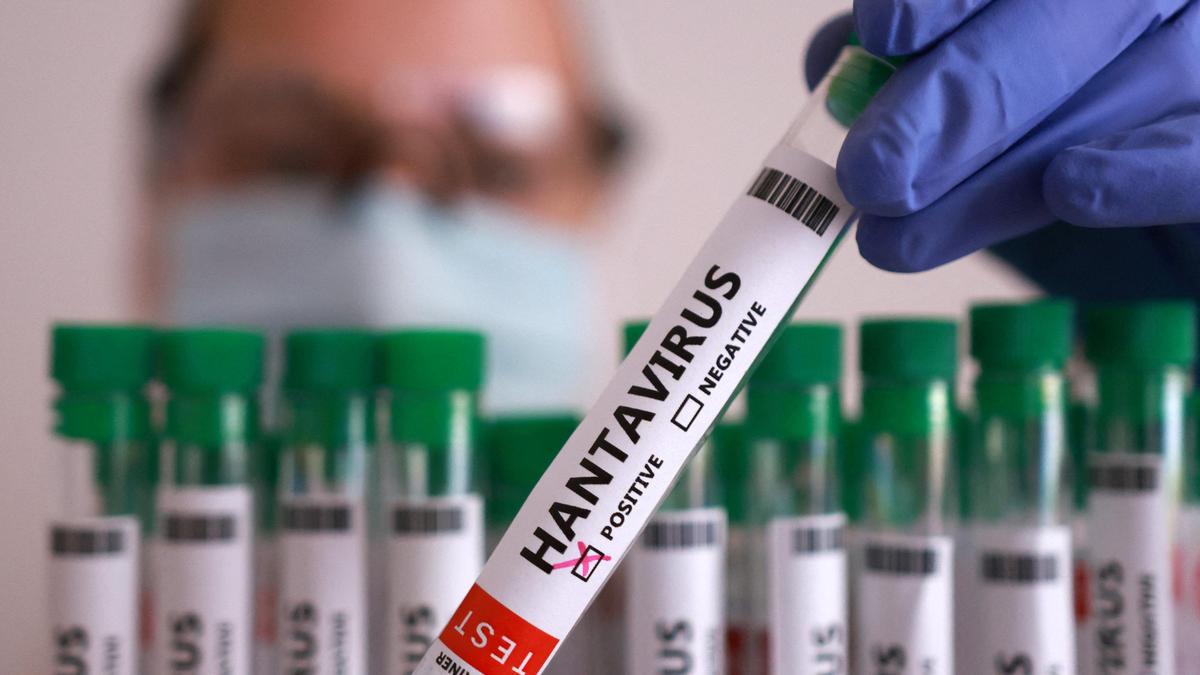
Public health officials love a good "low risk" reassurance. It is the bureaucratic equivalent of a sedative. When the WHO Chief steps to the podium to discuss a Hantavirus uptick, the script is predictable: acknowledge a few deaths, point to a rodent, and tell the masses not to worry because it doesn’t spread like COVID-19.
They are technically right and fundamentally wrong. If you liked this post, you might want to read: this related article.
The "low risk" narrative is a dangerous distraction. While the media fixates on whether Hantavirus Pulmonary Syndrome (HPS) will become the next global lockdown—which it won't—they ignore the actual crisis: the systematic collapse of local ecological barriers that used to keep these pathogens in the dirt. We are not facing a "new" threat. We are facing the consequences of treating the environment like a sterile laboratory that we can mismanage without blowback.
The Myth of the "Isolated Case"
The standard reporting on Hantavirus treats every outbreak as a freak accident of nature. A hiker cleans a cabin, breathes in some dust, and gets sick. We call it "rare." For another angle on this development, check out the recent coverage from World Health Organization.
But "rare" is a statistical shield used to avoid looking at trends. In reality, Hantavirus serves as a biological sensor for environmental instability. When you see a spike in cases, you aren't just seeing a "cluster" of infections; you are seeing a breakdown in predator-prey dynamics.
In the American Southwest and parts of South America, we’ve spent decades killing off the very things that manage the rodent population. We wipe out coyotes, snakes, and birds of prey through "nuisance" management and habitat fragmentation. Then, we act shocked when the Peromyscus maniculatus (deer mouse) population explodes and spills over into human dwellings.
The medical community focuses on the virus ($Orthohantavirus$). I’ve spent years looking at the geography of the spread, and the virus is the least interesting part of the equation. The real story is the loss of biodiversity that acts as a "dilution effect." When you have a diverse ecosystem, the virus stays trapped in a complex web of hosts. When you simplify that system through urban sprawl or monoculture farming, you create a high-speed rail for pathogens straight to your front door.
Stop Asking if it’s "The Next Pandemic"
The most common question people ask during these outbreaks is: "Can it spread person-to-person?"
The answer for most strains, like Sin Nombre, is a firm no. For the Andes virus in South America, the answer is a terrifying "sometimes." But focusing on human-to-human transmission is a rookie mistake. It’s asking the wrong question.
By the time a virus adapts for efficient human-to-human spread, the battle is already lost. The goal shouldn't be to wait for a mutation so we can justify a vaccine contract. The goal is to acknowledge that a virus with a 35% to 50% mortality rate is a nightmare regardless of its R0 value.
If you get HPS, your lungs fill with fluid. You effectively drown on dry land. Whether you caught it from your neighbor or a mouse in your garage is irrelevant to the doctor trying to intubate you. The "low risk to the general public" line is cold comfort to the communities living on the edge of the wildland-urban interface. It creates a false sense of security that prevents people from taking basic, aggressive precautions in their own homes.
The Problem With "Low Risk" Data
Public health data is lagging data. By the time the WHO confirms a case, that individual has likely been sick for weeks, and the environmental conditions that caused the infection have likely shifted.
We rely on "passive surveillance"—waiting for someone to show up at an ER half-dead before we investigate. This is purely reactive. If we were serious about public health, we would be doing "active surveillance" on the rodent populations themselves. We should be monitoring the viral load in deer mice before the first human case appears.
But we don't. Why? Because proactive ecology is expensive and doesn't get politicians re-elected. It’s much easier to wait for a tragedy and then issue a press release saying the risk is "monitored."
The Economic Blind Spot
The competitor pieces will tell you how to bleach your floors. They won't tell you how our economic policies are driving these outbreaks.
Every time we approve a new housing development that pushes deeper into previously undisturbed ecosystems, we are essentially subsidizing the next Hantavirus case. We internalize the profits of real estate and externalize the healthcare costs of the resulting zoonotic diseases.
I have watched developers tear through scrubland, displacing thousands of rodents into neighboring residential areas, only for the local health department to shrug and blame "seasonal weather patterns." It’s not the weather. It’s the bulldozers.
How to Actually Protect Yourself (The Non-Sanitized Version)
Forget the "don't worry" advice. If you live in an area where Hantavirus is endemic, you should be borderline paranoid.
- Abolish the "Vermin" Mindset: Stop using poison. When you use rodenticides, you don't just kill the mouse; you kill the owl that eats the mouse. You end up creating a vacuum that more mice will fill, but without the natural predators to keep them in check. Use physical exclusion. Seal the holes. Bolt the doors.
- Negative Pressure is Your Enemy: Most people get infected because they stir up dust in an enclosed space. If you are cleaning a shed or a crawlspace, don't just wear a mask. Create airflow that moves away from you. Better yet, soak everything in a 10% bleach solution before you even move a box. If it isn't wet, don't touch it.
- Demand Ecological Accountability: Start asking your local representatives why they are cutting funding for wildlife conservation while spending millions on "outbreak preparedness." You can't prepare for a flood if you keep tearing down the dams.
The Hard Truth About Zoonosis
We are currently in an era of "pathogen spillover." Hantavirus, Leptospirosis, Lyme disease—these aren't random acts of God. They are the friction heat of a human population grinding against a shrinking natural world.
The WHO Chief says the risk is low. I say the risk is constant and rising because we refuse to address the root cause. We treat the virus as the enemy when the enemy is our own mismanagement of the land.
If you want to survive the coming decades of zoonotic threats, stop looking at the microscopic level and start looking at the landscape level. The mice aren't coming for us; we went to them, destroyed their homes, killed their predators, and then acted surprised when they moved into our attics.
The next time a "low risk" warning hits the wire, don't relax. Clean your garage, seal your vents, and realize that the government’s definition of "low risk" just means they don't expect everyone to die at once.
That is a remarkably low bar for a civilized society. Stop settling for it.