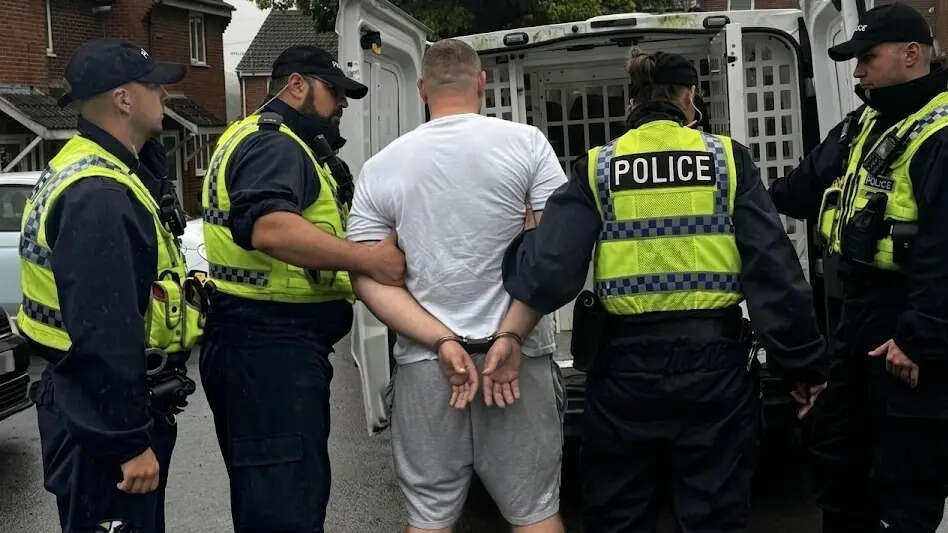
Fresh data from the Children’s Commissioner for England has exposed a staggering racial divide in the use of strip searches by police forces. Black children are nearly eight times more likely to be subjected to these invasive procedures than their white counterparts. This is not a statistical anomaly. It is the result of a culture where "adultification"—the perception of Black children as older and more dangerous than they are—dictates the split-second decisions of officers on the street. While official guidelines insist these searches should be rare and conducted with a "responsible adult" present, the reality on the ground is a chaotic failure of Safeguarding protocols.
The numbers are grim. Between 2018 and 2022, thousands of children were stripped by police. In many cases, officers failed to ensure an appropriate adult was in the room, violating the very codes of practice designed to protect minors from trauma. This isn't just about bad apples. It’s about a system that has normalized the physical violation of children under the guise of the "War on Drugs," despite a low success rate in finding actual contraband. Learn more on a connected subject: this related article.
The Myth of the Level Playing Field
Policing in England and Wales operates on the principle of "reasonable suspicion." On paper, this is a neutral standard. In practice, suspicion is a mirror of societal bias. When an officer sees a group of white teenagers in a park, they often see "youthful high spirits." When they see Black teenagers in the same setting, the lens shifts toward "gang association" or "county lines involvement."
This shift in perception is where the disparity begins. If you are searched more often, you are traumatized more often. But the strip search is the extreme end of this spectrum. It requires a child to remove their clothing in a police station or, in more harrowing instances, in the back of a van or a school room. The psychological impact of this cannot be overstated. We are talking about developing minds being forced into a state of total vulnerability by the state. Additional reporting by Reuters delves into related views on the subject.
Critics often argue that police are simply "going where the crime is." They point to stabbing statistics or drug seizure maps to justify the intensity of policing in specific postcodes. This argument is a circular trap. If you concentrate your resources in one community, you will naturally find more low-level infractions there, which then "justifies" the continued concentration of resources. Meanwhile, middle-class drug use remains largely unpoliced because it happens behind closed doors or in "safe" neighborhoods.
Failure of the Appropriate Adult Safeguard
The Police and Criminal Evidence Act (PACE) Code C is supposed to be the shield. It dictates that an "appropriate adult"—usually a parent, social worker, or volunteer—must be present during a strip search involving a minor. The data shows this shield is full of holes. In a significant percentage of searches, no such adult was present.
Why does this happen? Operational urgency is the usual excuse. Officers claim they couldn't wait for a parent to arrive, or that the child didn't want their parents to know. These excuses fall flat when weighed against the legal requirement to protect a minor’s welfare. When the state bypasses these protections, it sends a clear message to the child: your rights are conditional.
The absence of an adult creates a power imbalance that is ripe for abuse. Without a witness, there is no one to challenge the necessity of the search or the manner in which it is conducted. It becomes a private moment of state-sanctioned humiliation. For a Black child already skeptical of authority, this experience often marks the permanent end of any possible trust in the police.
The Shadow of Child Q
We cannot discuss this issue without acknowledging the case of "Child Q." In 2020, a 15-year-old Black girl was strip-searched by Metropolitan Police officers at her school while she was on her period. No appropriate adult was present. No drugs were found. The school had called the police because they "smelled cannabis."
The fallout from Child Q was supposed to be a turning point. There were protests, reviews, and promises of reform. Yet, the latest data suggests the needle has barely moved. The "Child Q effect" has prompted more paperwork, but it hasn't dismantled the underlying bias that led to the search in the first place. The institutional reflex to criminalize Black childhood remains intact.
The Mechanics of Adultification
Adultification is the psychological engine driving these searches. It is a phenomenon where Black children are denied the "closeness to innocence" usually afforded to white children. They are viewed as more capable, more aggressive, and more sexually developed. In a policing context, this means an officer is less likely to see a 14-year-old Black boy as a victim of grooming by a drug gang and more likely to see him as a hardened criminal who needs to be "disrupted."
This isn't just a feeling; it’s backed by research. Studies have shown that people consistently overestimate the age of Black boys by several years. When an officer perceives a child as an adult, the threshold for using force or invasive search tactics drops. The child’s fear is interpreted as non-compliance. Their confusion is seen as a tactical delay.
The High Cost of Zero Results
If these searches were a highly effective tool for removing dangerous weapons from the streets, the police might have a utilitarian argument to hide behind. They aren't. A vast majority of strip searches result in nothing being found. Even when something is found, it is frequently a small amount of cannabis for personal use—hardly a justification for the strip-searching of a minor.
The "hit rate" for these searches is embarrassingly low. We are sacrificing the mental health of an entire generation of Black youth for the sake of finding a few grams of weed. It is a staggering misallocation of resources. The "harm" being prevented by the search is almost always outweighed by the "harm" caused by the search itself.
The Regional Lottery
The disparity isn't uniform across the country, which suggests that leadership and local culture play a huge role. Some forces have much higher rates of racial disparity than others. This debunks the idea that the figures are simply a reflection of "national crime trends." If one force can manage to police its community without stripping eight times as many Black kids, why can’t another?
The Metropolitan Police, unsurprisingly, accounts for a massive chunk of these figures. But the issue is spreading. Suburban and northern forces are seeing similar trends as they adopt "hardline" tactics to deal with perceived rises in youth violence. The problem is that these tactics are being exported without the necessary safeguards or cultural competency training.
The Policing of Schools
One of the most disturbing trends is the increasing presence of police in schools. The "School Liaison Officer" was originally pitched as a way to build bridges. Instead, in many cases, it has created a "school-to-prison pipeline." When police are stationed in hallways, routine disciplinary issues that used to be handled by a headteacher are now handled by an officer.
This leads to the criminalization of behavior that is fundamentally developmental. A fight in the playground becomes an assault. A smart-aleck comment becomes a public order offense. And a "suspicious smell" becomes a strip search in the nurse’s office. Schools should be a sanctuary. For many Black children, they have become an extension of the street, where they are under constant surveillance.
Accountability and the Paper Trail
The lack of quality data has historically been a way for police forces to dodge accountability. If you don't track the ethnicity of the people you search, you can't be accused of bias. The fact that we now have this data is a credit to the Children’s Commissioner and advocacy groups who have fought for transparency.
However, transparency is not the same as accountability. Knowing the numbers is just the first step. The next step is a radical overhaul of the "Stop and Search" legislation. There needs to be a much higher legal threshold for a strip search. It should not be a routine part of a drug search. It should be a last resort, used only when there is credible evidence of a weapon that poses an immediate threat to life.
Furthermore, there must be consequences for officers who fail to follow the rules regarding appropriate adults. If a search is conducted without an adult present and without a life-threatening emergency, that search should be deemed illegal, and the officers involved should face disciplinary action. Currently, the "oops, we forgot the adult" defense is accepted far too easily.
Beyond the Body Worn Camera
Body-worn cameras were supposed to be the great equalizer. The theory was that if officers knew they were being recorded, they would behave better. While cameras have helped in some cases of extreme misconduct, they don't solve the problem of systemic bias. An officer can be perfectly "polite" while conducting a completely unnecessary and traumatizing strip search.
The footage often shows a clinical, bureaucratic violation of a child’s rights. The officer follows the "procedure" while ignoring the humanity of the subject. We don't need better-recorded trauma; we need less trauma.
The Role of Independent Oversight
Current oversight bodies, like the Independent Office for Police Conduct (IOPC), are often viewed as "toothless" by the communities they are meant to serve. Investigations take years. Outcomes are rarely satisfying. To fix this, we need truly independent, community-led panels with the power to review search records and recommend the stripping of licenses for officers who show a pattern of biased behavior.
Trust is not something that can be restored through a marketing campaign or a few "community tea" events. It is restored through the fair application of the law. As long as a Black child in London or Manchester knows they are eight times more likely to be stripped by a stranger in a uniform than their white classmate, that trust will remain a fantasy.
The Economic Impact of Trauma
We often talk about the social cost, but there is a hard economic cost to this style of policing as well. Children who are traumatized by police are less likely to engage with education and more likely to suffer from long-term mental health issues. This leads to higher costs for the NHS and the social care system. By "securing" the streets through invasive tactics, the state is actually creating long-term instability.
We are essentially paying the police to create future "customers" for the justice system. It is a self-perpetuating cycle of exclusion.
A New Framework for Search and Seizure
The solution isn't just "more training." Police have had "unconscious bias" training for years, and the numbers haven't changed. The solution is a legislative change that removes the incentive for these types of searches.
- Mandatory External Authorization: Any strip search of a minor should require the immediate sign-off of a high-ranking officer who is not on the scene.
- The "No Adult, No Search" Rule: Aside from immediate threats to life (like a visible firearm), no search should proceed without a legal guardian or advocate present.
- Automatic Review: Every strip search of a child that yields no contraband should trigger an automatic internal investigation into the "reasonable suspicion" used to justify it.
- End the Drug Focus: Strip searches should be banned for suspected possession of small quantities of Class B substances. The harm of the search outweighs the harm of the drug.
The British policing model is built on "consent." But you cannot have consent when a significant portion of the population feels like they are being hunted rather than protected. The data is out. The disparity is undeniable. The question now is whether the Home Office has the political will to treat Black children as children, or if they will continue to allow the "adultification" of bias to ruin lives.
Stop pretending this is a "training issue." It is a policy choice. Until the law changes to protect the most vulnerable, the strip search will remain a tool of state-sponsored intimidation rather than a legitimate tactic of law enforcement.