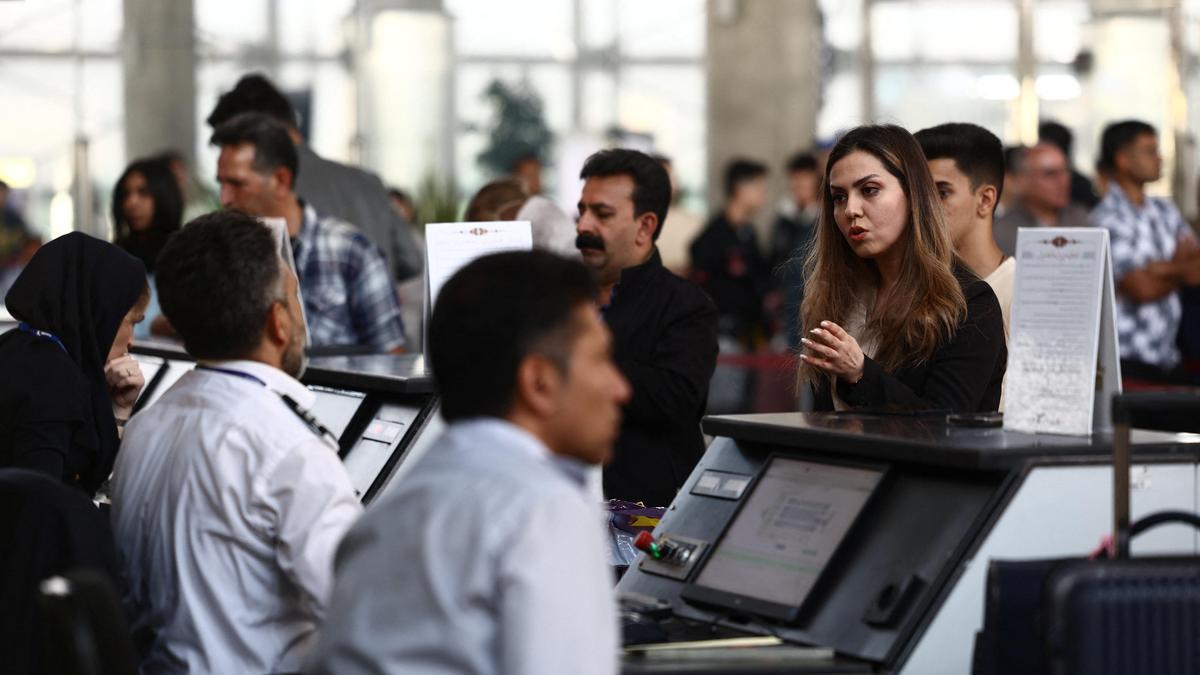
The mainstream media is falling for the oldest trick in the de-escalation playbook. Headlines are buzzing with the news that Iran has resumed commercial flights from Imam Khomeini International Airport. The narrative is predictably shallow: planes are in the air, so the immediate threat of total war has evaporated.
This is a dangerous misreading of how regional power dynamics actually function. Resuming a flight schedule isn't an olive branch. It’s a stress test of a nation’s internal logistics and a calculated piece of theater designed to project stability while the foundation is still cracking. If you think a civilian Airbus taking off for Istanbul means the risk premium on your regional investments should drop, you haven’t been paying attention to the last forty years of brinkmanship. For a closer look into this area, we recommend: this related article.
The Logistics of Performance Art
Aviation is the first thing to die and the first thing to be "resuscitated" in a conflict zone because it is highly visible. When a government reopens its airspace, it isn't making a statement about safety; it’s making a statement about sovereignty.
I’ve watched analysts track flight transponders as if they were pulse checkers for peace. They aren't. Reopening an airport after a kinetic exchange is a low-cost, high-reward psychological operation. It signals to the domestic population that the "enemy" failed to degrade core infrastructure, and it signals to the global market that the oil will keep flowing. For further details on this topic, extensive reporting can also be found on The New York Times.
But look at the data the optimists ignore. Which airlines are actually landing? It’s almost exclusively state-owned carriers or regional partners with deep political ties. The "resumption" of flights is often a ghost schedule. If major European or North American carriers aren't rushing back into that airspace, the "safety" being touted is nothing more than a localized opinion. Insurance underwriters don't care about a press release from a civil aviation authority; they care about the proliferation of surface-to-air missile batteries that don't just disappear because a NOTAM (Notice to Air Missions) was canceled.
The "Human Shield" Fallacy in Modern Airspace
There is a grim reality that nobody in the diplomatic corps wants to say out loud: commercial flights are often used as involuntary shields.
In a high-tension environment, a crowded sky is a complicated sky. By pushing civilian traffic back into the corridors, a state complicates the targeting math for its adversary. This isn't a return to "business as usual." It’s the tactical deployment of civilian assets to create a "gray zone" where the cost of a mistake—like the tragic downing of Ukraine International Airlines Flight 752—becomes a deterrent in itself.
To view the reopening of Tehran’s gates as a humanitarian win is to ignore the strategic utility of those passengers. They are being used to normalize a status quo that is anything but normal. If you are a traveler or a logistics manager, the "resumption" shouldn't be your green light. It should be your warning flare. The risk of electronic warfare interference, GPS spoofing, and "fog of war" misidentification is at its peak precisely when a conflict supposedly "cools down" into this nervous standby phase.
Why the Market is Wrong About De-escalation
The financial markets react to news of reopened airports with a sigh of relief. Crude futures dip. Regional indices tick up. This is a classic case of valuing optics over structural reality.
True de-escalation requires a dismantling of the triggers that led to the grounding in the first place. Has the underlying friction been resolved? No. Has the rhetoric changed? No. Have the proxy networks been neutralized? Quite the opposite.
The aviation industry operates on razor-thin margins and massive liabilities. When a state forces a reopening, it is often subsidizing the risk for its national carrier while the rest of the world waits for the other shoe to drop. We are seeing a bifurcation of reality: the "official" version where the engines are humming, and the "intelligence" version where the threat level hasn't moved an inch.
The Illusion of Air Superiority
The competitor articles love to talk about the "reopening" as a sign of Iranian resilience. Let’s get real. Resilience isn't about flying a plane from point A to point B in a contested zone. Resilience is having an economy that doesn't shudder every time a drone enters the neighbor's airspace.
By focusing on the airport, we are ignoring the more critical indicators of regional health:
- The Insurance Premiums: Check the "war risk" surcharges for cargo. If those haven't plummeted, the "resumption" is a lie.
- Maintenance Backlogs: Iran’s fleet is aging under the weight of decades-old sanctions. Reopening an airport doesn't fix a lack of spare parts for a Boeing 737 classic. It just increases the flight hours on airframes that are already pushed to their limit.
- The Brain Drain: Look at the ground crews and the air traffic controllers. High-stress environments lead to mistakes. A "resumed" schedule with an exhausted, panicked workforce is a recipe for a secondary disaster that has nothing to do with missiles and everything to do with human error.
Stop Asking if it’s "Safe" and Start Asking Why Now
People always ask: "Is it safe to fly to Tehran now?"
That is the wrong question. The right question is: "Why does the Iranian government need you to believe it’s safe right now?"
The answer is usually currency. Every day that airport is shut, the rial takes a beating. Every day the airport is shut, the shadow economy of trade and transport that keeps the regime afloat begins to starve. The reopening of commercial flights is a desperate grab for hard currency and a way to break the psychological siege.
It’s not about the passengers. It’s about the optics of the gate.
The Actionable Truth for the Industry
If you are a stakeholder in regional logistics or travel, do not mistake activity for stability.
- Ignore the NOTAMs: They are legal shields, not safety guarantees.
- Track the "Big Three": When Emirates, Qatar, and Turkish Airlines are all back to full capacity without caveats, then—and only then—can you talk about a return to the status quo.
- Watch the Secondary Hubs: If traffic is being diverted or "pre-screened" in third-party countries before landing in Tehran, the threat is still active.
The sky over Tehran isn't "clear." It’s just being used as a billboard. The next time you see a headline about "resumed flights," remember that in the world of high-stakes geopolitics, the most dangerous time is when everyone is pretending the crisis is over.
You aren't watching a return to commerce. You’re watching a regime hold its breath and waiting to see who is brave enough—or foolish enough—to walk through the door first.
Pack your bags if you want, but don't pretend the world has changed because a flight board flipped from "Cancelled" to "On Time." The engines are running, but the pilots are looking over their shoulders.