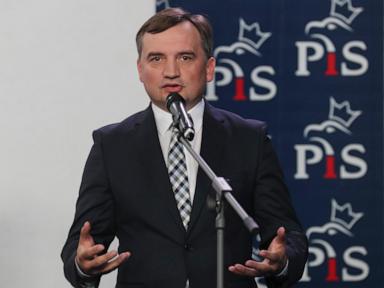
The man who spent a decade re-engineering Poland’s judiciary into a partisan weapon is currently a ghost. Zbigniew Ziobro, the former Justice Minister and architect of the "reforms" that put Warsaw on a collision course with the European Union, claims to be on American soil. His sudden departure from Poland comes at a moment when the new government’s "Iron Broom" policy is sweeping through the halls of power he once commanded. This is not a vacation. It is a calculated retreat by a politician who understands better than anyone how the legal machinery can be turned against its creator.
Ziobro’s presence in the United States, confirmed by his own social media channels and various political allies, creates a diplomatic and legal knot. In Warsaw, a special parliamentary commission is circling. They want to know about the Pegasus spyware scandal, the alleged misuse of the Justice Fund, and the systemic erosion of judicial independence. By placing an ocean between himself and the investigators, Ziobro has shifted the narrative from a legal defense to a high-stakes game of international hide-and-seek.
The Strategy of the Medical Shield
The official line from Ziobro’s camp is health. He has been battling a serious bout of esophageal cancer, undergoing aggressive treatment that his supporters say has left him physically fragile. This isn't just a personal tragedy; it is a potent political armor. In the court of public opinion, a man fighting for his life is a difficult target for aggressive prosecution. It complicates the optics of a forced summons or an arrest warrant.
However, the timing is impossible to ignore. The Tusk administration has made the prosecution of the previous government’s excesses a cornerstone of its mandate. They are not looking for a symbolic victory. They are looking for accountability for the systemic capture of the state. Ziobro, as the leader of the Sovereign Poland party and the former Prosecutor General, is the ultimate prize. By relocating to the U.S. for "specialized treatment," he effectively stalls the momentum of the Polish prosecutors.
America as a Legal Fortress
Why the United States? For a Polish politician, there is no better place to complicate an extradition or a legal inquiry. The U.S. legal system is notoriously slow when it comes to international judicial cooperation, especially when the case involves high-level political figures. Ziobro knows that as long as he is on American soil, any attempt to bring him back to Poland will involve years of litigation, State Department reviews, and a high bar for "dual criminality."
There is also the matter of the Polish diaspora. Ziobro has long cultivated ties with conservative Polish-American circles, particularly in places like Chicago and New Jersey. These communities provide more than just a social safety net; they offer a political platform. From the U.S., Ziobro can project a narrative of political persecution to a global audience, painting himself as a victim of a "Brussels-backed" revenge plot by Donald Tusk.
The Pegasus Shadow
The most dangerous thread for Ziobro isn't just the policy failures, but the surveillance state he allegedly helped build. The Pegasus spyware investigation is the ticking time bomb of Polish politics. Evidence suggests that the software, designed for anti-terrorism, was used to monitor political opponents, lawyers, and even internal rivals.
As Justice Minister, Ziobro sat at the apex of the pyramid. The investigators want to know who authorized the purchases and who signed off on the targets. If the paper trail leads to his desk, medical leave in Pennsylvania or Florida will not stop the legal process forever. It will, however, give him the time needed to wait for a shift in the political wind.
The Justice Fund Money Pit
Beyond the high-tech surveillance, there is the more mundane but equally damaging "Justice Fund." Originally intended to help victims of crime, the fund reportedly became a slush fund for Ziobro’s Sovereign Poland party. Money that should have gone to trauma centers and legal aid for the vulnerable was instead diverted to fire departments in key voting districts and conservative media outlets.
- The Scale: Millions of zlotys diverted over several years.
- The Mechanism: Grants awarded with little oversight to organizations with direct ties to Ziobro’s associates.
- The Risk: This is a financial crime, which is often easier to prove in court than the more abstract "abuse of power" charges.
The current administration is systematically dismantling the networks that allowed this fund to operate. They are following the money, and the money usually talks.
A System He Built Against Him
The irony is thick enough to choke on. For eight years, Ziobro argued that the "caste" of judges in Poland needed to be purged and that the executive should have more control over the judiciary. He pushed through laws that allowed the government to discipline judges for the content of their rulings. Now, he faces a judiciary that is struggling to regain its independence while under intense pressure to deliver justice for the previous eight years.
Ziobro is now complaining about the lack of due process and the "political nature" of the investigations. These are the exact concerns raised by the Venice Commission, the European Commission, and various NGOs during his tenure. He is now seeking the protection of the very democratic norms and international legal standards he spent a decade dismissing as foreign interference.
The Diplomatic Headache for Washington
The U.S. State Department is in an unenviable position. Poland is a critical NATO ally, especially with the ongoing war in neighboring Ukraine. Washington needs a stable, cooperative government in Warsaw. However, turning a blind eye to a former official fleeing prosecution doesn't sit well with the Biden administration’s rhetoric on the rule of law.
If Poland issues an Interpol Red Notice or a formal extradition request, the U.S. will have to decide if Ziobro is a political refugee or a fugitive from justice. This isn't just about one man. It’s about the precedent it sets for how the West handles the fallout of populist-authoritarian eras.
The Long Game of Sovereign Poland
Ziobro’s party is not dead. Even in his absence, Sovereign Poland remains a vocal, if diminished, force in the Polish parliament. They are positioning themselves as the "true" defenders of Polish sovereignty against the "German-controlled" government in Warsaw. Every day Ziobro stays in the U.S. is another day he can play the martyr.
His strategy is clear:
- Delay through medical claims and international travel.
- Deflect by accusing the Tusk government of the same "politicization" he was accused of.
- Disrupt the investigative process by refusing to appear for testimony, forcing the government into a heavy-handed response that looks bad on camera.
The Fragility of the Iron Broom
Donald Tusk’s government is under immense pressure to deliver results. Their voters want to see "the bad guys" in handcuffs. But the legal process is slow and full of trapdoors left behind by the previous administration. Ziobro knows this. He didn't just change the laws; he changed the personnel in the prosecutor's office and the courts.
The "Iron Broom" is hitting resistance not just from Ziobro’s flight, but from the legal structures he left behind. There are still "neo-judges"—those appointed under the contested rules—sitting on the bench. There is still a Constitutional Tribunal that views every move by the new government as illegal. Ziobro’s trip to the U.S. is a tactical retreat to a secondary defensive line while his primary defenses in Warsaw continue to hold the fort.
Accountability or Exile
The ultimate fate of Zbigniew Ziobro will determine the credibility of the Polish transition back to a standard liberal democracy. If he is allowed to remain abroad indefinitely, it sends a message that the highest-ranking officials are immune to the consequences of their actions if they have the resources to flee.
The Polish prosecutors have a choice. They can wait for his return, which may never happen, or they can begin the grueling process of international legal pursuit. This involves proving that the charges against him are not political, but based on clear violations of the Polish criminal code. It requires a level of forensic precision that the Polish prosecutor's office hasn't had to use against one of its own in decades.
Ziobro’s American stay is a stress test for the international legal order. It tests the strength of extradition treaties, the sincerity of "rule of law" rhetoric in Washington, and the patience of a Polish public that was promised a reckoning. He is betting that the world’s attention span is short and that his medical condition will eventually make his prosecution seem like an act of cruelty rather than an act of justice. It is a cynical bet, but given his career, it is entirely on brand.
The man who once held the keys to every prison cell in Poland is now using the entire map of the world to stay out of one. This isn't just a legal battle; it’s a masterclass in political survival by evasion. Whether the U.S. continues to provide the scenery for this act remains the most pressing question for the authorities in Warsaw. If the goal was to make himself a problem that won't go away, Ziobro has already succeeded. The "Iron Broom" has found a corner it cannot easily reach.