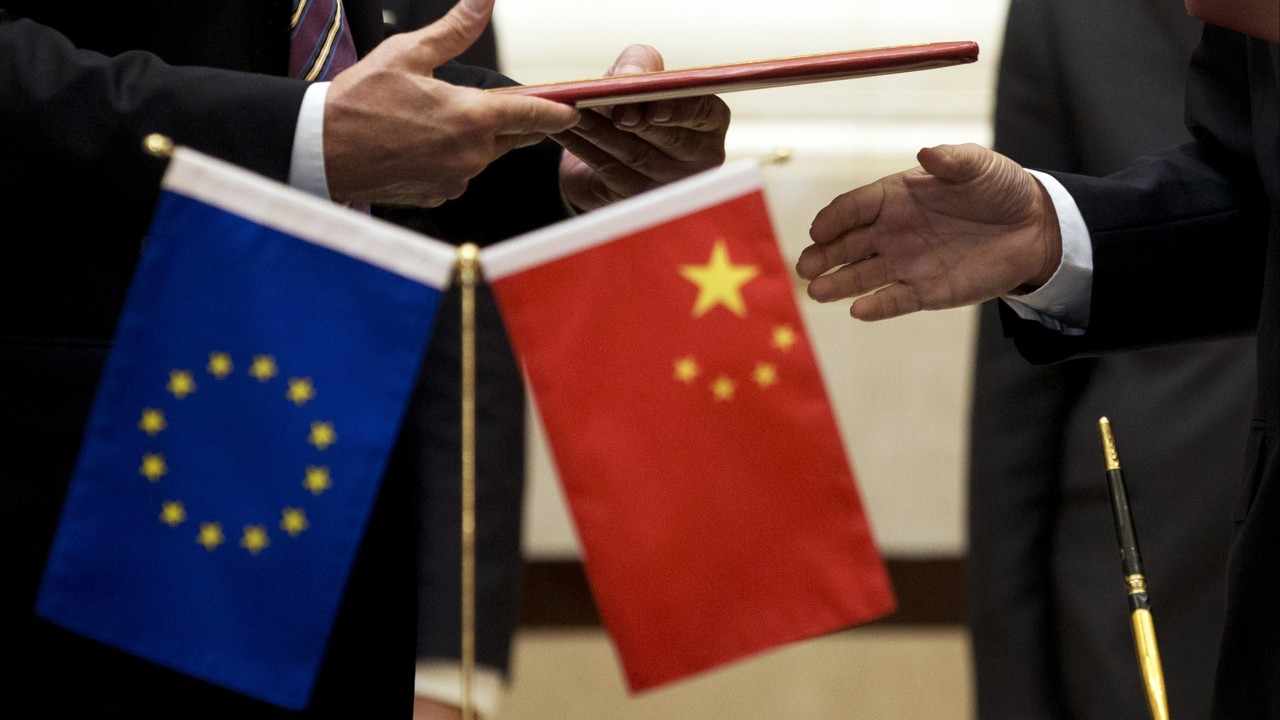
Foreign Minister Wang Yi recently landed in Europe with a suitcase full of metaphors and a singular mission to halt the accelerating slide toward a full-scale trade war. He didn’t come to apologize for industrial overcapacity or the tight-knit relationship between Beijing and Moscow. Instead, he brought a specific brand of rhetorical pressure, urging European leaders to abandon their "protectionist attic" and return to the "market gym" of Chinese competition.
It is a clever bit of branding. By framing trade barriers as a sign of physical weakness and the Chinese market as a rigorous fitness center, Beijing is attempting to flip the script on the European Union’s de-risking strategy. However, beneath the colorful language lies a cold, structural reality that neither side is ready to resolve. Europe is no longer convinced that more time in the "gym" will lead to a balanced physique. To the EU, the gym feels increasingly rigged, with one athlete receiving state-funded supplements while the others are asked to compete on an empty stomach.
The Subsidy Wall and the Death of Neutrality
The primary friction point is not just about who sells more cars. It is about the fundamental nature of the global economy. For decades, the European project relied on the assumption that China would eventually converge toward a market-oriented model. That hope has evaporated. Under current leadership, the Chinese state has doubled down on a "supply-side structural reform" that prioritizes manufacturing and technology at any cost.
When Wang Yi calls for Europe to leave the "attic," he is really asking Brussels to ignore the massive state subsidies that have fueled the Chinese electric vehicle and green energy sectors. Europe sees it differently. The European Commission has already launched an investigation into Chinese EV subsidies, a move that would have been unthinkable five years ago. This shift isn't just about protecting French carmakers or German engineering. It is about the survival of the European industrial base in a world where Chinese firms can operate at a loss for years, backed by provincial banks and national policy mandates.
The Overcapacity Trap
Consider the sheer volume of steel, solar panels, and batteries now flowing out of Chinese ports. This isn't just "competition." This is a deluge. When a single nation produces more than the entire world can consume, prices collapse. While this might seem like a win for consumers, it is a death sentence for domestic industries that cannot match those artificial price points.
Beijing's current economic playbook is to export its way out of a domestic property crisis. If Chinese consumers aren't buying, the world must. This creates a zero-sum game that European leaders, particularly in Paris and Berlin, are finding impossible to ignore. They are no longer debating whether to protect their markets, but how much protection is enough to avoid a total industrial hollowing.
The Geopolitical Shadow Over the Gym
You cannot talk about trade without talking about Ukraine. This is the "elephant in the room" that Beijing’s top diplomat tried to sidestep during his recent tour. For Europe, the conflict in Ukraine is an existential threat. For China, it is a complicated partnership that provides a strategic counterweight to the United States.
Every time Wang Yi speaks of "uninterrupted trade" or "joined interests," European officials hear a refusal to condemn Russia’s actions. This is where the "gym" metaphor falls apart. It is difficult to train alongside a partner who is providing the economic fuel for a fire in your backyard. The European Union has recently signaled that it will target Chinese companies that are helping Russia circumvent sanctions. This is a massive escalation. It marks the first time that the EU has been willing to sacrifice economic ties for the sake of its security interests in such a direct, confrontational manner.
The Myth of De-Risking Without De-Coupling
The term "de-risking" was supposed to be a middle ground. It was marketed as a way to reduce dependency on China without cutting ties completely. In practice, it is proving to be a logistical nightmare. Modern supply chains are so deeply intertwined that "de-risking" a single semiconductor or battery component can take years and cost billions.
Beijing views de-risking as just a polite word for containment. They aren't wrong. By moving production away from China or diversifying suppliers, Europe is actively trying to insulate itself from potential Chinese economic coercion. The irony is that the more Europe tries to "de-risk," the more aggressive Beijing becomes in its rhetoric, creating a feedback loop of mistrust that no amount of diplomatic charm can easily break.
The German Dilemma
No country is more caught in the middle than Germany. For the German automotive industry, China is not just a "gym." It is the lungs through which they breathe. Companies like Volkswagen, BMW, and Mercedes-Benz generate a massive portion of their global profits from the Chinese market.
If Germany supports the EU’s anti-subsidy measures, they face immediate retaliation in China. If they don't, they risk the long-term collapse of their domestic manufacturing ecosystem as cheaper Chinese EVs flood the continent. This internal friction within the EU is exactly what Wang Yi is trying to exploit. By offering "market access" and "cooperation" to specific countries, Beijing hopes to fracture the European consensus.
It is a classic "divide and rule" strategy, dressed up in the language of global partnership. But the strategy is losing its effectiveness. Even the most pro-China voices in the German business community are starting to realize that the playing field in China is tilted permanently against them. The days of easy growth in the East are over, replaced by a grueling battle for relevance in a market that is increasingly hostile to foreign brands.
The Real Reason Reform is Failing
The central problem is that China cannot "open up" in the way Europe wants without dismantling its own power structure. The Chinese economic miracle was built on state control of capital. Asking Beijing to stop subsidizing its favorite industries is like asking a bird to stop using its wings. It is fundamentally part of how they operate.
European leaders are finally starting to accept this. They are realizing that "fair competition" is a Western concept that doesn't translate perfectly into the Chinese model. This is the brutal truth of the current standoff. We are witnessing the collision of two incompatible economic systems. One is built on transparent market rules and democratic oversight. The other is a top-down, state-driven machine that prioritizes national power over individual profit.
The Price of Admission
If Europe does stay in the "gym," what is the price? It involves accepting that a significant portion of their green transition will be built on Chinese technology. It means acknowledging that their own manufacturers may never catch up in the battery or EV race. For many in Brussels, that price is simply too high. They would rather build their own "gym" at home, even if it costs more and takes longer to get in shape.
The Shift Toward Industrial Sovereignty
The next phase of this relationship will be defined by "industrial sovereignty." This is the new buzzword replacing the softer language of the past decade. It means that Europe is no longer content to just be a consumer of global goods. They want to be a producer.
This requires a massive investment in domestic manufacturing, something the EU has traditionally struggled with due to its fragmented nature. However, the threat of a dominant China has provided a rare moment of unity. From the European Chips Act to the Net-Zero Industry Act, the continent is finally trying to build its own muscular industrial policy. It is an expensive, slow-moving project, but it is the only way to counter Beijing's long-term strategy.
The era of "blind engagement" is dead. It has been replaced by a period of wary, transactional diplomacy where every meeting is a negotiation and every trade deal is a potential trap. When Wang Yi tells Europe to leave the "attic," he is really telling them to stop building their own defenses. But Europe has spent too long in the drafty hallway of global trade to ignore the storm that is coming. They are finally starting to lock the doors.
If European leaders want to survive this century as more than just a luxury boutique and a history museum, they have to stop listening to the metaphors and start looking at the data. The data says that the trade deficit with China has ballooned to over 400 billion dollars. The data says that Chinese firms are winning not just because they are better, but because they have the infinite resources of a superpower behind them.
The response to this shouldn't be a retreat into isolationism, but a clear-eyed assessment of what is at stake. The "gym" of the 21st century is a place of extreme competition where the rules are written by those who show up with the most leverage. Right now, China has the leverage. Europe is just starting to find its grip.
The path forward isn't through a "market gym" that is rigged from the start. It is through a rigorous, uncomfortable re-evaluation of what Europe is willing to fight for. If that means higher prices for consumers in exchange for a stable industrial future, then that is a conversation the continent needs to have. Anything else is just diplomatic window dressing.
The next time a foreign diplomat comes calling with a suitcase full of clever analogies, European leaders would do well to check the fine print. The "gym" they are being invited to join might just be a cage. It is time to stop playing the role of the polite guest and start acting like a sovereign power that knows exactly what its survival is worth.