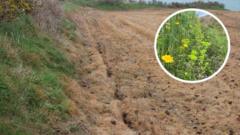
The recent public shaming of a farming family, slapped with a £19,000 penalty for damaging rare wildflowers, is being celebrated as a victory for conservation. The dominant narrative is comfortable, tidy, and completely wrong. The public loves a villain, and the media loves a story about greedy landowners bulldozing pristine nature.
But look closer at the mechanics of rural policy, and you realize this fine isn't a victory for the environment. It is a symptom of a broken regulatory framework that treats food producers as inherently hostile to nature. By turning rare species into legal liabilities, bureaucratic conservationism is achieving the exact opposite of its intended goal. It is incentivizing the quiet, preemptive destruction of habitats before they can ever be discovered by an inspector.
We need to dismantle the lazy consensus surrounding environmental fines and look at the economic reality of managing the British countryside.
The Counter-Intuitive Peril of Environmental Liabilities
When a regulatory body fines a farm for damaging a Site of Special Scientific Interest (SSSI) or a protected species, the urban public applauds. They assume the threat of a £19,000 penalty forces landowners to become better stewards.
It does not. It changes the risk calculus.
In property law and agricultural economics, an asset is something that generates yield or appreciates in value. A liability is something that costs money, restricts operational freedom, or invites state intervention. Under current framework models, a rare orchid or a nesting colony of protected birds is not an asset to a working farm. It is a high-risk financial liability.
Imagine a scenario where a tenant farmer discovers a small patch of rare Southern Marsh-orchids in a marginal grazing paddock. If they report it, or if a local naturalist spots it, that paddock can be slapped with a restrictive management order. The farmer can no longer cut hay when they need to, they cannot apply standard fertilizer, and they cannot rotate livestock efficiently. If they accidentally damage the plot during routine maintenance, they face public ruin and a five-figure fine.
What happens next is an open secret across the agricultural sector. It is called "shoot, shovel, and shut up," though in the botanical world, it is more accurately described as "plow, spray, and forget."
By penalizing accidental damage with draconian severity, regulators ensure that farmers ensure rare species never appear on their land in the first place. Early-stage habitats are quietly managed out of existence before any surveyor can register them. The current punitive system rewards ecological sterility.
The Fallacy of the Pristine Wildflower Meadow
The core misunderstanding driving these court cases is the myth of the untouched wilderness.
People look at a wildflower meadow and see an ecosystem that thrives because humans left it alone. This is biologically illiterate. A British wildflower meadow is an artificial, highly managed artifact of traditional agriculture. It requires low-intensity grazing, specific cutting schedules, and deliberate soil disturbance to survive. Without the farmer's intervention, ecological succession takes over. The meadow rapidly reverts to scrub, brambles, and eventually dense canopy woodland. The rare wildflowers disappear anyway, choked out by dominant species like nettles and coarse grasses.
The legal system treats nature as a museum piece to be locked behind glass.
I have spent decades analyzing land use policies and watching generational farms navigate these absurd paradoxes. When you penalize a farming family for a management misstep, you ignore the reality that their daily, active management is the only reason those flowers existed there in the first place. You are punishing the very people who maintained the habitat, while ignoring the neighboring industrial farm that paved over its hedgerows forty years ago and now faces zero regulatory risk because its land is entirely sterile.
The Economic Asymmetry of Conservation Penalties
Let us look at the raw numbers. A £19,000 fine to a small, family-run livestock operation is not a slap on the wrist. It represents the entire net profit margin of a bad fiscal year.
Defra (the Department for Environment, Food and Rural Affairs) and its various arms-length bodies operate with a fundamental disconnect from the cash-flow realities of working farms. Agricultural inputs—diesel, fertilizer, feed, and machinery maintenance—have skyrocketed over the last five years. Most family farms survive on paper-thin margins supplemented by diversifying or accepting state subsidies that come with suffocating red tape.
When a regulatory body extracts £19,000 from a farm's working capital, that money does not go toward habitat restoration. It does not fund seed collection, invasive species eradication, or better drainage management. It disappears into treasury coffers or legal fees.
The immediate consequence of an aggressive fine is a reduction in the farm’s capacity to do environmental work. The farmer cuts corners elsewhere. They delay repairing a drystone wall, they cancel plans to plant a new woodland shelterbelt, or they sell off marginal land to aggressive developers who know how to navigate planning loopholes far better than a third-generation tenant farmer.
The punitive approach assumes farmers are rational actors who will respond to financial threats by becoming meticulous ecologists. In reality, they respond by minimizing exposure to the threat vector. The threat vector is nature itself.
Dismantling the Premise of the Public Inquiry
The public dialogue surrounding rural enforcement is dominated by flawed premises. Let us address the questions that regularly appear in the wake of these environmental court cases.
Should farmers be held legally responsible for knowing every species on their land?
The current legal framework answers with an uncompromising yes. But this ignores the shifting, dynamic nature of biology. A seed bank can lie dormant in the soil for thirty years, waiting for a specific combination of rainfall and hoof-disturbance to germinate. A farmer executing a standard cultivation plan can suddenly find themselves violating an environmental law because a plant decided to wake up that particular spring. Expecting commercial food producers to possess the specialized taxonomic expertise of a university botanist is absurd. When the law demands the impossible, it breeds contempt for the law.
Aren't fines necessary to deter deliberate environmental destruction?
This question assumes that the destruction of a habitat is a deliberate act of malice. In the vast majority of cases, it is a failure of communication, outdated mapping, or an operational error by a contractor who does not know the boundary lines of an SSSI. Imposing catastrophic fines for administrative errors or accidental oversights does not deter bad actors; it alienates the good ones. The truly malicious actors simply buy a heavy disc harrow, clear the land in the middle of a storm at 3:00 AM, and accept the fine as a minor cost of doing business to unlock millions in development value. The family farm trying to survive is the only entity crushed by these rulings.
Can market-led incentives replace state-enforced conservation penalties?
The standard bureaucratic response is that green subsidies, like the Environmental Land Management schemes (ELMs), are already doing this. But these schemes are designed by administrative committees, not land managers. They are rigid, slow to pay, and change with every political cycle. A market-led approach would involve decentralizing conservation completely, allowing private mitigation banking where landowners are paid market rates by corporations to actively cultivate and expand biodiversity, rather than being ordered by the state to preserve it under threat of prosecution.
The Risk of the Alternative Model
To be entirely transparent, shifting from a punitive conservation model to a cooperative, asset-based model carries distinct risks.
If you remove the threat of heavy fines, you will inevitably encounter a small percentage of unscrupulous operators who will clear ecologically valuable land purely for short-term convenience. Without state-enforced boundaries, fragile micro-habitats could be lost during market downturns when farmers prioritize survival over stewardship.
But we must weigh that structural risk against the guaranteed failure of our current trajectory. The existing adversarial system has overseen a catastrophic, well-documented decline in British wildlife over the past half-century. The strategy of using the courts to bludgeon the rural community into compliance is visibly, measurably failing. You cannot sue your way to a thriving ecosystem.
Realignment Over Retribution
If the goal is genuinely to protect rare flora and fauna, the strategy must change from state retribution to collaborative asset management.
First, we must decriminalize accidental habitat damage on working agricultural land. If a farm damages a protected site, the remedy should not be a cash fine paid to the state. The remedy should be a mandatory, fully funded restoration partnership. The farm provides the land and labor; the state or local wildlife trust provides the expertise and materials.
Second, we must reverse the financial incentives. A population of rare orchids should be the most profitable asset on a farm, not the most dangerous. If a surveyor discovers a red-listed species on a property, that discovery should automatically trigger a tax exemption or a direct management dividend that exceeds the livestock yield of that acreage.
Until the presence of biodiversity is reflected as a net positive on a farm’s balance sheet, every court case, every £19,000 fine, and every sanctimonious press release from an environmental agency is simply accelerating the sterilization of the British countryside.
Stop celebrating the financial ruin of the people who feed you. Start making nature an asset worth protecting.