The disruption of used-car exports from Japan and South Korea to the Middle East is not a temporary logistical bottleneck but a fundamental fracturing of the "circular automotive economy." When conflict destabilizes the Levant and Red Sea shipping lanes, it triggers a price-cascading effect that begins in Tokyo and Seoul auctions and terminates in the diminished mobility of emerging markets. The current volatility exposes a fragile dependence on specific maritime chokepoints and a regional demand profile that lacks immediate substitutes.
Understanding this disruption requires a breakdown of the three structural pillars that sustain the used-vehicle trade: the Arbitrage of Regulatory Lifespans, the Logistics of Maritime Density, and the Geopolitical Risk Premium.
The Arbitrage of Regulatory Lifespans
Japan and South Korea operate under domestic regulatory regimes—specifically Japan’s Shaken inspection system—that make the ownership of older vehicles exponentially expensive. This creates a synthetic supply of high-quality, low-mileage vehicles that have no economic utility within their home markets but possess immense value in developing economies.
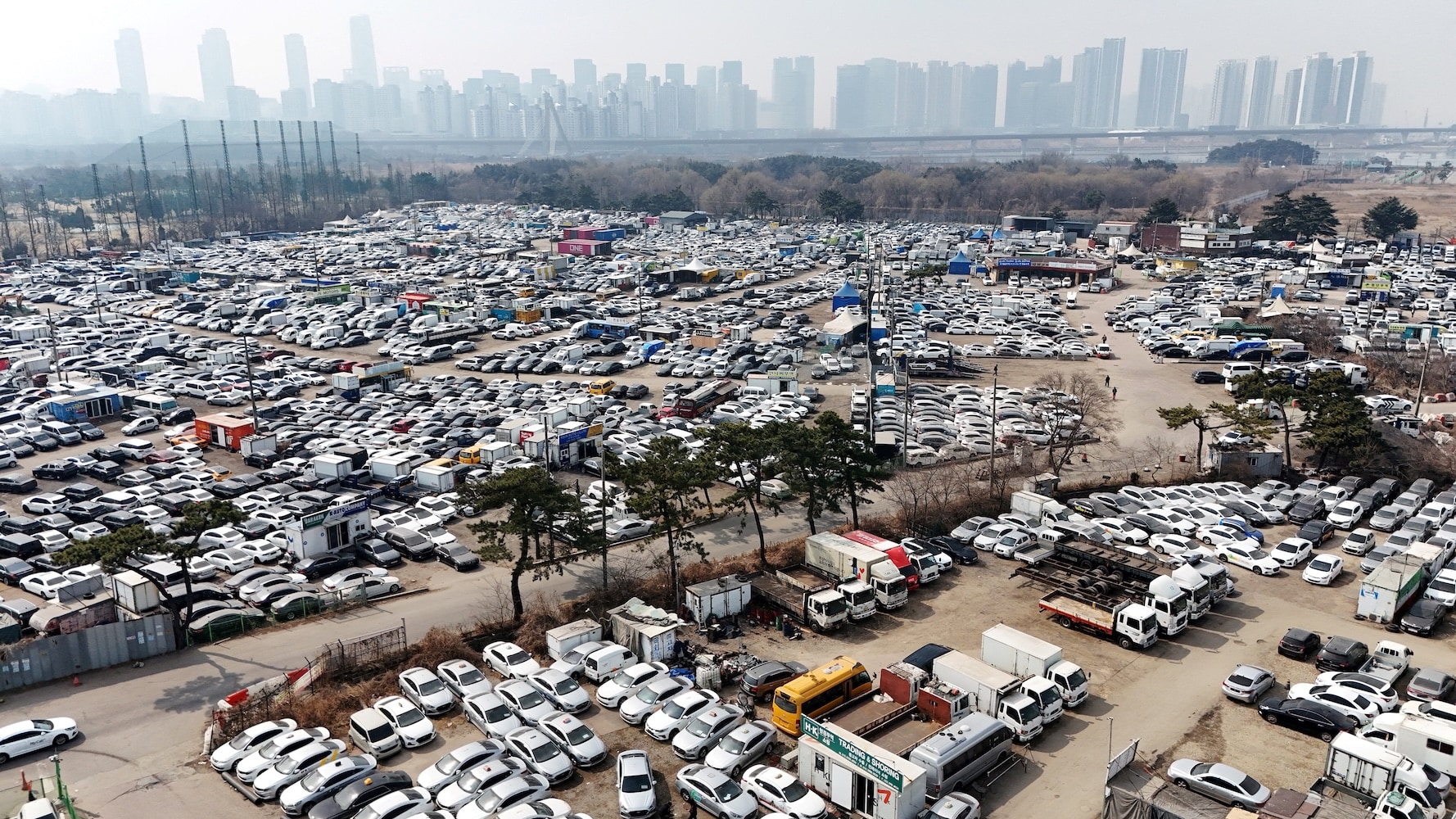
The Middle East serves as the primary clearinghouse for this supply. The United Arab Emirates (UAE), specifically the Jebel Ali and Dukm zones, acts as a re-export hub. When war disrupts the flow into these hubs, the "exit valve" for Japanese and Korean domestic markets closes. This leads to an inventory pile-up at domestic auction houses like USS (Japan) or AJ Sell (South Korea).
The immediate consequence is a downward pressure on domestic used-car prices within Japan and Korea. However, this is a "false floor." While prices drop due to oversupply, the inability to move units means that capital is locked in depreciating assets. For the export-oriented Small and Medium Enterprises (SMEs) that dominate this sector, the disruption represents a terminal liquidity crunch rather than a buying opportunity.
The Logistics of Maritime Density and the Red Sea Constraint
The used-car trade relies on Pure Car and Truck Carriers (PCTC) and RORO (Roll-on/Roll-off) vessels. Unlike containerized freight, which can be somewhat modular, RORO logistics are rigid and hypersensitive to port security.
The conflict in the Red Sea has forced a shift in shipping routes. Vessel operators are increasingly bypassing the Suez Canal in favor of the Cape of Good Hope. This detour adds approximately 10 to 14 days to the transit time from Busan or Yokohama to Mediterranean and North African ports.
The cost function of this disruption is defined by three variables:
- Fuel Consumption (Bunker Adjustment Factor): The extended route increases fuel burn by roughly 40% per voyage.
- Charter Hire Rates: Because vessels are at sea longer, the global supply of available PCTC capacity effectively shrinks. If a round trip that took 60 days now takes 75, the global fleet’s carrying capacity is reduced by 20% without a single ship leaving service.
- Insurance Surcharges: War risk premiums for vessels entering the Gulf of Aden or the Eastern Mediterranean have spiked, in some cases reaching 1% of the vessel's hull value per voyage.
These costs are not absorbed by the shipping lines; they are passed directly to the export-import agents. In a low-margin industry where the "winning" bid at auction is often decided by a $200 margin, a $1,000 increase in freight costs renders the entire transaction economically unviable.
The Regional Demand Elasticity Problem
The Middle East is not a monolithic consumer; it is a bifurcated market consisting of high-end demand in the Gulf Cooperation Council (GCC) and "utility demand" in conflict-adjacent zones like Jordan, Iraq, and Lebanon.
The Jordan-Iraq corridor is a critical artery for Korean exports. Jordan’s Free Zones serve as the processing center where vehicles are converted, repaired, or simply transshipped. When regional stability wavers, two things happen simultaneously:
- Currency Devaluation: Local buyers in neighboring countries see their purchasing power vanish against the USD (the standard currency for international car trades).
- Physical Border Closures: Insurance providers often revoke coverage for inland transit in "High Risk Areas," effectively halting the movement of cars from the port to the end buyer.
This creates a "trapped inventory" scenario in ports like Aqaba. Vehicles sit in salt-heavy air, depreciating in physical condition and market value, while storage fees accrue daily. For a South Korean exporter, a car stuck in a port for 90 days often results in a total loss of the initial investment.
Competitive Displacement and the Rise of Chinese New Energy Vehicles (NEVs)
The disruption of the Japanese and Korean used-car flow creates a vacuum that is being aggressively filled by Chinese manufacturers. This is the most significant long-term threat to the established order.
While Japan and Korea struggle with the logistics of moving used internal combustion engine (ICE) vehicles through disrupted lanes, China is utilizing land-based rail networks (the Belt and Road Initiative) to move new electric and hybrid vehicles into Central Asia and the Middle East.
The "Value-for-Money" proposition is shifting. If a used Toyota Hilux from Japan becomes 30% more expensive due to shipping costs and delays, a subsidized, new Chinese EV becomes a rational alternative for an urban buyer in Amman or Dubai. This is not just a temporary loss of sales for Japan and Korea; it is a permanent loss of market share and "brand loyalty" in the secondary market.
The Cost of Quality vs. The Cost of Certainty
The Japanese used-car market has long traded on the "Certainty of Quality." The rigorous inspection sheets (AUCTION GRADES 1-6) provided a level of trust that compensated for the distance. However, the current conflict has replaced "Certainty of Quality" with the "Uncertainty of Arrival."
For a dealership in Libya or Egypt, a slightly lower-quality vehicle that is available today via a local land route or a less disrupted shipping lane is preferable to a "Grade 4" Honda that might be stuck behind a naval blockade for three months.
This shift forces Japanese and Korean exporters to reconsider their geographic diversification. We are seeing a pivot toward Southeast Asia (ASEAN) and East Africa (Mombasa/Dar es Salaam). However, these markets have different regulatory standards—such as Age Limits on imports—that many of the vehicles intended for the Middle East cannot meet.
Structural Vulnerability in the "Last-Mile" Financing
A factor often overlooked in the competitor's surface-level reporting is the collapse of Trade Finance (Letters of Credit) during regional conflicts. Banks in the Middle East become highly conservative, restricting the issuance of LCs for "non-essential" goods like used cars.
Without an LC, the exporter in Nagoya has no guarantee of payment upon arrival. This forces the trade into "Cash Against Documents" or "Telegraphic Transfer" terms, which places 100% of the risk on the buyer. In a war-adjacent economy, very few buyers have the liquidity or the risk appetite to prepay for a vehicle that has a non-zero chance of being diverted or destroyed in transit.
Strategic Realignment and the "Buffer" Model
To survive this era of permanent volatility, the Japanese and Korean export sectors must transition from a "Just-in-Time" export model to a "Regional Buffer" model.
- Forward Deployment of Inventory: Exporters must move away from shipping individual units upon sale. Instead, they must utilize bulk RORO shipments to "safe-haven" hubs (e.g., Singapore or Salalah) before a buyer is even identified. This allows for immediate "last-mile" delivery when a window of stability opens.
- Digital Verification as a Hedge: To compete with new Chinese imports, used-car exporters must integrate blockchain-based history reports that are immutable. If the "arrival" is uncertain, the "value" must be indisputable to justify the wait.
- Diversification of Power-Trains: The Middle East's demand for large-displacement ICE vehicles is a liability in a world of fluctuating oil prices and shipping constraints. Exporters need to aggressively pivot their procurement toward the hybrid models now becoming available in the 5-7 year old age bracket in Japan.
The current disruption is not a "glitch" in the system; it is a signal that the system's architecture—centralized, RORO-dependent, and geopolitically exposed—is obsolete. The exporters who will remain solvent are those who stop viewing the Middle East as a singular destination and start viewing it as a series of high-risk nodes requiring sophisticated logistical hedging.
The immediate move for stakeholders is to liquidate aging inventory currently earmarked for the Red Sea route, even at a 10-15% loss, to preserve liquidity for the pivot toward the emerging ASEAN and Latin American corridors where maritime security is currently more stable. Holding for a "return to normalcy" in the Levant is an exercise in sunk-cost fallacy.