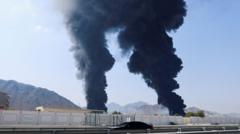
The Strait of Hormuz is currently the most expensive twenty-one miles of water on the planet. Since the U.S.-Israeli offensive against Iran ignited on February 28, the world’s most critical energy chokepoint has shifted from a bustling maritime highway to a graveyard of commercial intent. On March 15, for the first time in modern history, the number of inbound commercial transits through the strait hit zero.
U.S. President Donald Trump, speaking from the familiar cabin of Air Force One on March 16, 2026, issued a demand that has sent a tremor through the foundations of Western security. He is calling for a "Global Coalition" to police the waterway, specifically demanding that NATO allies, along with Japan, South Korea, and even China, deploy warships to escort tankers through the Iranian-laid minefields.
The rationale is pure Trumpian transactionalism. The United States is now essentially energy independent, receiving less than 1% of its oil from the Gulf. Meanwhile, China pulls 90% of its crude through that narrow neck of water. Japan and South Korea sit at 70%. In the President's view, the U.S. has already "obliterated" the Iranian Navy and Air Force; the remaining "policing" is a janitorial task for those who actually need the oil.
But this isn't just about oil prices, which have already surged past $103 per barrel. It is about the survival of the North Atlantic Treaty Organization.
The Article 5 Paradox
The President’s warning was explicit. If allies do not assist in the Strait, it will be "very bad for the future of NATO." This isn't just rhetoric; it is an assault on the core premise of the alliance. NATO is a defensive pact built on the geography of the North Atlantic. It was never designed to act as a private security firm for global energy interests in the Persian Gulf.
By framing the Hormuz blockade as a "NATO test," the administration is effectively moving the goalposts of collective defense. The European response has been a mix of paralyzed silence and sharp rejection. German Chancellor Friedrich Merz was the first to break cover, reminding Washington that NATO is a "defensive alliance, not an interventionist one."
The tension lies in the definition of "attack." While Iran has not struck a NATO capital, its "effective closure" of the strait—achieved through sea mines, shore-based drones, and GPS spoofing—has inflicted an economic wound on Europe that feels like an act of war. Yet, the European Union is hesitant to follow Trump into a conflict they feel he provoked. They see a trap: if they send ships, they become co-belligerents in a war they didn't vote for. If they don't, they risk the withdrawal of the American security umbrella in Europe.
The Ghost Fleet of the Royal Navy
The most telling sign of the alliance’s decay is the response from London. Once the "special relationship" guaranteed a British carrier strike group at the side of any U.S. venture, the UK’s 2026 contribution is almost parodic. Reports indicate the UK has committed exactly eight sailors to the mission.
The British are not just politically reluctant; they are physically depleted. Years of deferred maintenance and a lack of escort hulls mean the Royal Navy’s "heavy assets" are currently tied up in training or repair. When Trump complained that "the UK might be considered the No. 1 ally... but when I asked for them to come, they didn't want to come," he wasn't just talking about Prime Minister Keir Starmer’s hesitation. He was acknowledging the reality that the European pillar of NATO is a hollowed-out shell.
The China Wildcard
In a move that would have been unthinkable three years ago, the White House is openly inviting Beijing to the table. "China should help too," Trump noted, citing their massive dependence on the region. This is a high-stakes gamble. If China agrees to "police" the strait, it gains a permanent, legitimate military foothold in the Gulf, effectively replacing the U.S. as the guarantor of energy security for the East.
China’s current strategy is far more subtle. They are currently negotiating "selective transit" directly with Tehran. While Western-aligned shipping is paralyzed by the cancellation of war risk insurance—which jumped from 0.15% to 1% of vessel value in a single week—Chinese-flagged tankers are still making the run. Iran is using the strait as a diplomatic scalpel, allowing "friendly" nations through while keeping the "hostiles" under a functional blockade.
The Invisible Blockade
You don't need to sink every ship to close a strait; you just need to make the insurance unpayable. On March 5, the International Group of P&I Clubs effectively cancelled war risk coverage for the Gulf. Without that paper, a $200 million tanker carrying $100 million in crude is a ghost ship.
Iran’s strategy is not about naval dominance. Their navy is, as the President claims, largely at the bottom of the ocean. But the "shore-to-ship" threat remains. Low-cost drones and "dumb" sea mines don't require a fleet. They require a coastline. As long as Iran can launch a $20,000 drone from a mobile truck on the shore, a $2 billion destroyer is perpetually on the defensive.
The U.S. demand for "people who will take down some bad guys operating along the Iranian coast" is a call for an amphibious ground war. It is an invitation to a quagmire that no NATO ally is willing to accept.
The End of the Post-War Order
The Hormuz crisis is the final proof that the post-1945 era of "freedom of navigation" guaranteed by a single superpower is over. We are entering an era of "sovereign transits," where your ability to move goods through a chokepoint depends on your bilateral relationship with the neighbor, not the protection of an international fleet.
The President’s ultimatum to NATO is a recognition of this new reality. He is telling Europe that the "one-way street" of American protection is closed for repairs. If the Europeans want to keep their lights on this winter, they will have to learn how to fight for their own fuel.
The immediate next step for any business leader or policy analyst is to monitor the March 20 meeting of EU foreign ministers. If they fail to produce a unified naval commitment, expect the White House to begin the formal process of "re-evaluating" U.S. troop deployments in Eastern Europe. The price of oil is no longer measured in dollars; it is being measured in the survival of the West’s most successful military alliance.
Contact your logistics providers immediately to secure alternative tonnage via the Cape of Good Hope, as the "Hormuz Buffer" of strategic reserves is expected to deplete by the end of the month.