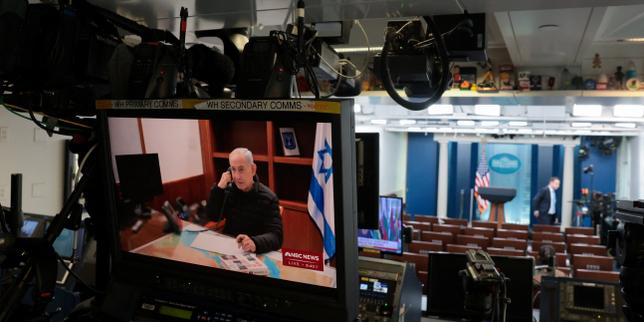
Benjamin Netanyahu’s political career is not merely defined by its longevity, but by a fixed strategic objective: the neutralization of the Islamic Republic of Iran. While observers often characterize this focus as an "obsession," a structural analysis reveals it as a consistent application of a specific security doctrine. This doctrine posits that the Iranian threat is not a variable to be managed, but a foundational existential risk that dictates Israel’s entire military and diplomatic posture. Since his 1996 electoral victory, Netanyahu has operated under a framework that prioritizes the prevention of Iranian nuclearization above all other domestic and regional considerations, viewing it as the ultimate "cost function" for Israeli survival.
The Netanyahu Doctrine functions through three distinct operational pillars: the internationalization of the threat, the application of "gray zone" kinetic action, and the systematic rejection of diplomatic accommodation. By deconstructing these pillars, we can quantify the evolution of this policy and identify why it has remained the central gravity well of Israeli statecraft for three decades.
The Tri-Pillar Framework of Strategic Denial
Netanyahu’s approach replaces traditional deterrence—which assumes a rational actor can be persuaded not to strike—with a policy of total denial. This shift is rooted in the assessment that the Iranian leadership operates on a different ideological timeline than Western secular democracies.
1. The Global Information Campaign
The first pillar involves moving the Iranian issue from a regional friction point to a global security crisis. Netanyahu pioneered the use of visual aids and high-stakes rhetoric in international forums, such as the United Nations, to create a sense of temporal urgency. The logic is simple: if the threat is perceived as immediate and global, the burden of containment shifts from Israel to a US-led coalition. This strategy maximizes international pressure while minimizing the unilateral political costs to Jerusalem.
2. Kinetic Attrition in the Gray Zone
The second pillar is the "Campaign Between Wars" (MABAM). This involves precise military strikes, cyber operations, and clandestine sabotage intended to degrade Iranian capabilities without triggering a full-scale regional conflagration. The objective is to increase the Iranian regime's "maintenance cost" for its nuclear program and regional proxies. By targeting logistics hubs in Syria, centrifuges in Natanz, and personnel in Tehran, Israel forces Iran into a defensive posture, slowing their progress through incremental friction.
3. The Diplomacy Nullification Strategy
Netanyahu has consistently argued that diplomatic agreements, such as the 2015 Joint Comprehensive Plan of Action (JCPOA), do not solve the problem but merely postpone it while providing Iran with the economic resources to fund its conventional military expansion. His strategy focuses on "Maximum Pressure"—a combination of crippling economic sanctions and a credible military threat. This framework treats any deal that allows Iran to retain enrichment infrastructure as a strategic failure.
The Economic and Geopolitical Cost Function
Maintaining a thirty-year focus on a single adversary requires a massive allocation of national resources. The opportunity cost of the Netanyahu Doctrine is measurable across several sectors of the Israeli state.
- Defense Budget Allocation: A disproportionate percentage of the IDF and Mossad budgets is diverted toward long-range strike capabilities, intelligence gathering in Iran, and multi-layered missile defense systems like Arrow 3. This reduces the capital available for conventional ground force modernization or domestic infrastructure.
- Diplomatic Capital: The relentless focus on Iran has often strained relations with US administrations that prefer diplomatic de-escalation. Netanyahu’s 2015 speech to the US Congress against the sitting President’s policy remains the quintessential example of prioritizing the Iranian objective over partisan neutrality in Washington.
- The Proxy Feedback Loop: Iranian containment has inadvertently accelerated the buildup of "Ring of Fire" proxies. As Israel focuses on the "head of the snake" in Tehran, groups like Hezbollah and Hamas have integrated deeper into their respective territories, creating a secondary layer of attrition that Israel must now manage simultaneously.
Structural Failures and Logical Bottlenecks
The Netanyahu Doctrine faces a significant logical bottleneck: the "Sunset Clause." Even the most stringent sanctions have not stopped the advancement of centrifuge technology or the accumulation of highly enriched uranium. This creates a divergence between political rhetoric and technical reality.
The first limitation is the irreversibility of knowledge. Unlike physical infrastructure, which can be destroyed by munitions, the technical expertise Iranian scientists have acquired cannot be bombed out of existence. This means that even a successful military strike would only set the program back by three to five years, requiring a permanent cycle of kinetic intervention.
The second limitation is the emergence of a multipolar world. The efficacy of the "Maximum Pressure" strategy relied on a US-dominated financial system. With the rise of the BRICS bloc and increased Chinese and Russian cooperation with Tehran, the economic leverage Israel and its allies can exert is diminishing. Iran has demonstrated a capacity for "resistance economics," finding ways to export oil and bypass SWIFT-based sanctions, thereby decoupling its survival from Western approval.
The Shift from Nuclear to Regional Hegemony
In the last decade, the nature of the Iranian threat has mutated. While Netanyahu remains focused on the nuclear threshold, Iran has achieved "strategic depth" through its drone and missile proliferation. The 14 April 2024 direct attack on Israel marked a fundamental shift in the conflict's architecture. It signaled that Iran is no longer content to fight solely through proxies but is willing to engage in direct state-to-state confrontation.
This shift undermines the "Gray Zone" pillar of Netanyahu’s strategy. When the adversary is willing to absorb strikes and retaliate directly, the campaign between wars risks becoming a full-scale war. The cost function of the Netanyahu Doctrine has spiked, as Israel must now maintain a permanent high-alert status for its air defense networks, which carry an astronomical price tag per interception.
Measuring Strategic Success vs. Tactical Persistence
To quantify Netanyahu's success, one must distinguish between tactical delays and strategic victories.
- Tactical Successes: High. The Iranian nuclear program is significantly behind where it was projected to be in the late 1990s. High-profile assassinations and cyber-attacks (like Stuxnet) have successfully introduced paranoia and friction into the Iranian system.
- Strategic Victories: Low. Iran is closer to weapons-grade uranium than ever before. Its influence in Baghdad, Damascus, Beirut, and Sana’a has expanded rather than contracted. The regional environment is more volatile, and the "normalization" with Arab states via the Abraham Accords—once seen as a counter-Iran alliance—is under severe pressure due to the ongoing conflict in Gaza.
The Final Strategic Play: Forcing the Binary Choice
The endgame of the Netanyahu Doctrine is to force the United States into a binary choice: accept a nuclear-armed Iran or participate in a preventive military strike. By consistently moving the "red line," Netanyahu has narrowed the middle ground for diplomacy.
The current trajectory indicates that Israel will likely move toward a "Preemptive Neutralization" model. This would involve a transition from the Campaign Between Wars to a more overt series of strikes aimed at decapitating the leadership of the Islamic Revolutionary Guard Corps (IRGC) and destroying the hardened enrichment facilities at Fordow. The risk profile of this move is unprecedented, but within the logic of the Netanyahu Doctrine, the risk of inaction remains the greater threat.
The only remaining strategic variable is whether the Israeli domestic political landscape can sustain the economic and social strain of a multi-front war of attrition while maintaining the focus on Tehran. If the Iranian regime achieves a "breakout" before Israel can execute its denial strategy, the Netanyahu Doctrine will be forced to pivot from prevention to a permanent, high-cost nuclear deterrence model similar to the Cold War, representing the ultimate collapse of a thirty-year policy goal.
The immediate operational requirement for the Israeli defense establishment is the rapid expansion of the Laser-based defense system (Iron Beam) to lower the cost-per-interception against Iranian drones, coupled with an intensified lobbying effort to secure a formal US-Israel defense treaty that codifies the "Red Line" against enrichment. Without these two elements, the doctrine remains a series of tactical delays without a definitive resolution.