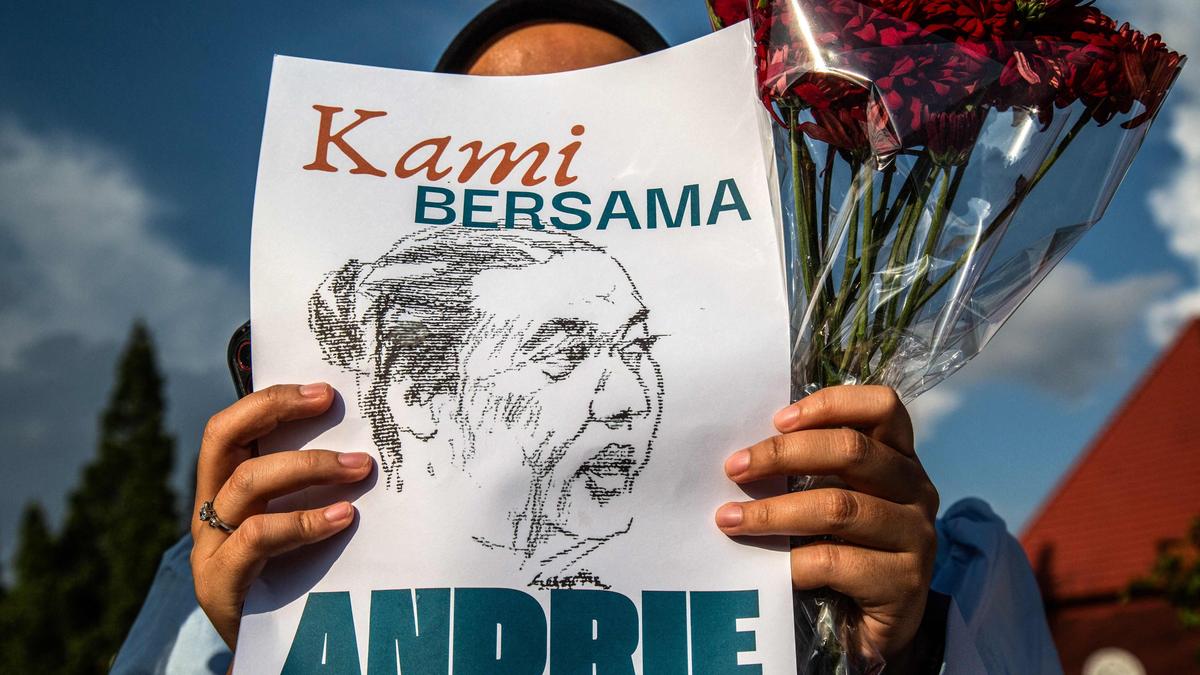
The arrest of four military officers in connection with an acid attack on a prominent Indonesian activist marks a rare breach in the wall of silence that typically protects the nation’s security forces. This case is not just about a singular act of violence; it is a window into the systemic failure of oversight within the TNI (Indonesian National Armed Forces). For decades, activists who poke at the nerves of corruption or environmental degradation have found themselves in the crosshairs of "unknown actors" who conveniently vanish. This time, the trail led back to the barracks.
While the arrests suggest a shift toward accountability, the underlying mechanics of how these operations are ordered and funded remain obscured. To understand why this happens, we must look past the individuals holding the bottles of acid and toward the culture of the institution that produced them.
The Calculated Choice of Acid as a Weapon
Acid is not a weapon of passion. It is a tool of psychological warfare. Unlike a bullet, which is meant to end a life, acid is designed to leave a permanent, visible reminder of the cost of dissent. In the Indonesian context, where social standing and public presence are vital for activists, a disfigured face serves as a walking billboard for the dangers of challenging those in power.
The logistics of these attacks are often sophisticated. Surveillance is conducted for weeks. The perpetrators map out the victim’s commute, identifying "blind spots" where CCTV is absent or easily sabotaged. In the case of the four arrested officers, the execution reflected military precision—a rapid strike followed by a pre-planned extraction. This wasn't a drunken brawl or a personal vendetta. It bore the hallmarks of a sanctioned, albeit off-the-books, operation.
The Shadow of the Military Court System
The biggest hurdle to justice in Indonesia is not the police investigation but the legal black hole known as the Law on Military Tribunals. Under Law No. 31/1997, military personnel accused of crimes against civilians are tried in military courts, not civilian ones. This creates a conflict of interest that effectively kills any chance of a transparent trial.
Why Military Courts Fail Civilians
- Secrecy: Proceedings are often closed to the public, preventing journalists and victims’ families from monitoring the evidence.
- Lenient Sentencing: Historical data shows that even when found guilty, officers frequently receive "slaps on the wrist" or are merely reassigned to different provinces.
- Chain of Command Protection: A military judge is unlikely to push for testimony that implicates higher-ranking generals who might be his superiors in the chain of command.
Until these four officers are tried in a public, civilian court, the arrests remain a performance. The government frequently uses these high-profile detentions to quiet international outcry, only to let the momentum die once the news cycle moves on.
The Activist as the Enemy of the State
We need to talk about the "why." Why would military officers target a domestic activist? In Indonesia, the line between national security and corporate interest is often non-existent.
Military units are frequently deployed—sometimes officially, sometimes as "moonlighting" security—to protect mining operations, palm oil plantations, and infrastructure projects. When an activist organizes a local community to protest land seizures or water pollution, they aren't just fighting a corporation. They are threatening the revenue streams of the security apparatus tied to that project.
The rhetoric used by the military often frames these activists as "anti-development" or "instigators of chaos." Once a person is labeled a threat to national stability, the moral barrier to using violence against them evaporates. The officers involved likely viewed themselves as patriots protecting the state from a nuisance, a mindset fostered by a lack of human rights training and a surplus of nationalism.
The Myth of the Rogue Element
The standard defense from the TNI leadership is that these men were "rogue elements" acting on their own accord. This is a convenient fiction.
In a strictly hierarchical organization like the Indonesian military, junior officers do not spontaneously decide to procure industrial acid and stalk a civilian for weeks without at least the tacit approval of a superior. If they weren't ordered to do it, they were certainly told it would be ignored. The "rogue element" narrative protects the institution by sacrificing a few low-level pawns while keeping the kings and bishops safe on the board.
The Role of International Pressure
The only reason these four arrests happened is that the victim had a platform that reached beyond Indonesia’s borders. Global human rights organizations and foreign investors began asking questions that the Jakarta elite couldn't ignore.
However, this creates a dangerous tier system of justice. For every high-profile activist whose case reaches the headlines, there are dozens of village leaders and environmental defenders in remote regions like Papua or Kalimantan who disappear or are maimed without a single arrest ever being made. The system responds to noise, not to the law.
The Mechanics of the Investigation
The police deserve a rare moment of credit for following the evidence to the military’s door, but the real test is whether they can hold that line. Often, in the "inter-service" politics of Indonesia, the police (Polri) and the military (TNI) engage in a delicate dance. If the police push too hard, it can lead to physical standoffs between the two forces, as seen in previous years when police stations were burned down following the arrest of soldiers.
This investigation likely required a green light from the very top of the political establishment. That suggests the activist in question was significant enough that his silencing caused more trouble for the administration than the arrest of the officers would.
Historical Precedent and the Long Memory of Fear
To understand the weight of this case, one must remember Munir Said Thalib. Indonesia’s most famous human rights lawyer was poisoned with arsenic on a flight to Amsterdam in 2004. While an off-duty pilot was eventually convicted, the masterminds within the State Intelligence Agency (BIN) walked free.
The acid attack on this latest activist is part of that same lineage. It is a message sent to the entire civil society: "We can reach you anywhere. We can mark you forever." The arrests of four officers might offer a fleeting sense of progress, but unless the civilian government gains the courage to reform the military justice system, the cycle of violence will simply recalibrate.
The real metric of success isn't the arrest; it is the revelation of who signed the order. Without that name, the bottle of acid is still open, and the next victim is already being watched.
Check the court dockets for the trial location—if it's a military tribunal in a restricted zone, the cover-up has already begun.
Would you like me to draft a follow-up investigation into the specific business interests linked to the region where this activist was operating?