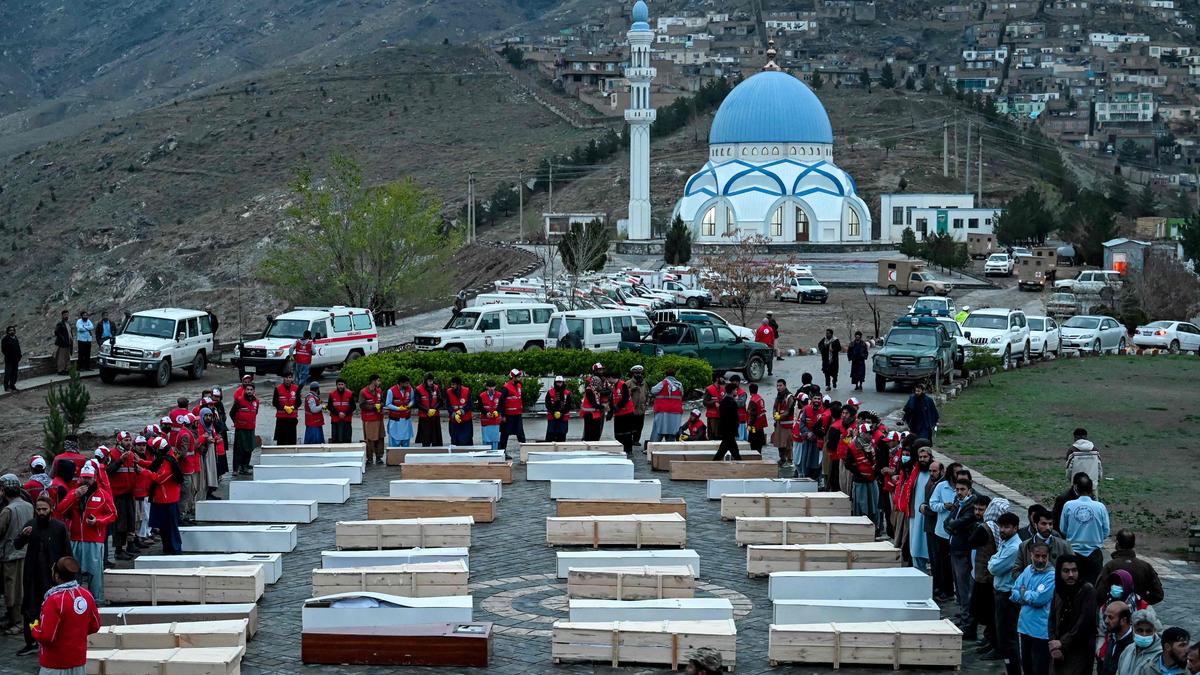
The mass funeral held in Kabul this week was not just a mourning of the dead. It was a formal declaration of a deteriorating geopolitical relationship that has moved beyond diplomatic spats into the territory of open, kinetic hostility. As thousands gathered to bury the victims of a devastating strike on a medical facility—an attack the Taliban administration squarely blames on Pakistani aircraft—the regional stability of Central Asia reached its lowest point in decades. While Islamabad maintains a calculated silence or issues measured denials, the evidence on the ground suggests a surgical escalation intended to send a message to the insurgent groups operating along the Durand Line.
This isn't just about a single hospital or a single day of tragedy. It is the culmination of a broken marriage between the Pakistani security apparatus and the Taliban leadership they once sheltered. For years, the narrative was simple: Pakistan supported the Taliban to gain "strategic depth" against India. Today, that depth has become a vacuum. The Taliban's refusal to rein in the Tehrik-i-Taliban Pakistan (TTP) has turned former patrons into bitter enemies, and the civilians in Kabul are paying the price for this intelligence failure.
The Anatomy of the Strike
The technical details of the raid suggest a level of sophistication that rules out local militia involvement. Eyewitness reports and debris recovered from the site point to precision-guided munitions. These are not the tools of a ragtag border force. They are the signature of a state military with advanced aerial capabilities.
By hitting a hospital, the aggressors—whether by intent or catastrophic intelligence error—crossed a red line in international law. The Taliban's Ministry of Defense claims Pakistani jets breached Afghan airspace in the early hours, loitering before delivering a payload that leveled a wing of the facility. If true, this marks a shift from "hot pursuit" of militants in the mountains to targeted strikes within Afghan urban centers.
The political fallout is immediate. In Kabul, the funeral served as a rallying cry for a government that is struggling with international legitimacy and a failing economy. Nothing unites a fractured population like a perceived foreign invasion. The Taliban leaders, usually seen as austere and distant, stood among the coffins, using the grief of the families to bolster their own nationalist credentials.
A Failed Proxy Strategy
To understand why a hospital in Kabul is in the crosshairs, one must look at the Map of Disappointment drawn by the Pakistani Inter-Services Intelligence (ISI). When the Taliban took power in August 2021, the celebration in Islamabad was audible. They expected a client state that would secure the western border and suppress the TTP.
Instead, they got an independent-minded neighbor that views the Durand Line as an colonial relic and the TTP as ideological brothers. The TTP has used Afghan soil to launch increasingly lethal attacks back into Pakistan, targeting police stations and military outposts in Khyber Pakhtunkhwa.
Pakistan's internal pressure is boiling. The public demands security, and the military, facing a domestic political crisis, cannot afford to look weak. When diplomacy failed to move the Taliban to act against the TTP, the military opted for the "Israel model": unilateral strikes across borders to take out perceived threats, regardless of sovereignty.
The Cost of Intelligence Blindness
There is a high probability that the hospital strike was based on flawed human intelligence. In conflict zones like Afghanistan, "tips" provided to foreign intelligence agencies are often used by local actors to settle tribal scores or eliminate business rivals. If the strike was intended for a high-value TTP target hiding near the facility, the result was a PR disaster and a war crime.
- Collateral Damage: The death toll includes doctors, nurses, and patients who had no link to the border insurgency.
- Radicalization: Every precision strike that hits a civilian target serves as a recruitment poster for the very groups Pakistan seeks to eliminate.
- Infrastructure Collapse: Afghanistan's healthcare system is already on life support; losing a functioning hospital is a blow that will be felt for years.
The Regional Power Vacuum
While Kabul and Islamabad trade accusations, the rest of the world is looking away. The United States has little appetite for re-engaging in the Afghan theater, and China is more interested in mineral rights than in mediating a border war. This leaves two nuclear-armed or nuclear-adjacent neighbors to settle their differences through fire and smoke.
Russia and Iran are watching with increasing nervousness. A full-scale conflict between the Taliban and Pakistan would destabilize the entire region, potentially sending millions more refugees across borders and opening a gap for ISIS-K to expand its "Khorasan" project. ISIS-K thrives in the chaos of state-on-state conflict, often picking up the disillusioned fighters who feel their own leaders are too weak or too compromised.
The Taliban's response has been uncharacteristically restrained in physical terms, despite the fiery rhetoric at the funeral. They lack a traditional air force to retaliate in kind. Their strength lies in asymmetric warfare—the same tactics they used to exhaust the Soviet Union and the United States. If the Taliban decides to "unleash" the various militant groups living under their protection, the Pakistani heartland could see a wave of violence that makes the last decade look peaceful.
The Economic Stranglehold
Pakistan holds a powerful card that it hasn't fully played yet: the border crossings at Torkham and Chaman. Afghanistan is a landlocked nation dependent on these arteries for food, medicine, and fuel.
Every time a strike occurs, the borders close. Prices in Kabul markets skyrocket. The Taliban leadership knows they cannot feed their people if the trade routes are severed. This creates a desperate dynamic where the Taliban must choose between their ideological loyalty to the TTP and the physical survival of their citizens.
However, the "starve them into submission" tactic rarely works with a group that spent twenty years living in caves. It only hardens the resolve of the hardliners within the Taliban cabinet, specifically the Haqqani faction, which maintains the closest ties to the border militants.
Broken Promises and Ghost Soldiers
The tragedy at the hospital highlights a broader truth about modern warfare in the region: there are no "clean" strikes. The dense urban fabric of Kabul makes any aerial operation a gamble with civilian lives.
The Taliban's claim of Pakistani involvement is backed by the fact that no other regional actor has the motive or the proximity to carry out such a mission. While the US maintains a "beyond the horizon" counter-terrorism capability, its focus has shifted almost entirely to ISIS-K, not the TTP groups that bother Islamabad.
The silence from the international community is deafening. Usually, a strike on a hospital would trigger emergency UN sessions and sanctions. But because the victim is the Taliban-led Afghanistan, the world has chosen a path of cynical indifference. This indifference is a dangerous precedent; it suggests that sovereignty only matters if the government in power is liked by the West.
The Mirage of Strategic Depth
For decades, the Pakistani military establishment operated under the assumption that they could control the fires they lit. They believed the "Good Taliban" (those who fought in Afghanistan) could be separated from the "Bad Taliban" (those who fought in Pakistan).
The hospital strike is the definitive proof that this distinction has collapsed. The fire has jumped the fence.
The mass funeral in Kabul was attended by thousands of young men who now see Pakistan not as a "brotherly Islamic nation," but as an aerial aggressor no different from the powers that came before. This shift in public perception is perhaps the most damaging long-term consequence of the strike. You can rebuild a hospital wing, but you cannot easily repair a generation's worth of resentment.
The Taliban are now faced with a choice. They can continue to provide sanctuary to the TTP and risk more "accidental" strikes on their cities, or they can conduct a bloody internal purge to satisfy Islamabad. Given their history, they are unlikely to choose the latter. They value their reputation as the "defenders of Afghan soil" above all else.
As the earth was shoveled over the coffins this week, the sound wasn't just of mourning. It was the sound of a regional alliance being buried for good. The border is no longer a line on a map; it is a front line. And in this new war, the distinction between a militant hideout and a civilian hospital is becoming dangerously blurred.
The next move won't be made in a diplomatic chamber. It will be made in the cockpit of a jet or the basement of a militant safehouse. The cycle of retaliation is no longer a possibility; it is the current reality.