The shift from localized kinetic strikes to systemic energy infrastructure targeting represents a fundamental evolution in Middle Eastern conflict dynamics. While traditional military doctrine focuses on the degradation of an adversary's command and control, the current escalatory cycle between Iran and the U.S.-Israel axis has pivoted toward the neutralization of economic lifelines. Iran’s specific threat to target Gulf energy centers following a strike on its gas fields is not merely rhetoric; it is a calculated application of asymmetric leverage designed to globalize the costs of a regional conflict. This strategy relies on the high geographical density of global energy production and the extreme fragility of the maritime chokepoints that facilitate its distribution.
The Architecture of Proportional Deterrence
To understand the current threat profile, one must first deconstruct the Iranian doctrine of "Forward Defense." This framework dictates that any kinetic damage to domestic Iranian industrial assets—specifically the South Pars gas field or the Kharg Island oil terminal—must be met with a mathematically equivalent or superior disruption to the energy security of U.S. allies in the Gulf Cooperation Council (GCC).
This doctrine operates on three distinct layers of escalation:
- Proximal Attrition: Utilizing regional proxies to conduct low-cost, high-frequency drone or missile strikes against desalination plants and local refineries.
- Maritime Interdiction: Leveraging the physical constraints of the Strait of Hormuz to impose a "risk premium" on global shipping without necessarily closing the waterway entirely.
- Core Infrastructure Decapitation: Direct ballistic missile or loitering munition strikes against high-value targets such as Saudi Arabia's Abqaiq processing facility or Qatar’s North Field production platforms.
The logic is simple: if Iran cannot monetize its natural resources due to external strikes, it will ensure no other regional actor can either. This creates a "mutually assured economic destruction" (MAED) scenario that shifts the burden of deterrence from military commanders to global energy markets and political leaders in Washington and Brussels.
Measuring the Volatility Coefficient
The impact of a strike on Iranian gas fields, such as those in the Assaluyeh region, extends beyond immediate production loss. Iran relies heavily on gas for domestic power generation and secondary oil recovery. A significant degradation of this capacity forces a domestic pivot, where the regime must prioritize internal stability over export commitments.
The retaliatory threat against Gulf "energy centers" targets the most sensitive nodes in the global supply chain. The GCC's vulnerability is defined by its centralization. A handful of processing hubs handle the vast majority of the region's output.
The Abqaiq Precedent and Modern Capability
The 2019 strikes on Saudi Aramco facilities demonstrated that even sophisticated air defense systems like the Patriot (MIM-104) have "blind spots" when facing low-altitude, high-precision swarms. Modern Iranian loitering munitions, such as the Shahed-136, possess a flight profile that minimizes Radar Cross Section (RCS) and utilizes terrain-masking to bypass traditional interceptors.
The cost function of this asymmetry is staggering. A drone costing approximately $20,000 can theoretically disable a processing train worth hundreds of millions, while the interceptor missiles used to defend the site cost between $2 million and $4 million per unit. This "Negative Exchange Ratio" ensures that the defender eventually faces inventory exhaustion or economic unsustainable defense costs.
The Strait of Hormuz Bottleneck
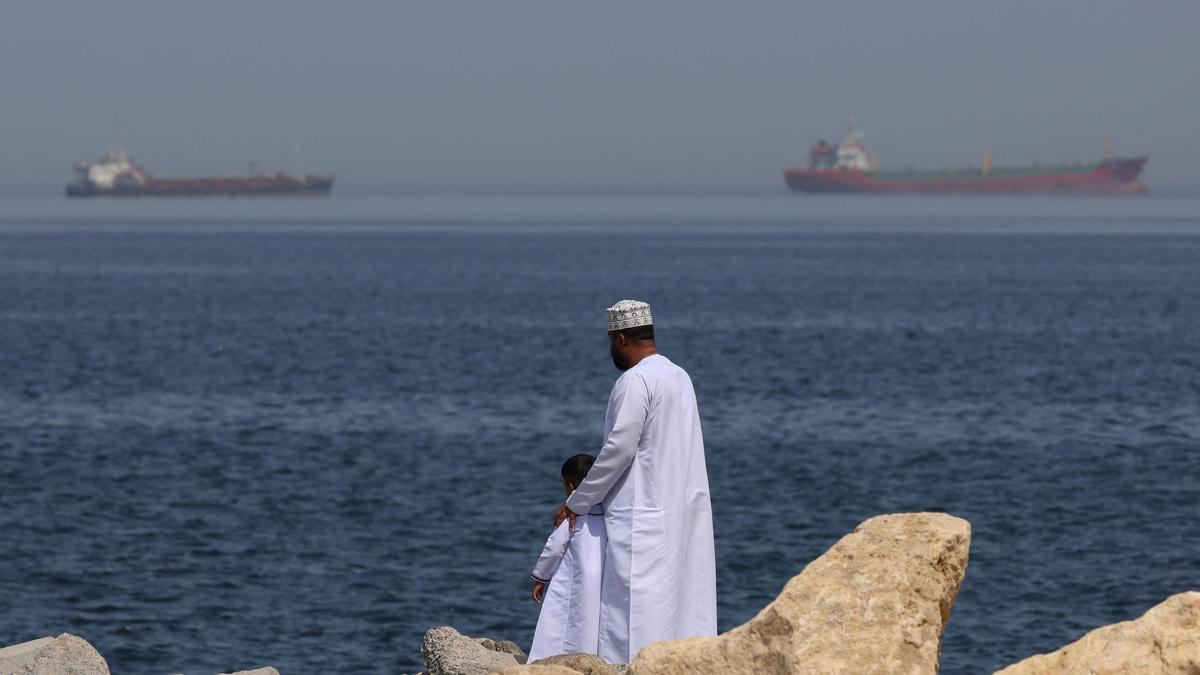
The Strait of Hormuz is the most critical chokepoint in the global energy map, with approximately 20-21 million barrels of oil per day (bpd) passing through—roughly 20% of global consumption. Unlike the Red Sea, where the Bab al-Mandab strait allows for some limited rerouting around the Cape of Good Hope, the Strait of Hormuz has no viable alternative for the volume of liquefied natural gas (LNG) and crude oil it handles.
The mechanism of Iranian leverage here is "Active Denial." By mining the shipping lanes or utilizing fast-attack craft (FAC) equipped with anti-ship missiles (ASMs), Iran can raise insurance premiums to the point where commercial shipping becomes non-viable. This does not require a total naval blockade. A mere 5% increase in the probability of a vessel being hit is sufficient to trigger a global supply shock.
Logistics of the LNG Crisis
The vulnerability of Qatar’s North Field—the world’s largest non-associated gas field—cannot be overstated. If Iranian threats translate into strikes on Qatari LNG infrastructure, the global gas market would face a deficit that no amount of U.S. shale production could bridge in the short term. The European Union, having decoupled from Russian pipeline gas, is now acutely dependent on this specific node of Middle Eastern infrastructure.
Tactical Deficiencies in Gulf Air Defense
Despite massive capital expenditure on Western defense systems, GCC energy centers remain vulnerable due to "Integration Gaps." Most regional defenses are designed to counter high-altitude ballistic threats rather than "sub-threshold" incursions.
- Saturation Thresholds: Current Aegis and Patriot systems have a finite number of simultaneous target tracking capacities. Swarm tactics are designed to exceed this threshold, ensuring at least one projectile reaches the target.
- Sensor Blindness: The flat geography of the Gulf coast creates radar clutter issues, particularly against sea-skimming missiles or small, carbon-fiber drones that have minimal thermal signatures.
- Point Defense Limitations: Hard-kill systems (like the C-RAM or Phalanx) have a very limited range. If a drone is intercepted only hundreds of meters from a volatile gas storage tank, the resulting debris or secondary explosion can still cause catastrophic damage.
The Global Macroeconomic Feedback Loop
The "vow to attack" functions as a psychological weapon before it ever becomes a kinetic one. The mere announcement of such a strategy forces market participants to price in a "Geopolitical Risk Premium."
$P_{market} = P_{supply/demand} + P_{risk}$
In this equation, $P_{risk}$ is highly sensitive to Iranian rhetoric because of the historical reliability of their asymmetric capabilities. If a strike on an Iranian gas field occurs, the subsequent retaliation against a GCC hub would likely trigger:
- Immediate Brent Crude Spike: Projections suggest a jump to $120-$140 per barrel within 72 hours of a confirmed hit on a major Gulf refinery.
- Credit Default Swap (CDS) Volatility: The cost of insuring the sovereign debt of regional players would skyrocket, choking off foreign direct investment.
- Supply Chain Decoupling: Global manufacturing hubs in Asia, particularly China and India, would face immediate energy rationing, leading to a contraction in global industrial output.
Counter-Escalation Frameworks
If the U.S. and Israel proceed with strikes on Iranian energy assets, they must account for the "Retaliatory Offset." There are two primary schools of thought on how to manage this:
The Defensive Perimeter Strategy
This involves the rapid deployment of Integrated Air and Missile Defense (IAMD) systems to every major energy node in the Gulf. This is logistically improbable given the number of high-value targets and the global shortage of interceptor stockpiles.
The Decapitation Strategy
Rather than defending the targets, this approach focuses on destroying the "Launch Origin Points" within Iran. However, Iran has spent decades hardening its missile silos and dispersing its drone manufacturing into underground "missile cities." A campaign to neutralize these assets would require a scale of aerial bombardment that would almost certainly trigger a full-scale regional war, the very outcome the U.S. seeks to avoid.
The Strategic Inevitability of Asymmetric Response
The core miscalculation in many Western analyses is the assumption that Iran will react to a strike on its gas fields with a conventional military response. Conventional parity is impossible; therefore, the response will be unconventional and focused on the weakest link in the global economy.
Iran’s move toward targeting "energy centers" marks the end of the era where energy infrastructure was considered off-limits due to the collateral damage to the global economy. In a scenario where the Iranian state feels its existential survival is at stake—signaled by a strike on its primary revenue generators—the "Global Commons" of energy becomes a legitimate battlefield.
The strategic play for GCC states is no longer just procurement of more hardware, but the urgent diversification of export routes and the hardening of "Passive Defenses" (e.g., redundant processing trains, rapid-repair kits, and massive underground storage). Without these, the region remains a hostage to the kinetic exchange between Tehran and its adversaries.
The most probable outcome of a U.S.-Israeli strike on Iranian gas fields is a multi-front "Infrastructure War" that bypasses traditional militaries and targets the pumps, pipes, and tankers that fuel the modern world. The tactical success of destroying an Iranian gas field will be weighed against the strategic failure of a $150-per-barrel oil reality and the potential collapse of the fragile post-pandemic economic recovery.
Would you like me to map the specific coordinates and production capacities of the GCC energy hubs most at risk in this escalation matrix?